
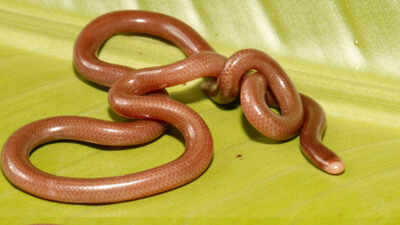
All that is nestled underground comes to the surface one day. And thus, the newly described blind snake species from the Qinghai-Xizang Plateau in China is one such animal, with its slender, earthworm-like appearance and eyes concealed beneath its scales. It is a snake so distinct that it differs from any that you may have typically come across.According to a research paper published in ZooKeys on September 17, 2026, researchers have now officially identified a new species of blind snake named Indotyphlops gyirongensis. The discovery was made following an examination of a single specimen collected in Gyirong Town, Gyirong County, in China’s Xizang Autonomous Region, close to the Nepal border.The researchers combined physical examination with molecular and genetic analysis to establish that the specimen belonged to a previously undescribed species. The study was conducted by Bing Lyu, Songwen Tan, Zhichao Zhao, Van Wallach, Qin Liu and Peng Guo.
A snake that spends its life out of sight
With its largely underground lifestyle, the blind snake is a rather intriguing species. Unlike the snakes commonly encountered in grasslands, forests or around human settlements, these small, slender reptiles are adapted to moving through soil and leaf litter. Their eyes are greatly reduced and covered by scales, which means that they do not rely on sight in the same way as many other snakes.The blind snake has now been proposed as the Gyirong blind snake, with its scientific name referring to the town where it was found. The specimen was collected in August 2025 at an elevation of approximately 2,262 metres and was discovered beneath a stone. It was an adult female measuring 265 millimetres in length, with a body diameter of just 3.5 millimetres at its midpoint. Its tail measured 7.5 millimetres, making the animal particularly slender in proportion to its overall length.The collection site itself offers an interesting glimpse into the kind of environment in which the species was found. According to the researchers, the surrounding area is characterised by evergreen broad-leaved forest, with deep humus and a thick layer of fallen leaves, an environment where animals can rather easily remain concealed beneath the surface.
A unique species
Identifying a new species is not simply a matter of finding an animal that looks unfamiliar. Researchers have to establish how it differs from species that have already been documented, and this becomes especially important with blind snakes, whose broadly similar body shapes can make identification difficult.In this case, the researchers examined several physical characteristics, including the arrangement of scales, body measurements, head shape and coloration. One of the distinguishing features of Indotyphlops gyirongensis is its light-coloured head cap, which sets it apart from several related species. It also has 18 rows of smooth, glossy scales around its body and a distinctive arrangement of overlapping scales around the upper lip, described by the researchers as a T-V pattern.Another detail is the absence of a pointed spine at the end of its tail. While these characteristics may appear rather technical at first, they are important in distinguishing one species from another, particularly when the animals being compared share such similar appearances.The researchers also used genetic analysis to establish the specimen’s relationship with other members of the Indotyphlopsgenus. Their findings placed it within this group while indicating a considerable genetic difference from its closest relatives. The concluding analysis further revealed that this species forms a distinct evolutionary lineage.
A discovery that leaves more questions
While the discovery of the snake is remarkable, there are multiple things the researchers are yet to ascertain. Its overall distribution across the region, population size, dietary habits and more are not known. Moreover, understanding this snake species presents a challenge because of its tendency to remain underground, and therefore, its evolutionary history has not yet fully documented.Lastly, this discovery highlights how much of wildlife diversity remains misunderstood, undocumented or simply concealed in plain sight, potentially opening up a plethora of curious questions.