
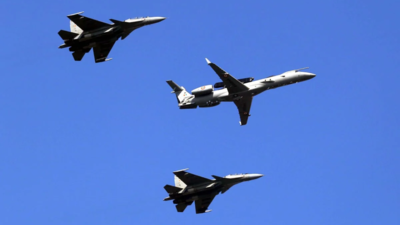
As the Indian Air Force (IAF) is working to gradually increase the size of its fleet, the air arm of the armed forces is also lagging behind in the number of force-multipliers. These aircraft, as the name suggests, help increase the efficiency of the existing fleet. This can be done in different manners, such as by keeping the fighters in the air for longer by refueling them or by helping them with better situational awareness, in order to be more combat effective. The IAF’s fighter fleet is backed by a comparatively small number of support aircraft. A comparison with eight other air arms from across the world shows that India has one of the weakest fighter-to-tanker and fighter-to-airborne early warning aircraft ratios.The IAF has an estimated 564 combat aircraft, but operates only six Il-78 aerial refuelling aircraft and six airborne early warning and control platforms, comprising three indigenous Netra systems and three Israeli-origin Phalcon aircraft. This translates into approximately 94 fighter aircraft for every tanker and the same ratio for every AEW&C aircraft. Its dedicated intelligence, surveillance and electronic intelligence fleet is estimated at around eight aircraft, or approximately one for every 70 fighters.The gap becomes clearer when compared with other air forces. Japan has around 344 fighters supported by 22 airborne early warning aircraft, giving it a ratio of approximately 16:1. China’s People’s Liberation Army Air Force has an estimated 2,000 fighters and around 55 AEW&C aircraft, translating into approximately 36:1. Pakistan, with around 410 fighters and 8 AEW&C aircraft, has a ratio of approximately 51:1. India’s figure is therefore significantly worse than those of its two principal regional military competitors.The tanker position is similarly concerning, the IAF’s six Il-78s support a fighter fleet of more than 560 aircraft, producing a ratio of 94:1. France, with approximately 185 fighters and 13 A330 MRTT tankers, has a ratio of around 14:1, while the UK’s Royal Air Force has approximately 171 fighters and 14 Voyager tankers. Japan operates 10 tankers for a fighter fleet of around 344 aircraft. The USAF has the best fighter to tanker ratio at 3.8:1. This while Pakistan is slightly worse off than India in this situation with the fighter to transport ratio at 100:1 and for China, the figures stand at roughly 50:1.These aircraft are not merely support assets, as they contribute to combat outcomes directly, but in a non-kinetic manner. AEW&C platforms extend radar coverage, help detect and track incoming threats and coordinate fighter operations, while tankers allow aircraft to remain airborne longer, extend their operational reach and reduce dependence on vulnerable forward air bases. This as dedicated intelligence and electronic surveillance platforms provide information required for planning and executing operations.The IAF’s shortfall comes as it operates 29 fighter squadrons against an authorised strength of 42.5. The force is pursuing additional Tejas aircraft and the Netra Mk2 programme to improve its capabilities. The latter is planned around six Airbus A321 aircraft, while the existing Netra fleet received full operational clearance in June 2026.However, aircraft numbers alone do not establish combat effectiveness as sensor capability, radar coverage, aircraft availability, crew strength and integration with ground-based systems all influence operational output. The comparison nevertheless highlights an important point, that building fighter numbers without expanding the supporting fleet could limit the ability to employ those aircraft effectively in a sustained, high-intensity air campaign.