
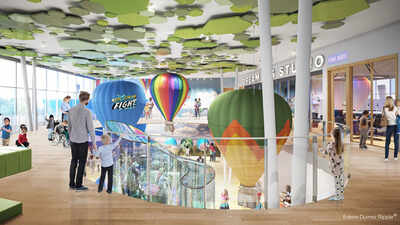
Some people, even after they are gone, leave such a profound mark on the world that their presence continues to be felt in the lives of people they never got to meet. For the Beery family, that legacy belongs to their nine-year-old son, Walker. Five years after losing him to brain cancer, his parents have fulfilled a wish he once made during his hospital stays: to give other children like him somewhere to play, explore and, even for a little while, forget that they are sick.On November 17, 2026, Manning Family Children’s in New Orleans, Louisiana, celebrated the opening of Walker’s Imaginarium, a 15,000-square-foot children’s museum built within the hospital. It is believed to be the first museum of its kind to be incorporated into a children’s hospital, transforming an idea that began with a little boy’s longing for a happier hospital experience into a space that can now bring joy to thousands of young patients and their families.
Why Walker dreamt of a Imaginarium
As reported by PEOPLE, Walker was just 7 years old when he was diagnosed with medulloblastoma, a rare and aggressive form of brain cancer, in August 2019. What followed was a difficult 2 year journey involving surgeries, lengthy hospital stays, chemotherapy and radiation. Yet, in the middle of everything he was going through, Walker was thinking about something beyond his own illness.During his time in hospital, he often wished there was somewhere he could go outside his room, get some fresh air and take a break from the endless cycle of treatments. His initial idea was a butterfly garden where children receiving care could spend time outdoors and enjoy a little distraction. It was a simple wish, but one that said a great deal about the little boy behind it. Even while dealing with an experience no child should have to endure, he wanted other children to have something to look forward to.Walker passed away in September 2021, aged 9. But his idea did not leave with him.In the years that followed, his parents, Taylor and Angel Beery, worked to turn his wish into something much bigger. Together with the nonprofit organisation Kids Join The Fight, which Walker helped establish, they began working towards creating a space where children receiving hospital care could experience the kind of joy that often gets pushed aside by illness.The result is a two-storey museum that feels a world away from the clinical surroundings of a hospital. And rather fittingly for a project born in New Orleans, the city itself has been woven into almost every corner of it.
Inside the Imaginarium
According to Good News Network, children entering the museum are welcomed by interactive lights, marching band music and percussion instruments arranged around a whimsical tree. There is even a year-round Mardi Gras parade, complete with a special float called the Krewe of Walker. An enormous LED butterfly hangs overhead, its wings moving in response to children playing on an accessible swing below it.Elsewhere, young visitors can explore an imaginative bayou, enjoy airboat rides, wander through a colourful forest or take part in a miniature sports field. There is also a lemonade stand and a playful recreation of Louisiana’s famous front-porch culture, complete with a crawfish boil. For children who fancy something a little more competitive, an outdoor terrace houses a nine-hole miniature golf course inspired by local landmarks, including an oversized alligator and a fireworks display at the Superdome.But the museum is not just about running around and having fun. Its design takes into account that every child has different needs, particularly those who are undergoing treatment or have limited mobility. According to Manning Family Children’s, the space includes wheelchair-accessible activities, sensory experiences and quieter areas where children and their families can simply sit together. The idea is to make play accessible to everyone, regardless of their physical or medical circumstances.There is also a dedicated classroom planned for the second floor, which will support children who miss out on school because of prolonged hospital stays. An interactive multimedia studio, developed in partnership with the Ryan Seacrest Foundation, is expected to open in February 2027.
How the family brought the idea to life
Speaking to PEOPLE, Walker’s father, Taylor, said the family was proud that the promise they had made had finally been delivered. Recalling his son’s approach to his illness, he shared that Walker never pretended things were easy. He simply refused to let the pain become the only thing that defined his experience.That thought seems to sit at the very heart of the project. As Lucio Fragoso, president and CEO of Manning Family Children’s, explained in the hospital’s announcement, while it may not always be possible to change why a child is admitted to hospital, it is possible to change what being there feels like.The project, which took five years of planning and construction, has been funded entirely through philanthropic contributions, with patient families, medical teams, architects and designers helping bring the idea to life. As reported by Becker’s Hospital Review, Manning Family Children’s has also become the first hospital to join the Association of Children’s Museums, making the initiative an important step towards bringing the experience of a children’s museum into healthcare settings.
Contribution beyond the museum
The family has also continued Walker’s work beyond the museum. Through Kids Join The Fight, they support paediatric brain cancer research and provide financial assistance to families navigating childhood cancer. The organisation was founded to ensure that other children and their families have access to the support and resources they need during an incredibly difficult time.It is difficult to imagine a more beautiful way to honour a child’s memory. What began as a little boy wishing for somewhere to escape his hospital room has become a 15,000-square-foot space where other children can make music, play games, discover new things and spend time with the people they love. The museum cannot undo what happened to Walker, nor can it make the experience of childhood illness any less difficult for the families who walk through its doors. But it can give them something that hospital corridors often leave little room for: ordinary childhood moments. And somewhere in between all those giggles and chatters, a 9-year old boy looks over smiling, seeing his Imaginarium exactly as he imagined.