
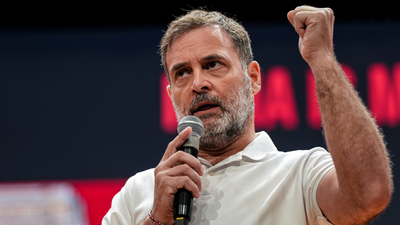
NEW DELHI: The Congress party has moved the Delhi high court against Meta and the Centre, alleging that an automated content-blocking system used by Facebook and Instagram is restricting legitimate political posts featuring Lok Sabha leader of opposition Rahul Gandhi, raising concerns over free speech and a level playing field ahead of elections.The party’s youth wing has challenged the government’s mandate requiring social media platforms to use automated tools to identify and remove copies of content that has already been blocked under a court order or a government notice.Congress alleges that Meta’s system is going beyond removing identical copies and is also blocking ordinary posts, including birthday greetings, tributes and even a wedding invitation, merely because they feature Rahul Gandhi’s name or photograph.In a petition filed in the Delhi high court on November 25, Manu Jain, who heads the social media department of the Indian Youth Congress, described the rules as “an instrument for the suppression of lawful political expression”.The party has asked the court to strike down the provision mandating automated takedowns, restore the restricted posts and direct Meta to disclose the criteria used by its system to block content.
Why is Congress fighting Meta
At the heart of the dispute is a February amendment to India’s Information Technology (IT) Rules, which requires large social media platforms to deploy technical measures “including automated tools” to identify and block content that is “exactly identical” to material previously removed following a court order or a written government notice.Before the amendment, platforms were only required to make an effort to use such tools. The revised rules make their use mandatory.The government maintains that these measures are necessary to prevent illegal and harmful content from spreading online, particularly in a country with more than 1.1 billion internet users.However, Congress argues that Meta’s automated system is not merely identifying duplicate copies of previously blocked material but is also catching unrelated posts featuring Rahul Gandhi.According to the petition, the restricted content included birthday messages, tributes to former Prime Minister Rajiv Gandhi, photographs of party workers with Rahul Gandhi, a wedding invitation extended to him and a post about his lecture at the University of Chicago.The party has questioned why such personal and political posts were blocked when they were not necessarily identical to any content previously removed under a legal order.In one instance cited in the petition, a birthday greeting posted on November 8 by a Youth Congress leader for a colleague, showing the latter standing beside Rahul Gandhi, was blocked on the same day.The user received a notification stating, “We restricted access to this content through an automated system implemented pursuant to legal requirements”.Congress has also alleged that affected users were not informed about the specific government order, legal notice or reason behind the restrictions.The petition said “no order, notice, reason or even a ‘legal request’ has been disclosed”.
Meta’s restrictions jump to 5.4 million posts
The dispute has also drawn attention to the sharp increase in the number of posts restricted by Meta in India.According to the company’s transparency report, Meta restricted more than 5.4 million posts in the first half of 2026, compared with around 70,000 during the whole of 2025.Meta has said it is complying with India’s amended IT Rules by restricting “100% identical copies of content, at scale and in country”. The company has also acknowledged that it is still testing and refining the system because of the “unprecedented nature of this effort”.It maintains that it is required to carry out automated restrictions at such scale in only a limited number of countries, which explains the higher volumes in India.Meta declined to comment on the lawsuit. The IT and Home ministries, named as co-respondents in the petition, did not immediately respond to requests for comment.India is also among seven markets, including Brazil and Hong Kong, where Meta does not disclose to users which government authority sought a particular restriction, citing “legal obligations and regulatory considerations”.
Congress alleges impact on free and fair elections
Congress has argued that the automated blocking system could affect its ability to communicate with voters, particularly ahead of state elections scheduled for early next year.The petition contends that restricting political posts featuring the leader of opposition “distorts the level playing field” required for free and fair elections.The legal action follows a week-long campaign by the Congress against Meta, including protests by its youth wing outside the company’s offices in several cities. The party has also put up hoardings depicting Meta CEO Mark Zuckerberg in the traditional attire of the Rashtriya Swayamsevak Sangh (RSS), the ideological parent of the BJP.
Share your thoughts in the comments
Be respectful · TOI community guidelines
The BJP, meanwhile, has accused Congress protesters of vandalising private company offices. The dispute has also reached the company’s senior management. At a meeting with Congress representatives earlier this week, the party urged Meta to challenge initial government takedown orders, citing Elon Musk-owned X’s legal battle against the Centre over content restrictions.Meta told the Congress delegation that it remained neutral towards all political parties and was bound by Indian laws.The case puts Meta in a difficult position in its biggest market. While the government requires platforms to comply with content-removal orders to retain their legal protections, the Congress wants the company to challenge restrictions that it believes go beyond the law. Hearings in the Delhi high court are expected to begin in the coming days.