
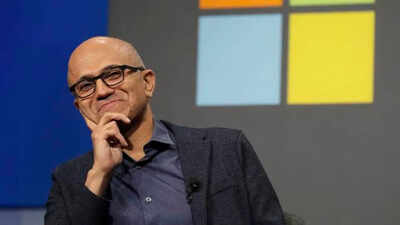
A group of current and former Microsoft employees has turned CEO Satya Nadella‘s own words against the company. Their open letter, signed “Concerned Microsoft Workers,” opens with Nadella’s line that “everyone is a stakeholder in AI” and uses it to make the case that staff deserve a direct say in how the company builds and uses AI. The letter accuses Microsoft of forcing AI tools on employees, backing away from its climate goals and taking on government contracts it says put human rights at risk.The timing has given the letter a far bigger audience. On October 26, Microsoft offered buyouts to about 60,000 employees, more than a quarter of its workforce, in what The New York Times describes as the largest such offer in the company’s history.The letter sets out three demands: no AI without worker input and protections, no AI without community protections, and no environmental promises traded away for AI.
Microsoft staff rework the company’s own mission statement in the letter
Nadella’s quote is not the only bit of Microsoft language the signatories borrow. The letter closes by reworking the company’s mission, saying workers can steer AI away from enriching a powerful few and towards empowering every person and organisation on the planet to achieve more.In between, it takes on decisions employees rarely question in public. It says staff are made to use AI tools with little training and no reason beyond speed. It calls the company’s Community-First AI Infrastructure plan vague on jobs and money for towns hosting data centres, and silent on emissions.The letter also wants Microsoft to listen to its own chief science officer and lobby for AI regulation rather than against it. It flags that AI stocks made up 41% of the S&P 500 as of July, a concentration it warns could end in a bubble. Some claims are sharper still, including that internal planning documents discuss ways to make users addicted to AI products.The group is not limited to full-time employees. Staff at GitHub and LinkedIn, vendors, interns and contractors can join too.
Microsoft’s buyout offer to 60,000 employees in India, US, UK and Canada is its biggest yet
The Voluntary Exit Offer covers eligible staff at level 70 and below in participating teams across the four countries. Sales and some engineering teams were excluded. Takers get at least eight weeks of base pay, scaled up by tenure and level, and must decide by December 9 before leaving on December 31.Employees did not wait long to look. Within an hour of the announcement, so many rushed to an internal site to check their eligibility that some suspected it had buckled under the load, the NYT reported. A Microsoft spokesperson put the brief delay down to maintenance timing.The company expects fewer than 5% of those eligible to accept. In a note to staff, chief people officer Amy Coleman called the programme uncharted territory for Microsoft: “The Voluntary Exit Offer is new for us. We’ll learn from it.” She has told the NYT the buyouts are not tied to how AI is changing work, though she did not rule out layoffs later.This is also Microsoft’s second buyout of 2026. In April, around 8,600 long-serving US employees were offered early retirement, and about three in ten took it.
Record Azure growth has done little for Microsoft employees’ pay
On paper, the AI push is working. Microsoft’s September-quarter profit rose 32% to $36.6 billion, Azure sales grew 48% to $33.2 billion, and capital spending climbed to $45.2 billion. OpenAI alone accounted for about 11% of revenue.Staff say very little of that has reached them. Some merit raises this year came in below 1%, employees told the NYT. At a town hall last month, a question on weighing more than $100 billion a year in AI spending against flat rewards drew roughly twice the reactions most other questions got.As recently as September, Forbes ranked Microsoft the world’s best employer for a third straight year. Now, employees told the NYT, they do not expect departing colleagues to be replaced, which leaves more work for those who stay.The unease has a wider backdrop. Earlier this year, Microsoft AI CEO Mustafa Suleyman predicted that most professional work done “sitting down at a computer” could be automated within 12 to 18 months. He named accounting, legal, marketing and project management among the fields at risk.Microsoft laid off 10,000 people in 2023 and more than 15,000 in 2025, followed by about 4,800 job cuts this July. Its headcount stood at 223,000 in June, down 5,000 from a year earlier.