
Bengaluru: Another day, another draw, and the scores remain level at the Fide World Chess Championship. Game 4 between defending world champion D Gukesh and challenger Javokhir Sindarov ended in a 34-move draw on Saturday, leaving the scores tied at 2-2 after four consecutive draws.
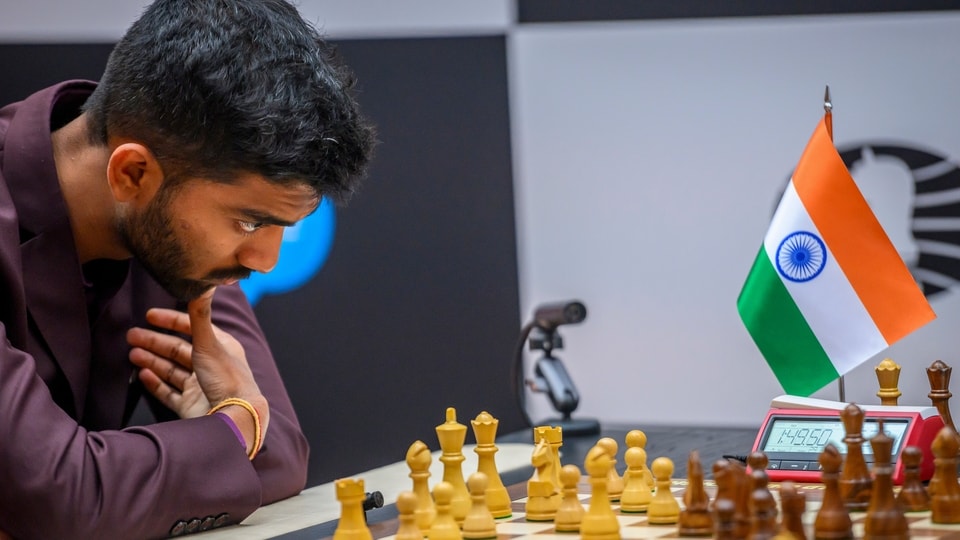
So far, the youngest-ever World Championship match has been an exercise in restraint in Geneva, with both 20-year-olds favouring controlled chess over ambitious play and risk-taking. Neither has seemed particularly willing to push the boundaries or gamble for a win.
After playing the quiet London System in Game 2, the question on Saturday was which opening Gukesh would turn to and whether he would show greater ambition in his second game with White. His first had ended abruptly in a draw by repetition after just 20 moves. Having sprung a successful opening surprise in Game 3 and briefly unsettled Sindarov, Gukesh might have felt emboldened to take greater risks. Would it be the cautious Gukesh who has largely been on show in Geneva so far, or the one who planted himself at the board for long, grinding battles that marked his title-winning campaign against Ding Liren in 2024?
Playing White, Gukesh opened with 1.e4, and after the London, Berlin and Rio de Janeiro, the Petrov’s Defence, a solid, resilient opening, was on the board. Gukesh got in some good ideas – 5. Be2 and a fresh, strikingly beautiful 9.Qb1 idea, which had commentators gushing.
“Never seen such a tactic”
Black managed to defend well, stay solid and it was White’s pawn structure that was under some duress. The challenger, in turn, tried to knock the Indian off his preparation with 9…a6. Eventually after a string of exchanges, the players arrived at a queen endgame. With neither side possibly breaking through, a draw was the logical result.
“This 9. Qb1 idea you don’t play without preparation, ” Gukesh said, beaming. “It was just too beautiful and I was hoping to get to play it. So, I was just happy to play it. You know what’s the refutation…Nd5 and short castle. I’ve never seen such a tactic. It was in my notes. But okay, he reacted decently. Maybe I was slightly more pleasant but it should always be solid for both sides.”
“Surely, there were more ups and downs in Singapore, here it’s very high-level chess.
“In general, chess is an equal game. If both sides play well, it will always be a draw. Today was a tricky game, but I think, we both played well. Qb1 was a big surprise. He got the position he wanted. In general, my position was super solid, hard to beat,” Sindarov offered.
With White, a player usually tries to put his opponent under pressure. Of course, these days unlike earlier it’s easy to equalise with Black and survive the opening. In the past, it may have been a struggle, not quite so anymore.
As White, Gukesh’s struggle with his clock continued. On move 29, he fell under eight minutes. With increment not kicking in until after move 40, it seemed like he was living dangerously.
A three-fold repetition within the next five moves followed.
Apart from accuracy levels of both players – hovering at around 99 per cent – there’s something to be said about how refreshingly cordial this World Chess Championship match has been, especially given the history of bad blood between rivals.
After five hours of intense battle in Game 3, defending world champion Gukesh leaned across the table and whispered to his opponent: “I’m really sorry for all the coughing.” Sindarov smiled and replied: “It’s nothing.”
World Chess Championship history is full of bad blood, psychological warfare and moments of spectacular hostility. Rivals have refused handshakes, accused each other of cheating and quarrelled over everything from sunglasses and yoghurt to bathroom visits.
In 1978, Anatoly Karpov and Viktor Korchnoi were barely on speaking terms. In 2006, Vladimir Kramnik and Veselin Topalov nearly saw their match grind to a halt over the former’s toilet breaks. Against this backdrop of hostility and suspicion, the easy courtesy between two 20-year-olds fighting for the biggest prize in chess is all the more striking.
Both players have now had two games with White and perhaps gleaned a little more about each other’s preparation and motives. Ten games remain, and the fireworks are still awaited.