
For decades, the idea of alien life has lived somewhere between science and science fiction. From Hollywood & Bollywood films to grainy UFO footage on the internet, the possibility that humanity is not alone in the universe has fascinated people across the world. But in recent years, the conversation has moved increasingly from speculation to scientific inquiry.Renewed interest has been triggered by reports that the United States government may release additional classified records related to unidentified aerial phenomena (UAPs), the modern term for UFOs. The push gained momentum after US President Donald Trump said his administration would direct the Pentagon and other federal agencies to identify and release such records. In a social media post, he cited the “tremendous interest” in extraterrestrial matters following comments by former US president Barack Obama, saying the public deserved greater transparency.These files, expected to come from agencies such as the Pentagon and US intelligence departments, are believed to contain observations of aerial objects that remain unexplained. While scientists caution that such documents are unlikely to confirm alien spacecraft, they have reignited a broader question: are we any closer to discovering life beyond Earth?The answer is complicated: both yes and no. Humanity has learned more about the universe in the last three decades than in the previous three centuries. Thousands of planets have been discovered beyond our solar system.
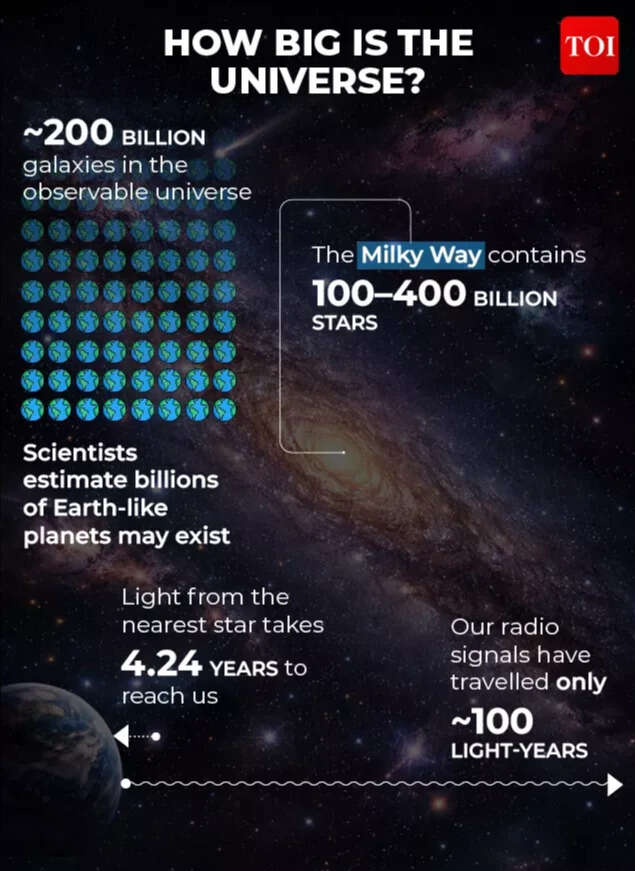
Telescopes can now analyse the atmospheres of distant worlds. Space missions continue to search for microbial life on Mars and icy moons.Yet despite these advances, one puzzling question remains unresolved: if the universe is so vast and old, why have we not found clear evidence of alien civilisations?The fascination with extraterrestrial life is not limited to scientists. At times, it has also reached the highest levels of political power in the United States.
From Carter to Trump: The alien question in American politics
Curiosity about aliens and UFOs has long extended into the highest levels of American politics. For decades, several US presidents have publicly spoken about extraterrestrial life, sometimes seriously, sometimes jokingly, reflecting how deeply the topic has entered public imagination.The debate gained fresh attention recently after former US president Barack Obama said in a podcast interview that aliens are “real,” though he clarified he had seen no evidence of extraterrestrial contact during his presidency. Obama later explained that statistically the universe is so vast that the odds of life existing somewhere else are high, even if visits to Earth are unlikely.Earlier American leaders also showed fascination with the idea. Jimmy Carter once reported witnessing what he believed was a UFO in Georgia in 1969, an experience he later documented with the International UFO Bureau. As president, Carter even placed a message from Earth aboard the Voyager Golden Record, launched on the Voyager 1 and Voyager 2 spacecraft in 1977, intended for any extraterrestrial civilisation that might encounter them.During the Cold War, Ronald Reagan famously used the idea of an alien threat to highlight humanity’s shared destiny. Speaking at the United Nations in 1987, Reagan remarked that global divisions might disappear quickly if humanity faced “an alien threat from outside this world.”Former president Bill Clinton also expressed interest in the mystery. In a 2014 television interview, he said he had asked aides to investigate Area 51, the secretive US Air Force testing facility long associated with UFO speculation, to ensure there was no hidden alien activity there.More recently, the topic resurfaced during the presidency of Donald Trump. Trump previously said he had received briefings about UFOs during his first term but remained sceptical about extraterrestrial visitors.
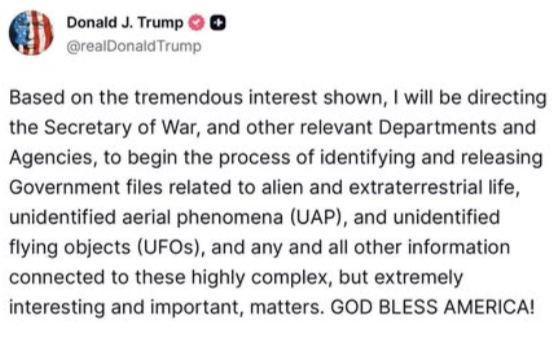
Trump UFO files release announcement (Image Source – Truth/Donald Trump)
However, his daughter-in-law Lara Trump recently suggested in a podcast interview that Trump may have “a speech ready” about extraterrestrial life that could be delivered at the right time.Together, these comments illustrate how the possibility of alien life, once confined largely to science fiction, has occasionally surfaced even in presidential conversations, reflecting both scientific curiosity and the enduring mystery surrounding the universe.This puzzle lies at the heart of one of science’s most famous ideas — the Fermi Paradox.
The great cosmic puzzle
The paradox is named after Italian-American physicist Enrico Fermi, who raised a simple but profound question during a conversation with colleagues in 1950. Looking at the immense scale of the universe, Fermi reportedly asked, “Where is everybody?”
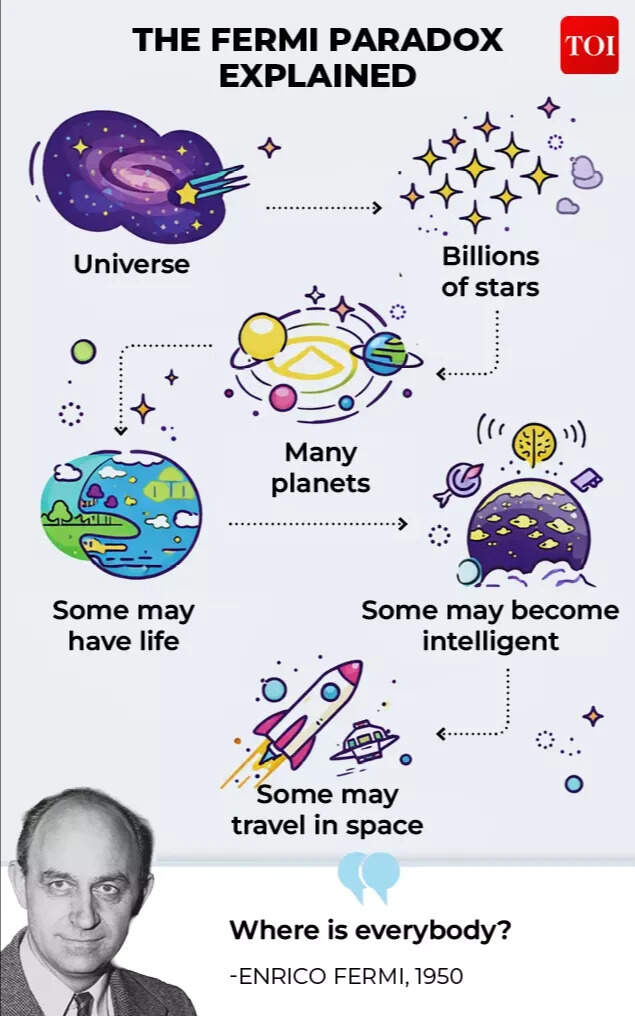
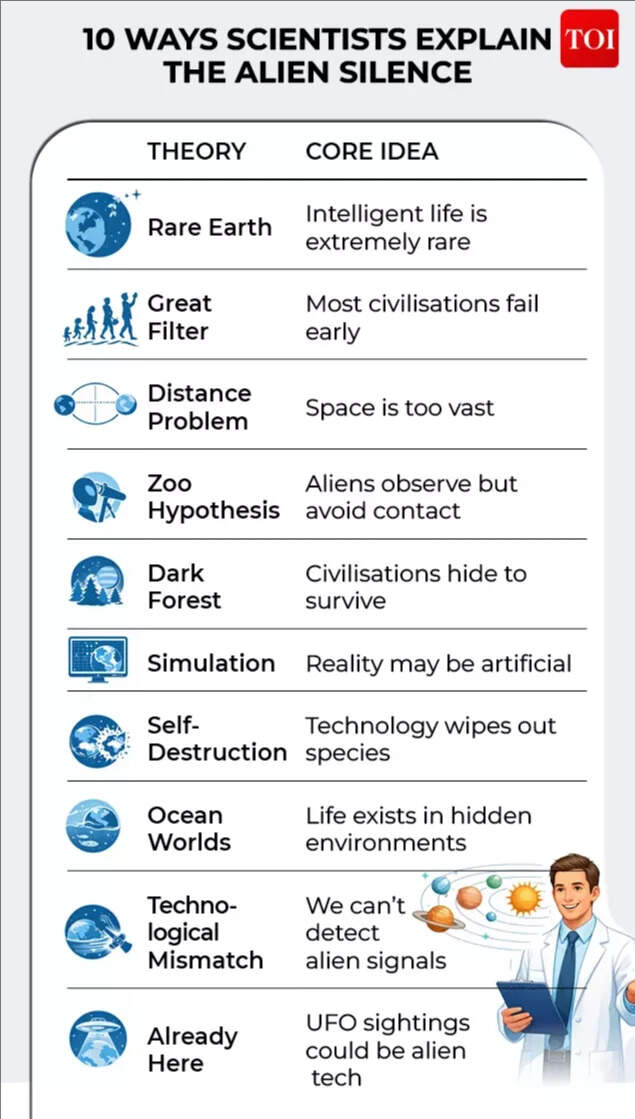
The logic behind the question is straightforward. The Milky Way Galaxy alone contains hundreds of billions of stars. Many of those stars likely host planets. Over billions of years, some of those planets could have developed intelligent life. Given enough time, such civilisations might develop advanced technology and explore space.In theory, even a single technologically advanced civilisation could spread across the galaxy in a few million years — a short period on cosmic timescales. If that is possible, then traces of alien technology, signals or visits should already be visible.Yet humanity has found none.This contradiction between high probability and zero evidence is what scientists call the Fermi Paradox.Over the decades, scientists, philosophers and futurists have proposed many explanations. Some suggest alien life is extremely rare. Others argue that intelligent species often destroy themselves before exploring the stars. A few theories even suggest that aliens may already be aware of humanity but deliberately avoid contact.Here are some of the most intriguing explanations that attempt to solve the mystery.
The rare Earth hypothesis
One possibility is that intelligent life is extraordinarily rare.The Rare Earth Hypothesis suggests that while microbial life might be common, the conditions required for complex organisms — and eventually intelligent species — are incredibly unlikely.Earth’s history offers several examples of unlikely events that made complex life possible. These include the presence of a large stabilising moon, plate tectonics that regulate climate, a protective magnetic field and a relatively stable star. Even small changes in these conditions could have prevented the emergence of complex life.Under this theory, Earth may simply be one of the very few places where all the necessary factors came together.
The great filter
Another influential idea is known as the Great Filter hypothesis.This theory proposes that somewhere between the formation of planets and the rise of interstellar civilisations lies a difficult barrier, a “filter” that most life forms fail to pass.The filter could occur at many stages. Perhaps life rarely begins in the first place. Maybe complex organisms almost never evolve. Or perhaps intelligent species tend to destroy themselves through nuclear war, environmental collapse or uncontrolled technology.If the Great Filter lies ahead of humanity, it would imply that technological civilisations often collapse before achieving long-term survival.
The distance problem
Even if intelligent life exists elsewhere, the sheer size of space may make contact extremely difficult.The nearest star system, Proxima Centauri, is more than four light-years away. Current spacecraft would take tens of thousands of years to reach it.Human radio signals have travelled only about a hundred light-years into space since the first broadcasts in the early twentieth century. That is a tiny fraction of our galaxy.Civilisations might exist thousands or millions of light-years away, separated by distances too vast for practical communication.
The zoo hypothesis
Some researchers have proposed a more unusual idea: that aliens deliberately avoid contacting humanity.Known as the Zoo Hypothesis, the theory suggests advanced civilisations may observe Earth without interfering, much like humans watch animals in a wildlife reserve.Under this scenario, extraterrestrial societies might follow ethical rules that prevent them from influencing developing worlds until those worlds reach a certain level of technological maturity.While there is no evidence for this idea, it remains a popular concept in discussions about extraterrestrial intelligence.
The dark forest theory
A darker explanation is known as the Dark Forest Hypothesis.According to this theory, the universe may be filled with intelligent civilisations, but they remain silent out of fear. In a galaxy where resources are limited and survival is uncertain, revealing one’s location could invite attack from a hostile civilisation.As a result, every advanced society might hide quietly, avoiding communication with others.This concept has gained popularity in recent years through science fiction but also raises serious philosophical questions about cosmic survival.
The simulation hypothesis
Another controversial idea suggests humanity might not be living in a natural universe at all.The Simulation Hypothesis proposes that reality could be an advanced computer simulation created by a highly advanced civilisation.If that were the case, alien life might not appear simply because the simulation’s creators chose not to include it.While the theory remains speculative, it has been discussed by physicists and philosophers exploring the limits of technological possibilities.
The self-destruction theory
Some scientists believe intelligent civilisations often eliminate themselves through technological risks.Once a species develops advanced technology, it gains the power to alter or destroy its environment. Nuclear weapons, artificial intelligence, bioengineering or environmental collapse could threaten long-term survival.If most civilisations collapse shortly after reaching technological maturity, the window for detecting them may be extremely small.Humanity itself is only about a century into the age of modern technology — a blink of time on cosmic scales.
The ocean worlds hypothesis
Another possibility is that alien life may exist in places that are difficult for humans to observe.Several moons in our solar system, such as Europa and Enceladus, are believed to contain vast oceans beneath thick layers of ice.If microbial life exists in these oceans, it might thrive in darkness far below the surface. Detecting such organisms from Earth would be extremely challenging.Life could therefore be widespread but hidden in environments humans have barely explored.
The technological mismatch
Another theory suggests alien civilisations may communicate using technologies humans cannot detect.The SETI Institute, which leads the Search for Extraterrestrial Intelligence, has traditionally searched for radio signals from space. But advanced societies might use entirely different methods, such as laser communications or technologies not yet understood by human science.If alien signals exist in forms beyond our detection capabilities, humanity might simply be listening to the wrong channels.
The “They Are Already Here” idea
Perhaps the most controversial explanation is that extraterrestrials have already visited Earth.Supporters of this idea often point to mysterious sightings of objects in the sky — commonly known as UFOs.In recent years, governments have begun referring to these sightings as Unidentified Aerial Phenomena, a broader term that includes any unexplained objects observed in the atmosphere.However, scientists stress that unexplained does not necessarily mean extraterrestrial.
The UFO sightings that captured public imagination
Several high-profile incidents have fuelled speculation about alien visitors.One of the most famous is the Roswell Incident in 1947, when debris recovered in New Mexico was initially described by local authorities as a “flying disc”. The US military later said the material came from a secret surveillance balloon.Another widely discussed case involved US Navy pilots encountering an unidentified object during exercises near the Pacific Ocean in 2004. The incident, often called the USS Nimitz UFO encounter, involved radar detections and infrared footage of a fast-moving object that appeared to defy conventional aircraft behaviour.In 2017, several such videos were released publicly by the United States Department of Defence, drawing renewed attention to unexplained aerial sightings.Despite the mystery surrounding some cases, many UFO sightings eventually turn out to be misidentified aircraft, weather balloons, satellites or natural atmospheric phenomena.
UFO reports beyond the West
Unidentified objects in the sky are not limited to the United States.In India, reports of strange lights have occasionally emerged from remote regions. In 2012, residents and military personnel in the Himalayan region of Ladakh reported seeing glowing objects moving across the night sky near the India-China border.Investigations suggested the lights were likely Chinese lanterns or astronomical phenomena, but the sightings attracted widespread media attention.One of the most famous modern cases occurred in November 2023 at Imphal Airport. A bright, white, ball-like object hovered directly over the airfield in broad daylight. The Indian Air Force (IAF) didn’t take it lightly; they scrambled two Rafale fighter jets to intercept it. The pilots saw the object on their sensors, but as they closed in, it simply vanished. The airport was shut down for over three hours, and to this day, no official explanation has been given.Further north, in the Kongka La Pass of the Himalayas, locals have reported “silent, triangular craft” for years. This area is a “no-man’s land” between India and China, making it one of the most remote places on Earth. In 2024 and 2025, reports of glowing orbs emerging from the mountains became so frequent that local Indian Army units reportedly logged them as “unidentified technical observations.” These aren’t just stories; these reports were logged in official military records, though no conclusive explanation has been provided..Similar stories have appeared around the world for decades. Most remain unexplained, though few provide evidence of extraterrestrial technology.
The scientific search for life
While UFO sightings capture public imagination, the real scientific search for alien life focuses on astronomy and planetary science.One of the most promising areas of research involves exoplanets — planets that orbit stars outside our solar system.Since the 1990s, astronomers have discovered thousands of such worlds using telescopes like the Kepler Space Telescope and the James Webb Space Telescope.Some of these planets lie within the “habitable zone” of their stars, where temperatures might allow liquid water to exist.

Scientists are now beginning to analyse the atmospheres of distant planets, searching for gases such as oxygen or methane that could indicate biological activity.Meanwhile, robotic missions continue exploring our own solar system.Rovers on Mars are searching for signs that microbial life may once have existed there. Future missions may attempt to drill into the icy crusts of moons like Europa to search for organisms in subsurface oceans.Even microbial life beyond Earth would represent one of the most important discoveries in human history.
What scientists really think
Despite growing public interest in UFOs, most scientists remain cautious.There is currently no verified evidence that extraterrestrial spacecraft have visited Earth. At the same time, many astronomers believe the universe is so vast that it would be surprising if life existed only on our planet.The real challenge lies in detecting that life across immense cosmic distances.Astronomers often compare humanity’s search for alien signals to scooping a glass of water from the ocean and concluding that whales do not exist because none appeared in the sample.Humanity has only just begun to explore the cosmos.
A question that defines our era
The search for alien life is not just about curiosity. It touches on some of the deepest questions humanity can ask.

Are we unique in the universe? Is intelligent life a common outcome of evolution? Or is Earth an extraordinarily rare exception?New telescopes, space missions and scientific techniques may begin to answer these questions in the coming decades.For now, the universe remains silent.But as astronomers continue to scan the skies and explore distant worlds, the possibility remains that one day humanity may detect a signal, faint, distant and unmistakably artificial.If that moment comes, it would transform humanity’s understanding of its place in the cosmos.Until then, the mystery remains unresolved.And the question that Enrico Fermi asked more than seventy years ago continues to echo across modern science:“Where is everybody?”