WHEN WAS peak Donald Trump? As America braces for midterm elections in November, pinpointing the moment when the president started to turn into a lame duck is becoming something of a parlour game. Was it his decision to strike Iran in late February, entangling America in another messy conflict in the Middle East and sending petrol prices soaring? Or the week before, when the Supreme Court declared many of his wanton tariffs unconstitutional? Or, perhaps, a month before that, when a rare public rebuke from the Federal Reserve defanged a criminal probe into the central bank?
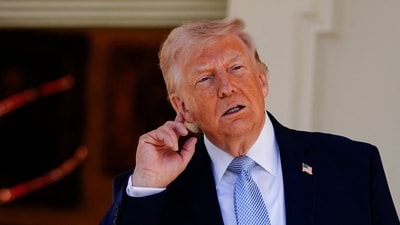
U.S. President Donald Trump gestures, as he heads back to the Oval Office, on the day of the 2026 White House Easter Egg Roll, in Washington, D.C., U.S., April 6, 2026. REUTERS/Nathan Howard (REUTERS)
Ask the stockmarket and the answer is, in aggregate, much earlier. The share prices of companies that investors expected to benefit from a Trump presidency hit a high in mid-2025, relative to those most associated with his defeated predecessor, Joe Biden. Today a “long Trump, short Biden” basket is 20% below its peak, roughly where it was around the time of the election in November 2024.
Some of the picks touched on the big themes of Mr Trump’s campaign, such as bullying of NATO freeloaders (which boosted European armsmakers) or his carbon-cuddling (great for fossil fuels). These are doing relatively well. The president’s threats to invade Greenland and his grumbling over allies’ reluctance to join his Iranian campaign continue to shore up Europe’s defence industry. The war in Iran has pushed up the price of oil—and the profits of American oilmen.
Other Trump trades have also performed decently. Fannie Mae and Freddie Mac, government-backed enterprises that offer liquidity to America’s mortgage market, first soared on rumours that Mr Trump is keen on reprivatising them, unwinding state control in place since the global financial crisis of 2007-09. The pair, which Bill Ackman, a hedge-fund billionaire sympathetic to Mr Trump, recently called “stupidly cheap” and “asymmetry at its best”, are down from their peaks but much higher than they were in November 2024.
Where the president’s policies have been muddier, expected winners have often seen limp returns. A case in point is tariffs, Mr Trump’s all-purpose tool of economic and foreign policy. Domestic American manufacturers failed to benefit from reduced overseas competition even before the Supreme Court ruling, partly because of the inconstancy of presidential duty-setting.
Occasionally, investors can be right about the policy but wrong about the beneficiary. Private-prison operators like GEO Group or CoreCivic looked poised to mint it thanks to the mass deportations Mr Trump promised. The administration still looks intent on reaching its target of throwing out millions of illegal immigrants, and is pouring money into the effort. But much of the cash is going straight to Immigration and Customs Enforcement and other arms of the government. The chunk making it to the private sector is rather less than the market had been banking on.
And then there are the clear losers. The market value of Rumble, which runs a right-wing social network, more than doubled in the months after Mr Trump was elected. It is now back to where it was before election day 2024. More surprising still is the fate of Trump Media & Technology Group (ticker: DJT). It runs Truth Social, the main venue for big presidential announcements, and has dabbled in cryptocurrencies and nuclear fusion. Mr Trump is the majority shareholder (via a trust controlled by one of his sons). DJT peaked well before the 2024 election, and is now down by around 80% relative to that.
Yet the Trump trade looming over all others is not in the equity market. Rather, it is the bet that American Treasury bonds would fall in price and yields, which move inversely, would jump. Investors expected Mr Trump to blow up the deficit, heat up the American economy and potentially mess with the independence of the Fed. In the months ahead of the election, yields on 30-year Treasuries rose by 0.5 percentage points.
In office, the president has tried to live up to all three expectations. His varying success—stellar at the first, mixed at the second and poor at the third—resulted in disappointment to those shorting Treasuries. But then the energy shock from the Iran war pushed up inflation expectations. The yield on 30-year bonds is up by 0.4 percentage points since November 2024. The president is unpredictable—except, it seems, in his ability to depress the value of American debt.