
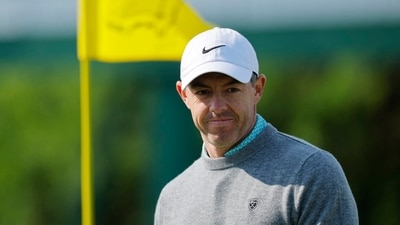
AUGUSTA, Ga.—Rory McIlroy was looking for a parking spot at Augusta National last year when he looked up, saw a bunch of guys in green jackets sipping cocktails on the clubhouse balcony and realized something terribly awkward: He hadn’t been invited to dinner.
“They’re going to see me,” he thought, “and it’s going to be weird.”
But 12 months later, McIlroy no longer has to worry about feeling left out. As the reigning Masters winner, he finally has a green jacket of his own and hosted the “Champions Dinner” this week. And that victory, following years of agony, has launched the phase of McIlroy’s career that will be put to the test at this year’s Masters.
For more than a decade, McIlroy had been motivated by ending his drought at majors and completing the career grand slam. Then both of those burdens suddenly vanished when he beat Justin Rose in a playoff here, making him just the sixth man to win all four major golf titles.
But with that weight off his shoulders, the entire framing of his career is set to change. Will that victory usher in a new run of trophies? Or will the 2025 Masters go down as his final, crowning achievement?
“You think every time you achieve something or have success that you’ll be happy, but then the goal posts move,” McIlroy said. “I felt like the career grand slam was my destination, and I got there, and then I realized it wasn’t the destination.”
McIlroy once blazed onto the scene as a curly-haired kid from Northern Ireland with drives so long they looked intergalactic to the rest of the field. By the time he won his fourth major in 2014, at just 25, he was viewed as the heir apparent to Tiger Woods.
Instead, McIlroy suffered heartbreak after heartbreak and didn’t take home another major for 11 years. And during that time, he grew from wunderkind into one of the game’s elder statesmen. The same way that McIlroy worshiped Woods before playing alongside him, a new generation of players reached the highest level of the game by wanting to be McIlroy. One of those was Mason Howell, the reigning U.S. amateur champion who is playing in the same group as McIlroy this week.
“Rory was one of my idols growing up,” Howell said, “so it’ll be a super special moment for me.”
Still, McIlroy is only 36. That might be old for a quarterback or a point guard, but that leaves plenty of time for a professional golfer to keep winning. And if there’s one major where McIlroy likes his chances most, it’s at Augusta National.
Unlike the other three other marquee events on the golf calendar, which cycle through different venues each year, the Masters returns to the same 18 holes every April. That means McIlroy, now in his prime, traveled to Augusta with more knowledge than most of the field: This is his 18th time competing in the tournament.
“I feel like I’m still young,” McIlroy said, “but I’m very experienced.”
McIlroy must now make that experience count in order to achieve a rare feat. Only three players—Jack Nicklaus, Nick Faldo and Woods—have won back-to-back Masters, and no one has managed it in more than two decades.
He will also need to rediscover some form. Early last year, McIlroy came into the Masters scorching hot following wins at Pebble Beach and the Players Championship. But since his emotional victory at Augusta National, McIlroy hasn’t won on tour a single time. Even he admitted that in the months after earning the green jacket that had eluded him for so long, he “felt a little flat on the golf course.” More recently, he withdrew from a tournament with a back injury.
Yet his desire to add to his five major wins remains as strong as ever. By his own estimates, he has another “10 good shots at this.” The difference this year is that he’s armed with proof that he’s actually capable of coming out on top here.
“I know that I can do it now,” McIlroy said, “so that should make it a little easier for me to go out and play the golf I want to play.”