
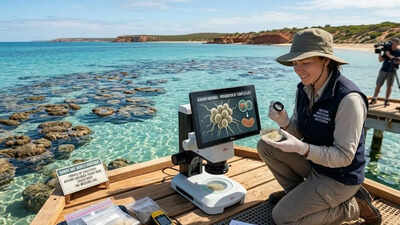
Scientists have discovered an archaea called ‘Asgard’ in the extremely high-salinity waters of Shark Bay, Australia, which contains microbes that provide a long-standing evolutionary enigma for many centuries – how did simple, single-celled bacteria develop into such complex multicellular organisms, animals, and human beings? These unique microorganisms serve as an evolutionary link; they carry with them the cellular machinery thought to be unique to complex cells, thus showing us the evolutionary transition point in evolution. The proto-eukaryote, which we now call a ‘living fossil,’ represents that particular initial microorganism that can exist and consume other initial microorganisms. This created the first eukaryotic cell. Without this unique, microscopic ancestor found in the hypersaline basins of Australia, the branch of the evolutionary tree representing humanity would never have developed.
A microbe found in Australia reveals the mystery of our existence
According to the study published in Nature, the identification of Asgard archaea, which were discovered in Shark Bay microbial mats, demonstrates that these are the closest living relatives of eukaryotes, or eukaryotic organisms in their cells, including humans. The Asgard archaea contain what are called ‘eukaryotic signature proteins’ (ESPs), which provide molecular scaffolding for the intracellular architecture. DNA analysis suggests that Asgard archaea represent the eukaryotic progenitor, establishing a direct evolutionary lineage between this unicellular organism and modern humans.
How endosymbiosis fueled the rise of multicellular life
Research relating to the Asgard archaea supports the endosymbiotic theory. According to this theory, published in PNAS, endosymbiosis begins with an Asgard-like organism engulfing some unrelated bacteria. Instead of digesting these bacteria, the larger Asgard-like cell and the bacteria existed together as symbionts. Over a period of millions of years, the engulfed bacteria gradually evolved and became what we now refer to as the mitochondria – the ‘engine’ of our cells, that provides a metabolic surge required for evolution to produce multicelled organisms.
How Asgard archaea bridge the two-billion-year gap
The remarkable microbial mats and living stromatolites in Shark Bay may very well be responsible for its World Heritage status and are truly spectacular as they exist in two times the amount of salt as open oceans. The ancient environment that they live in resembles the oceans of 2 billion years ago, which allows scientists to see a current version of the conditions that gave rise to complex life through the Asgard archaea that are now living in this particular ecological niche and are considered ‘missing links’ as they exhibit evolutionary plasticity.
The hidden complexity of simple microbes
Additionally, the Asgard archaea have a unique cytoskeleton compared to standard prokaryotic cells; this enables the cell to transform its shape and move, and possibly transport materials internally, which was once thought to be solely associated with complex forms of life, as per the Journal of Molecular Biology. Thus, they provide evidence that the cellular biomechanics that is necessary for complex, environmentally dependent life forms existed before the appearance of the first animals.