
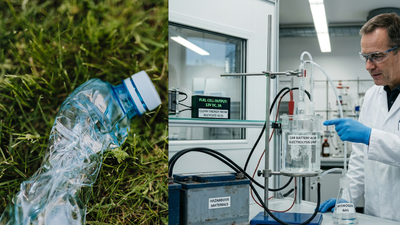
Plastic waste on a global level amounts to hundreds of millions of tonnes annually, although very little of that is recycled. On the other hand, corrosive waste such as spent battery acid from used cars is rendered neutral and disposed of. However, scientists now have devised an ingenious process that addresses both issues simultaneously. The latest development in science is the creation of a technique by a team from Cambridge University, which can convert such harmful battery acid into clean hydrogen and useful chemicals.
Car battery acid recycling meets plastic waste innovation
In ‘Solar reforming of plastics using acid-catalyzed depolymerization,’ which appeared in Joule, researchers describe a technique called solar-driven acid photoreforming. This technique involves using sulphuric acid reclaimed from used automobile batteries in the degradation of plastic waste into chemical compounds.The process is described by the University of Cambridge in that, at first, plastics are treated with reclaimed acid to degrade the polymers into smaller chemicals, including ethylene glycol. Then, these chemicals are converted into hydrogen fuel and acetic acid using sunlight.Prof Erwin Reisner, the author of the research, said,“We thought that acid was absolutely out of the question… but it worked in our catalyst.”These results have debunked old beliefs about acids in chemistry and provided novel opportunities for recycling challenging plastics, including nylon and polyurethane.
Clean hydrogen production using waste materials
Among other benefits of this invention is the creation of hydrogen gas, which has been viewed by many as a source of energy for the future. Not only does it help reduce plastic waste, but it also helps produce sustainable energy.According to Kay Kwarteng, the lead author of the research:“This acid is an untapped resource… It’s really a win-win.”This is because the acid can be recycled several times, hence helping reduce the costs associated with its production and disposal. Tests have also proven that the reactor can function without interruptions for more than 260 hours.It should be noted that this technique works on plastics that are difficult to recycle using other methods.
A circular economy approach to plastic pollution
“This discovery represents the promise of a circular economy, in which waste from one step in a process can serve as the raw material for the next.” Around the world, more than 400 million metric tons of plastic are produced per year, but less than 18 per cent of that amount is recycled. Through the use of plastic waste and battery acid waste, this development allows for the creation of “one waste stream that solves another.”Yet, the scientists understand that their discovery does have limitations. As Reisner said,“We’re not promising to solve the global plastics problem.”
How this might help solve the ongoing recycling problem
This scientific investigation marks an attempt to change our outlook on what is usually considered as waste. What appears to be waste could actually become a source of resources if viewed in a new way – for example, battery acid or plastics.Even though more work should be done to make this method applicable to an industrial scale, the idea itself is based on an already proved chemistry.Living in a society that has problems with plastic waste and requires sources of energy, we need to start thinking differently from time to time. We might not solve all our problems by inventing a new chemistry, but we can make an attempt.