
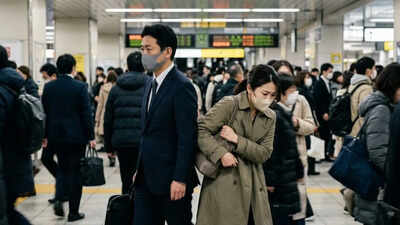
In the complex maze of trains, buses, and subway stations in Tokyo, a long-obscured form of gender-based harassment called Butsukari Otoko, or ‘bumping man,’ is on the rise. This type of violence occurs when men intentionally bump into women in crowded train stations during the busy rush hour period and use the anonymity of all the people around them to hide their blatant acts of physical violence from other people in the area. Many bystanders view these actions as just an example of the many issues caused by the increasing density of Japanese cities, but research shows that this behaviour is actually motivated by frustration and power. Most of these men choose to target those whom they perceive to be weaker or unlikely to retaliate; therefore, they are taking advantage of the rules of social norms that exist in Japanese culture to engage in hit-and-run style harassment against women, leaving the victims with long-lasting psychological damage and feelings of increased vulnerability.
Butsukari Otoko: A gendered power dynamic
Skewed power dynamics are behind this phenomenon rather than overcrowded city streets. Sociologists at Japan Women’s University have found that these offenders are typically middle-aged males who will purposely target those individuals they believe to be more prone to becoming victims, specifically, elderly, female, or those distracted by their cell phones. By picking victims that they feel are unlikely to fight back or cause a scene, they use the station as an outlet for their personal frustrations and to exert a sense of power and dominance that they is stripped from them by rigid corporate hierarchies or social alienation. This behaviour should not be classified as an unfortunate series of events, but as a targeted act of gender-based aggression.
The erosion of female agency in public spaces
Victims endure long-lasting effects beyond the obvious injuries inflicted on their bodies as a result of this form of violence, which is described as chronic ‘vigilance fatigue.’ Scholarly analysis in the International Journal of Japanese Sociology explains that these calculated acts of non-verbal intimidation are part of a continuum of micro-aggressions that take the form of urban encounters between men and women on public transportation systems.The requirement for women to scan the crowd and be aware of their surroundings at all times increases their levels of anxiety, thereby limiting their ability to use public spaces. The continual presence of strangers invading a woman’s personal space sends the implicit, yet clear, message that her psychological safety is secondary to the perpetrator’s assertion of spatial dominance.
The role of surveillance in prosecution
For Butsukari Otoko, navigating the legal system is difficult due to the complexity and requirements of the Japanese Penal Code concerning intention. According to National Police Agency documentation, these acts tend to be treated as assaults or public disturbances or nuisances, but for a successful prosecution, it is necessary to prove beyond a reasonable doubt that a collision between the perpetrator’s body and the victim’s body occurred because of intent rather than resulting from a large number of people being in Tokyo at the same time (there are often congestion levels frequently exceeding 150 per cent capacity). The actual perpetrator can usually assert plausible deniability to the authorities because they were among many other people at a busy time of day (example: during rush hours), and thus, unless you have high-quality CCTV (cameras) that show solid evidence that there was a conscious change in the path of the perpetrator’s body towards the victim’s body, these incidents typically do not get reported or prosecuted.