
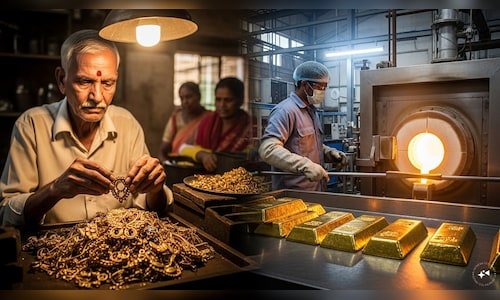
While the practice has always existed in India, industry experts say it is now gradually moving toward more organised and transparent channels.
What is changing in gold recycling?
According to Keyur Shah, CEO of Muthoot Exim, gold recycling in India has traditionally been driven by household needs—either exchanging old jewellery for new designs or selling gold during key life events such as weddings or financial requirements.
He notes that the key shift today is the movement toward organised platforms that offer more transparent valuation and standardised purity testing.
Shah highlights that younger consumers, including newly married couples, are open to selling excess or inherited gold through formal channels rather than informal buyers, mainly due to better transparency and trust in pricing mechanisms.
Mangesh Chauhan, Managing Director of Sky Gold & Diamonds, adds that the customer base for jewellery consumption itself is widening, with younger and middle-aged consumers now more actively participating in gold purchases. However, he points out that recycling is still largely need-based rather than a regular financial behaviour in India.
What is driving recycling behaviour?
Shah says higher gold prices often act as a trigger for recycling activity, encouraging households to monetise idle gold holdings. However, he emphasises that the broader shift is also linked to growing awareness of organised gold buying systems and improved access to retail-based recycling outlets.
Chauhan agrees that price movements play a key role, noting that consumers typically consider exchanging gold when prices rise sharply due to macroeconomic or geopolitical factors.
He adds that recycling decisions are usually linked to specific financial or social needs rather than broader behavioural change.
What are the key barriers?
Both experts point to different but overlapping challenges limiting wider adoption.
Shah highlights structural issues, stating that one of the biggest barriers is the limited presence of organised sector players across India.
He also points to low awareness among consumers regarding transparent and scientific methods of gold purity assessment, which restricts participation in formal recycling channels.
Chauhan, meanwhile, focuses on behavioural and cultural factors. He says gold in India is deeply tied to emotion, tradition, and financial security. It is often treated as a long-term legacy asset, especially among women, and is typically retained as a safety reserve for emergencies. According to him, this emotional value often outweighs financial considerations when it comes to selling or recycling gold.
How organised players are shaping the market
Shah explains that companies like Muthoot Exim are working to build a structured ecosystem through initiatives such as Muthoot Gold Point, which standardises gold buying through retail outlets and transparent testing processes.
He also adds that organised recycling has broader macroeconomic benefits, including reducing India’s dependence on gold imports and helping improve the current account balance, while also lowering environmental impact by reducing the need for mining.
Chauhan adds that while organised systems are improving trust and accessibility, the overall scale of recycling is still shaped more by consumer sentiment and price cycles than by structural adoption alone.
When do consumers recycle gold?
Shah says the decision is largely personal and depends on household needs at a given time, with gold continuing to be viewed as a long-term wealth-preserving asset.
Chauhan adds that consumers typically recycle gold only in two situations—when prices rise significantly or when there is a financial or social requirement such as weddings or emergencies.
Otherwise, gold is generally held as a stable store of value.
Is gold recycling sustainable?
Shah views gold recycling as both necessary and sustainable in the long run. He argues that even a small proportion of India’s estimated private gold holdings entering the recycling system could significantly reduce import dependence.
Chauhan agrees that recycling plays a useful role in resource efficiency but reiterates that in India, its adoption is still driven more by economic triggers and cultural behaviour than sustainability considerations.