
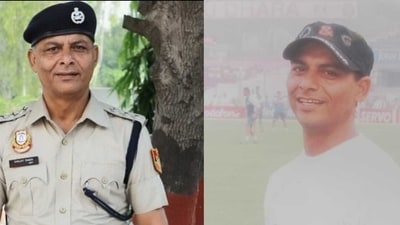
On a busy Saturday afternoon at Arun Jaitley Stadium, when Delhi Capitals pacer Lungi Ngidi collapsed on the field during a match against the Punjab Kings, ACP Sanjay Singh sprung into action. This wasn’t just a police officer responding; it was also the former cricketer in him.
The officer, who serves as ACP Traffic (Central District), was overseeing vehicular arrangements at the venue on April 25. “The moment I heard that a player had been injured and an ambulance was on the pitch, I rushed. I saw the player with an oxygen mask on inside the ambulance. The DC officials told me they had to take him to hospital. When I got to know he was hurt around his head and neck while fielding, I knew I had to act fast. Having played cricket for Delhi Police for 12 years, I knew how serious that kind of an injury could be. We all remember what happened to Raman Lamba—I had even played with him. Agar kucch ho jaata toh desh ka naam kharaab hota. Toh mujhe pata tha ki sab kucch bahut jaldi karna hoga.”
Singh immediately got on the phone and began coordinating a green corridor to rush the South African cricketer to BLK-Max Super Speciality Hospital in Rajinder Nagar. “It was 6:15 pm and that’s peak traffic hour. There were large crowds both inside and outside the stadium. The ambulance driver wanted to follow Google Maps, but I told him to follow my directions. I stayed in constant touch with traffic inspectors along the route, and we covered 8 km in just 11 minutes.”
Ngidi, 30, is now stable and has been discharged from the hospital.
Singh, who has been serving in the Delhi Police for 32 years now, credits Central Zone DCP Nishant Gupta for his faith, and the recent briefings during the AI summit for helping him make the quick plan. “I’m grateful to all my seniors—Additional CP, Joint CP, Special CP—for their guidance. Today, everyone is proud of the Delhi Police.”
Watching him methodically manage traffic outside the stadium, few would guess that Singh once terrorized opponents on the pitch. But he did! He shares that he played alongside Gautam Gambhir, Virender Sehwag, Yuvraj Singh, and Mohammad Kaif when they played DDCA league matches for teams like ONGC and Indian Airlines. “I remember once Kaif was batting brilliantly and no one could get him out. I was fielding and told my teammates I would take his wicket, and I did in the very next over,” he says with a smile.
He also witnessed the early hunger of Virat Kohli. “In those days, the DDCA league had a rule where only the top 16 teams qualified for the final stages,” Singh explains. “A team that qualified was allowed to take two players from teams that didn’t make the cut. That’s how Kohli, who must have been around 15 or 16 then, ended up in our team.”
The dedication was evident even then. “There was a match washed out by rain; Feroz Shah Kotla was full of water and we were all having chai-pakora. But Kohli was practicing alone in a corridor. Humne bola use ki aaja chai pee le, par woh khelta raha ghanto tak. You could see his dedication even then.”
Speaking about Sanju Samson, who won the Man of the Series award during the T20 World Cup, Singh adds, “His father was a head constable in Delhi Police and played excellent football. But both Sanju and his brother were drawn to cricket. Even as a child, the spark in Sanju was unmistakable.”
He’s seen the making of another cricketer – Nitish Rana. “His uncle Anil Rana played cricket for Delhi Police. He was one of the best batsmen. Nitish is playing cricket at the highest level today because of him. Nitish used to practice at New police line Cricket ground with us., where we regularly practice.”