
The Athletics Federation of India’s circular making it “mandatory for athletes to obtain prior approval from the Athletics Federation of India (AFI) before entering into any agreement or contractual arrangement with any sponsor or third party” led to much chatter.
The use of the word ‘sponsor’ was confusing to start with – are there sponsors lining up for our track and field stars other than Neeraj Chopra? In KPMG’s 2025 Business of Sport In India report, athletics did not feature among the top five watched or the top five most played sports in India. It’s not likely doors are being broken down to reach our runners and throwers and jumpers. There is a therefore a good chance that the circular is directed to the entity referred to as ‘third party’.
Public defence of the document came from Adile Sumariwala, ex-officio AFI member due to his being World Athletics vice-president, sometimes also referred to as “AFI spokesperson.The AFI’s own office-bearers — President Bahadur Singh Sagoo, Treasurer B. E. Stanley Jones, and Officiating Secretary G. Srinibas Patnaik — tend to be invisible.
The circular, Sumariwala said, was to counter the “mafia agents” who were “influencing” private organisations and using athletes as “commodity.” And to “protect Indian athletes because most of our athletes are not really educated… “cannot go through a 30-page contract” and “don’t know what they are signing.” Such condescension over athletes’ general intelligence belongs to a familiar frequency.
To start with, as any half-awake lawyer will tell you, the circular is essentially unconstitutional, a violation of fundamental rights. Gopal Sankaranarayanan, senior advocate, Supreme Court ticks them off – Article 19 (1) (g) Freedom of Profession, Occupation, Trade or Business and Article 14 Equality before Law.
He points out that in India’s richest sport, “Even the cricketers have individual sponsorships which are independent of the BCCI engagements with them.” Despite the fact that India’s elite cricketers have annual retainership contracts with the BCCI and also get paid match fees.
The AFI is not employer or owner of athletes, their employers usually the armed forces or PSUs. What is at the heart of this almost Trumpian communication via pronouncement is the a constant tug of war between the AFI and ‘third parties’ over control of the destinies of the athletes. Their career paths, their training schedules, their futures.
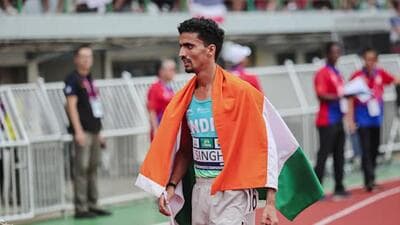
What is said to have kicked off the commotion leading to the circular is the movement of star middle-distance runner Gulveer Singh from Reliance Foundation Youth Sports to rivals JSW Sports.
At the turn of the century, the new, private non-profits emerged in the face of federation indifference to the requirements of elite athletes. They stepped in as facilitators of day to day logistics around travel and competition, access to financial assistance from the government, training expertise and quick medical intervention. The improvement in performances and medal tallies that followed made these organisations often more visible than the sports’ governing bodies. Or indeed the government, which unlike the federations had taxpayer rupees to offer.
Over the last decade, several of these private organisations have expanded their portfolio, setting up specialised training centres and independently hiring coaches whose methods and preparation schedules clash with those of the national coaches hired by the federations.
With a relatively small field of top-quality track and field athletes to pick from, athletics has become a particular flash-point. The AFI want keep the athletes reined in, and in their camps and rival organisations compete with each other, offering juicier deals to the latest upcoming star.
The kitchen-table approach to 21st century sports governance is what has led us here. Despite the supposed proliferation of “mafia agents” and rogue private bodies, there is no AFI regulation around athlete representation, no system of due diligence and registration. Nor is there a clear framework about the differences between the scouting, signing and marketing of athletes by private organisations and addressing conflicts of interest that arise from such overlap.
What emerges instead the circular as shaahi farmaan/ royal decree which promises contract approvals within ‘three-days.’ The AFI’s recent time-management history offers little confidence. Our team for the April 12 World Athletics Race Walking Team Championships in Brazil faced departure delays due to AFI’s late and incomplete visa applications. The AthleticsIndia website[5] reported that the final application formalities were only completed on April 8[6], the team reaching Brazil a day before the event.
On April 11, a video dropped showing a man sauntering across the track during the final of the junior men’s 200m as athletes approached the straight in the Indian Athletics Series – 3 at Delhi’s Nehru Stadium. The man happened to be a considerably clueless volunteer, not as Sumariwala had quickly posted[8], a journalist. Then The Bridge reported on April 17 that complaints had been made against javelin coach Naval Singh.
AFI will distance themselves here but there’s no hiding that athletics still heads our doping disciplines – 29 percent of total WADA positives from India – as the country completes a dubious hat-trick in the annual global dopers tally.
Sankaranarayan says, “instead of interfering with the little amounts that athletes are making” the AFI should “get them all handsome contracts” instead. But first, better the conditions for athletes at all level by “improving the quality of coaching, equipment, stadia, competition.” Expending energies on hosting the Olympics is not going to be the way to do it.