
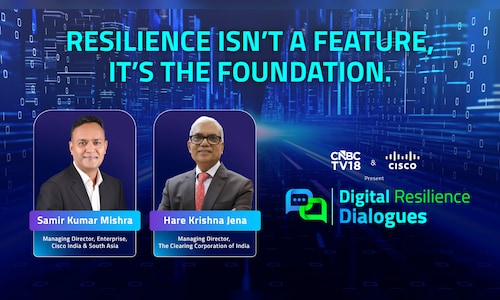
Digital Resilience Dialogues, hosted by Cisco in association with CNBC-TV18, works best when it gets past the vocabulary of transformation and into the machinery that keeps modern India functioning in real time. In this episode, hosted by Shruti Mishra, Hare Krishna Jena, Managing Director of The Clearing Corporation of India (CCIL), and Samir Kumar Mishra, Managing Director, Enterprise at Cisco India & South Asia, explored the national market infrastructure, emphasising where settlement, liquidity, and market continuity come together.
Jena began by providing a definition that directly captured the essence of CCIL’s mission. For a central counterparty, settlement finality has “two aspects”, he said, “one is the legal one, and the other one is the operational.” The legal layer comes from rules that are clear, time-bound, and aligned to global standards such as PFMI, which require settlement to be completed by the end of the value date. The operational layer is where the real engineering sits. “Systems may have disruptions at any point in time,” Jena said, “but we must be prepared that whenever there is any disruption we have to address those things, and we have to restore the system back.”
The operational weight of CCIL becomes more evident when understanding its functions. Established in 2001, it clears and settles transactions involving government securities, forex cash and forwards, interest rate derivatives, and forex options. Additionally, it manages retail systems like RBI Retail Direct and Forex Retail, allowing individual customers to access the interbank forex market. Though its public presence is limited, its systemic importance is significant.
Samir Kumar Mishra defined digital resilience as “the ability to keep your business up and running no matter what comes in the way,” whether from technology issues, cyberattacks, software bugs, or third-party outages. In many outages, he explained, the first few hours are lost simply trying to locate the problem, with IT, network, and security operations scattered across separate dashboards. “Digital resilience is a data problem,” he said, because operational data frequently resides in fragmented systems, hindering teams from gaining a complete view when quick decision-making is crucial.
When Mishra inquired what operational continuity means for CCIL’s scale, Jena responded by focusing on the structure of the settlement process itself. He explained that a settlement system broadly consists of two main components: the actual settlement of securities and funds, and the accompanying risk management framework. For a central counterparty, risk management is essential to every transaction. Additionally, CCIL oversees electronic trading platforms through its subsidiary, Clearcorp Dealing Systems, in real time. “It’s not the high availability alone,” Jena stated. “It should be available.” In markets where latency, connectivity issues, or system slowdowns can impact more than just an individual institution, this distinction becomes significant.
That need for constant availability shaped Samir’s architectural argument. There is no single point of failure in delivering applications and services, ensuring smooth operation. With end-to-end observability, potential issues can be spotted early, often before they impact business. Built-in threat detection, prevention, remediation, and response from the very start help keep everything secure. As Cisco’s research highlights, 89 percent of technology professionals believe that downtime truly depends on the strength of digital infrastructure.
The discussion about compressed settlement cycles highlights an often overlooked but essential aspect of market infrastructure: liquidity. While systems need to manage higher volumes, it’s equally important that liquidity is available when settlement timelines shorten. CCIL’s ability to run multiple batches of settlements offers near real-time processing, and multilateral netting helps lower liquidity risk throughout the system. “The gross could be a hundred billion dollars, but the net could be five billion dollars,” he said, explaining how infrastructure design reduces pressure across the market.
Security was a key theme throughout the conversation. Samir highlighted that only “7% of organizations in India have achieved a mature level of cybersecurity readiness.” He recommended adopting zero-trust architecture, continuously validating every user, device, and application, and granting access based on the principle of least privilege. He also mentioned that post-quantum cryptography is already being discussed as part of architectural considerations.
The discussion naturally extended from security concerns to AI. Samir explained the evolution from chatbots to agentic AI, where agents operate autonomously, but he cautioned that this broadens the attack surface and necessitates monitoring agent behaviour. “If people don’t trust AI, they are not going to use AI,” he emphasised, advocating for resilience “for AI and with AI.” Jena’s concluding perspective was more reserved. While distributed ledger technology, CBDC experiments, and AI-assisted coding might have a place in future market infrastructure, their success depends on ensuring they are secure, user-friendly, and aligned with national financial systems.
By the end, the episode really highlighted how resilience is all about being specific and prepared. It covered target times, settlement rules, redundancy, telemetry, margin automation, liquidity management, zero trust, and quarantining risks before they can spread. When it comes to national market infrastructure, this is truly what maintaining continuity looks like.