
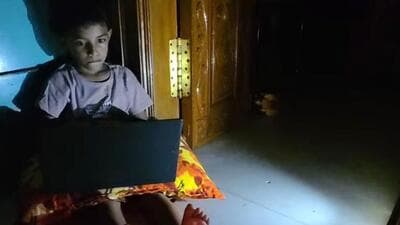
Bengaluru: Eight-year-old Tamizh Amudhan, seated on the floor of his house in Thiruthangal – a suburb of Sivakasi, India’s firecracker capital – with a laptop perched on a pillow in his lap, his slight frame and the room lit by his mother’s phone torch and a flickering candle. His father, Sathish Arumugam, clicked the picture on his phone, imagining it might be useful years from now. The striking image would come to capture a glimpse of the eight-year-old’s explosive promise.
Battling a power cut and a dying laptop, Tamizh went on to take down world No.7 Vincent Keymer in an online blitz game at the Freestyle Friday tournament. For context, the German grandmaster won the Weisenhauss Freestyle Chess Grand Slam defeating Magnus Carlsen and Fabiano Caruana, last year, won the Grenke Freestyle 2026 and has qualified for next year’s Freestyle World Championship.
Power went out in Thiruthangal around 6pm on Friday after thunderstorms hit the area. Tamizh’s laptop battery was at 48 percent at the time. He used his mother’s mobile phone hotspot to play the tournament that began two hours later. For tournament fair-play purposes, his mother’s phone was propped up as both a torch and a camera.
“He wanted to play until the laptop battery died. He managed to play four games, beating Keymer in one of them. I took the picture thinking it would be good motivation someday of playing despite the odds. I had no idea the world would see it so soon,” Sathish told HT.
A Candidate Master, Tamizh became world No.1 in the under-9 category, achieving the rare feat of crossing a rating above 2000 Elo in his age group. Around a year ago, Sathish and his family made the difficult decision to prioritise Tamizh’s chess. It meant the family would be split across two places, 350 kilometres apart – with Tamizh’s mother staying with him in their rented house in Thiruthangal, and his father and sister remaining in their hometown of Kallakurichi.
Tamizh joined the Hatsun Chess Academy in Thiruthangal, founded by reigning world champion D Gukesh’s former coach Vishnu Prasanna, where he attends classes from 9 am to 6 pm, six days a week. He has not attended school for at least a year now. Chess has taken precedence.
“It’s a risk we didn’t mind taking,” Sathish said. “He can always catch up later with formal education. But what he’s learning now through chess – dedication, focus, and hard work – will always stay with him.”
Vishnu describes Tamizh as a “super talented” and “intuitive” player and likens him to one of India’s best speed chess players, Nihal Sarin. “He loves to play, and plays very quickly. He wants to find ideas in every position. He’ll keep fighting in every position and try to be tricky. Even in a losing position,” he told HT. It’s what saw Tamizh through against Keymer. Playing with the Black pieces, Tamizh was in a losing position. On move 10, Keymer could have found a win with 10.Bxh7, instead he castled. Thereafter, the 8-year-old unleashed a series of attacking moves and eventually Keymer resigned.
It has been difficult for Sathish, a Tamil Nadu government employee, to fund Tamizh’s chess career, particularly travel to foreign tournaments. “We earlier missed out on the Commonwealth Championship because we couldn’t afford to travel,” Sathish pointed out, before expressing gratitude that timely help has now arrived. Hatsun, his academy’s primary sponsor, is now funding his tournament expenses. Tamizh is slated to play the Commonwealth Championship followed by the World Youth Championship. “He has a good chance of going for the youngest IM/GM records by the end of this year,” Vishnu offered.
Sathish is wistful about Tamizh’s feat making headlines worldwide, particularly in the Gulf. His father once worked as a labourer in Saudi Arabia. “Back then, we would stay in touch by recording messages on cassettes. My brothers and I would read out and record essays, poems, and Thirukkural verses for my father on cassettes. My father did not get to study when he was a child. He would listen to our messages over and over again. We would send and receive these cassettes through people we knew in neighbouring areas who were travelling there. Today, the place where my father worked as a labourer is hearing my son’s name.”