

David Attenborough was born on this day, a 100b years ago. When he first stepped foot on planet Earth, it had been only a couple of years since the first intercontinental flight had taken off in 1924. By the time he turned 18, World War II was on the verge of a close. It was the ideal time for what the legendary nature broadcaster and narrator went on to do — fly across the world, explore hidden natural treasures, and document them for the rest of the globe to witness and gawk at.
“People had never seen pangolins, sloths, or the centre of New Guinea before on television,” he says in the 2020 Netflix documentary David Attenborough: A Life on Planet. By that point, humans had gotten a groove on how to live the world. They’d eliminated their predator. They’d figured out a way to sustain themselves agriculturally. And the pervasive mood was of progress, not destruction. Countries began opening up instead of waging wars against each other.
Curiosity had taken the wheel, and the predatory sentiment had been relegated to the backseat. Over the next two decades, Attenborough made advances at his position in BBC. His resume was initially rejected, only to be spotted and acted upon by a senior executive who eventually hired him. But he was still not deemed fit for the television because his “teeth were too big”. But nature had its own devious ways of picking who gets to represent it. Thanks to the original presenter falling sick, Attenborough faced the camera for the first time in the early 1950s, kicking off his Guinness world record-holding 70+ year career as a nature narrator.
 A young David Attenborough.
With his Zoo Quest series, Attenborough took an enraptured audience across wildlife marvels in Madagascar and Sierra Leone (Africa), Paraguay and Guyana (South America), Indonesia (Asia), and New Guinea (Australia), introducing to them unchartered species like the Komodo dragon. His voyages across the world ran parallel to mankind’s discovery of the rest of the universe. With the first footage of planet Earth from the space in the Apollo Mission I in 1967, as the world gaped at the blue sphere in disbelief, an epiphany of a different kind hit Attenborough — that’s all we have.
Attenborough then gradually began working towards raising awareness about the human dependence on the remainder of the living ecosystem. With his gentle, semi-whisper-like narrating style, Attenborough insisted on the infiniteness of our home. “Anyone who believes in indefinite growth on a physically finite planet is either a madman or an economist,” he said famously, cautioning against no checks on unhinged capitalism that was now preying on what birthed it in the first place. Having lived half of his life already, and with no inkling of how much time he had left on the planet, Attenborough decided to become the face and the voice of the biggest nature documentary the world had seen so far.
With Life on Earth (1979), The Living Planet (1984), and The Trials of life (1990), Attenborough spearheaded a pioneering nature documentary trilogy that spanned hundreds of centuries, dozens of countries, and was released over more than a decade. That rejuvenated Attenborough into diving deep into nature further. At a time when most Britishers consider retirement, Attenborough, in his early 60s, reached the shores of Antarctica for Life in the Freezer (1993).
Although the focus remained on enhancing the fascination and value planet Earth holds for the humankind, Attenborough’s commentary turned more direct and aggressive at the turn of the millennium. With another page of a thousand years now turned, Attenborough kept reminding his audience how mankind — including them — have “not just ruined our planet, but completely destroyed it”. However, his finger-wagging didn’t come from the colonial hangover of an English septuagenarian, but from a nature-hugging well-wisher who manifested the new century to repair the damage caused by the last one.
Story continues below this ad
With his new Planet series — Planet Earth, Blue Planet, and Frozen Planet — he kept the childlike wonder of the Gen-Z alive. He didn’t talk down to them, but demonstrated how there’s a big, wonderful world beyond their smartphones. That’s probably why he became the fastest person to reach 1 million followers on Instagram in 2020, within just 24 hours of his debut. He wasn’t a fossil when it came to technology. Instead, he effectively milked it to further his mission. With the advent of infrared cameras, he gave us a peek into the life of nocturnal animals and with macro photography, zoomed into the lives of creatures perhaps too small to escape naked vision. His vision wasn’t just all about scale, but also peak detailing.
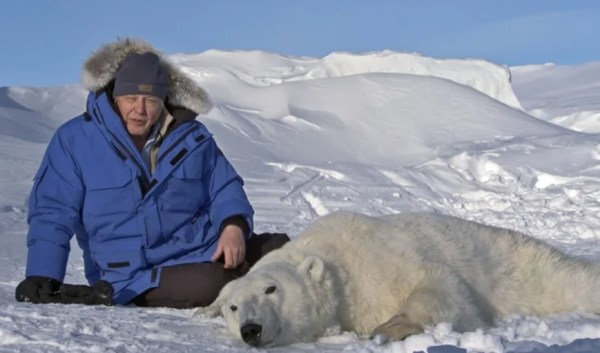 David Attenborough in his mid-80s in Antarctica for Frozen Planet.
When the entire world was introspecting during the Covid-19 pandemic, Attenborough did that too. In David Attenborough: A Life on Planet, he balanced cold facts about the destruction on Earth since his birth with the warmth of personally embarking on a new adventure in his early days. He depicted a microcosm obliterated by the Chernobyl disaster, drawing a parallel with what similar, more gradual man-made disasters could do to the remainder of biodiversity. “Deforestation too is happening as a result of bad planning and human error. This too will lead to what we see here,” he says in the documentary.
Also Read — Riddhima Kapoor on being the oldest debutant of her family at 45: ‘My father is always blessing me’
By shuttling between wide-eyed wonder and cold-blooded truth-spilling, Attenborough has crafted a career that saw him win a BAFTA across black-and-white, colour, HD, 3D, and 4K. His life lived on Earth has been a living life capsule of the evolution in filmmaking running parallel to that of the world it’s trying to chronicle. At 99, Attenborough‘s new miniseries Secret Garden aired its finale on May 3, just five days before he turns a century old. He still doesn’t plan to hang up his boots, arguing his job doesn’t entail something as draining and monotonous as “hewing coal”, but discovering the most wondrous natural miracles that the planet has to offer. Earth would agree he’s one of them, which is why a hundred candles on the cake is just its way of saying ‘thank you’ to its most ardent admirer.