
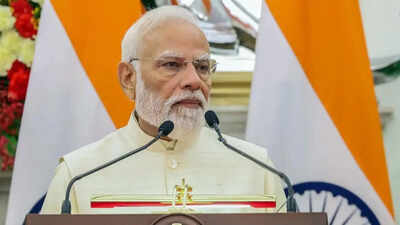
NEW DELHI: Prime Minister Narendra Modi on Sunday urged citizens to adopt wide-ranging lifestyle and consumption changes as part of a national effort to conserve foreign exchange and reduce the economic impact of the ongoing West Asia conflict and global energy crisis. These include cutting fuel use, prioritising public transport and postponing foreign travel to name a few. Addressing a public event in Secunderabad, PM Modi said that rising global energy prices and supply chain disruptions required ‘collective restraint’ and a ‘duty-first’ approach from citizens.“But friends, when the supply chain continues to be in crisis, no matter what measures we take, the difficulties only increase. Therefore, now we must fight unitedly, keeping the country and Mother India first. We must remember that patriotism is not just about dying for the country. Living for the country and fulfilling our duties to the country is also patriotism,” he said. Here are the nine suggestions offered by PM Modi:
Use petrol and diesel sparingly
PM Modi called for immediate restraint in fuel consumption, stressing the need to reduce dependence on imported energy.“In this time of global crisis, we have to make a resolution keeping duty paramount and fulfil it with complete dedication. A big resolution is to use petrol and diesel sparingly. We must curb our use of petrol and diesel,” he said.
Travel by metro
PM Modi urged citizens in urban areas to prioritise mass public transport systems such as metro networks to reduce fuel usage. He encouraged a behavioural shift towards shared and efficient mobility options in cities with metro connectivity. “In cities with metro lines, we should decide to travel by metro only,” he said.
Carpooling
PM Modi also suggested carpooling as a practical way to reduce fuel consumption when private vehicles are necessary.He emphasised that shared travel can significantly reduce pressure on fuel demand. ” If we must use a car, then we should try to carpool,” PM Modi urged.
Use electric vehicles
Highlighting cleaner mobility alternatives, PM Modi urged citizens who own electric vehicles to maximise their usage.He said EV adoption should be encouraged as part of broader efforts to reduce fossil fuel dependence. “People with electric vehicles should try to use them as much as possible,” PM Modi requested.
Work from home
Recalling pandemic-era practices, PM Modi urged institutions and citizens to revive work-from-home arrangements where possible.He said remote work systems help reduce travel, fuel consumption and overall economic pressure. “During the Corona period, we developed many systems of work from home, online meetings, and video conferences, and we even became accustomed to them. Today, the demands of the times are such that if we restart these systems, it will be in the national interest. We must prioritise work from home, online conferences, and virtual meetings again,” he said.
Online meetings
PM Modi also promoted the use of online meetings and digital coordination tools to reduce physical travel.He said such systems, widely used during the Covid-19 pandemic, remain relevant in the current global crisis.
Video conferences
PM Modi stressed the continued importance of video conferencing for official and professional communication.He said digital platforms can help maintain productivity while lowering transport and fuel requirements.
Saving foreign exchange
Linking household consumption to national economic stability, PM Modi urged citizens to reduce imports and conserve foreign exchange.“We must also place a strong emphasis on saving foreign exchange, as petrol and diesel have become so expensive globally… It is our responsibility to save the foreign currency spent on purchasing petrol and diesel,” he said. PM Modi also made a direct appeal to limit discretionary spending on gold, saying it adds pressure on foreign exchange reserves.“Gold purchases are another area where foreign exchange is used extensively. In the national interest, we must resolve not to purchase gold for a year,” he said. He cited edible oil and fertilisers as key areas where reduced consumption could strengthen the economy.“If every household reduces the use of edible oil, it is a huge contribution to patriotism,” PM Modi urged.
Postpone travelling abroad
PM Modi urged citizens, particularly the middle class, to defer non-essential foreign travel, including tourism and overseas weddings.He said such travel patterns place additional pressure on foreign exchange reserves during a time of global uncertainty.“The growing culture of weddings abroad, travelling abroad, and vacationing abroad is becoming prevalent among the middle class. We must decide that during this time of crisis, we should postpone travelling abroad for at least a year,” he said. US-Iran war has already impacted India with increased oil prices, limited arrival of crude cargoes and heightened volatility in global energy markets as tensions around the Strait of Hormuz disrupt one of the world’s most critical shipping routes.The Strait of Hormuz is a critical maritime passage through which a significant share of India’s crude oil imports flows. It has remained a key pressure point in the conflict, with disruptions pushing up freight costs, insurance premiums and global benchmark crude prices.