
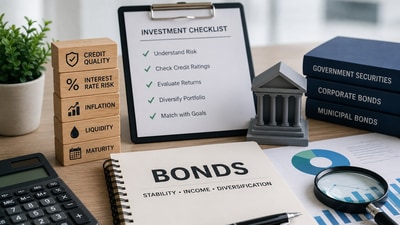
Bonds are a good financial product to diversify your overall investment portfolio. While equity can provide growth, fixed income can provide stability when equities are going down or are volatile. Similarly, gold acts as a hedge against high inflation and a safe haven against uncertainty. Along with providing stability to the overall portfolio, bonds can also provide regular income, depending on the chosen interest payment frequency. So, while there are many benefits of investing in bonds, they must be chosen carefully. In this article, we will discuss some mistakes that investors must avoid when investing in bonds.
Mistakes to avoid
Some mistakes to avoid when investing in bonds include the following.
- Not mapping them to financial goals
Investing in bonds must be a part of your overall financial planning process. A goal-based investing approach requires mapping all your investments to your financial goals. It helps you avoid making random bond investments.
The goal-based investing approach helps you choose the bond tenure based on the financial goal timeline and stay invested till the goal is achieved. It helps you become a focused and disciplined investor rather than engage in ad hoc trading (buying and selling bonds at random) for small financial gains.
Always map your bond investments to your financial goals, and stay invested till they are achieved.
2. Building a concentrated portfolio instead of a diversified bond portfolio
Asset allocation requires an investor to build a diversified investment portfolio. Diversification can be done across asset classes and within every asset class. At a broader level, your investment portfolio must be diversified across asset classes, such as domestic and international equity mutual funds, fixed income, gold and silver, real estate, etc.
Within fixed income, for diversification you can choose from financial products, such as Employee Provident Fund (EPF), Public Provident Fund (PPF), fixed deposits, bonds, Government small savings schemes, etc.
Within bonds, you can diversify among corporate bonds, Government securities (G-secs), State Development Loans (SDLs), PSU bonds, etc. Within corporate bonds, you must avoid concentration risk by spreading your investment across bonds of multiple companies. You may decide on a fixed amount allocation or a percentage allocation of fixed income/overall portfolio to bonds of a single company.
Always diversify your debt portfolio across bonds and other fixed income products. Within bonds, limit your exposure to a single company.
3. Not doing proper research
Before investing in a company’s bonds, make sure you do thorough research about that company. The company must have a steady/growing business, be profitable, have a management team of good pedigree, a sound track record of corporate governance, etc. Stock exchange-listed companies declare their financial results every quarter and disclose material information to the stock exchanges on an ongoing basis.
In the past, many companies have raised funds from investors by issuing bonds, and then ran into financial troubles, resulting in defaults. Some companies committed fraud, and the owners vanished. With proper research, you can stay clear of such companies.
Invest in bonds of companies with a stable/growing business and a proven track record.
4. Giving preference to the coupon rate over credit ratings
Most investors look to maximise their returns from any financial product. The same applies to bonds. However, for bonds, in addition to the coupon rate, investors need to pay attention to the credit rating. The bonds with the highest credit rating, usually the safest, will usually have a lower coupon rate. As the credit rating moves down, the risk increases, and so does the coupon rate.
If a particular company bond offers a higher coupon rate than other companies, the credit rating may be lower, and the risk involved may be higher. The highest credit rating signifies the highest degree of safety regarding the timely servicing of financial obligations.
For example, the CRISIL credit rating scale is as follows.
Credit rating |
Description |
|
AAA |
Highest degree of safety. Lowest credit risk |
|
AA |
High degree of safety. Very low credit risk |
|
A |
Adequate degree of safety. Low credit risk |
|
BBB |
Moderate degree of safety. Moderate credit risk |
|
BB |
Moderate risk of default |
|
B |
High risk of default |
|
C |
Very high risk of default |
|
D |
In default or expected to be in default soon |
Source: CRISIL website
The above table shows that as the credit rating goes down, the degree of safety reduces, and credit risk increases. A bond with lower credit rating offers a higher coupon to compensate investors for the additional risk they take compared to an AAA-rated bond. However, investors should not be blindly lured by the higher coupon rate.
If you have a conservative risk profile, you may focus on AAA, AA, or A-rated bonds. If you have a moderate or aggressive risk profile, you may consider bonds with credit ratings lower than A.
When choosing a bond, consider not only the coupon rate but also the credit rating and the risk involved. Accordingly, make an informed investment decision.
5. Not factoring in the interest rate risk
Interest rates and bond prices have an inverse relationship. When interest rates move up, bond prices fall, and vice versa. When investing in bonds with a longer tenure, consider the interest rate outlook. If the interest rates rise after you have bought a bond, the price of your bond will fall. If you plan to sell it, you may have to incur a loss on the bond’s face value. However, if you plan to hold the bond till maturity, you will redeem it on face value.
When buying a bond, bear in mind that its price will fall if interest rates move up.
6. Not factoring in the impact of inflation
When you buy a bond, the coupon rate is fixed. The real return that you earn from the bond is the coupon rate minus the inflation rate. If inflation moves up, it reduces your real return. Hence, when buying a bond, factor in the inflation outlook and its impact on your real returns.
7. Investing in illiquid bonds
You may have bought a bond with the intention of holding it till maturity. However, a financial emergency may arise, necessitating the sale of the bond. In such a scenario, the bond liquidity determines how soon you find a buyer and at what price. For illiquid bonds, finding a buyer can be challenging. Even if you find one, they may be willing to pay a lower price than the market price, resulting in a capital loss for you.
Invest in bonds with adequate liquidity, even if you plan to hold them till maturity. It will ensure you get a buyer at or near the market price, just in case you need to sell.
8. Not considering the call option
A call option gives the bond issuer the right (but not the obligation) to redeem the bond before its maturity. After the bond issuance, if market interest rates fall, the bond issuer will still be paying a coupon rate above market rates. In such a scenario, the bond issuer can exercise the call option and redeem the bonds before maturity. The bond issuer can then issue new bonds at a lower interest rate than earlier.
When choosing a bond, check whether there is a call option. If yes, bear in mind that the issuer can call the bonds back before maturity.
Be an informed investor: Make informed investing decisions
We have discussed the common mistakes an investor can make when investing in bonds. You are now aware of the factors to be considered, such as credit risk and other risks, liquidity, impact of interest rate movements, impact of inflation, etc. Now that you are aware of these mistakes, you can avoid them and make an informed decision to build a diversified bond portfolio that is mapped to your financial goals.
LinkedIn post
Bonds are often seen as the “safe” part of a portfolio. But safe does not mean foolproof.
A bond investment can still go wrong if you chase coupon over credit quality, ignore liquidity, forget inflation, or build a concentrated portfolio without linking it to real financial goals. In fixed income, the mistakes are usually quieter than in equity — but they can be just as costly.
Before you add bonds for stability, make sure you are not carrying hidden risks into your portfolio.
Explore the red flags before you invest:
#Bonds #FixedIncome #Investing #PersonalFinance #WealthManagement #RiskManagement #AssetAllocation
Facebook post
Many investors turn to bonds for stability. But that does not mean every bond decision is automatically smart.
A high coupon can hide higher risk. An illiquid bond can become a problem in an emergency. And ignoring inflation, credit rating or call options can change the outcome more than you expect.
If bonds are part of your money plan, these are mistakes worth avoiding early.