
The forest is never silent – not even in the calmest hours, and certainly not when birds are around. But they are not chattering to kill boredom. Every chirp, call and song carries a meaning that has rarely been understood by humans. Cornell researchers have succeeded in understanding some of this bird behaviour.Though studying birds would have taken years of fieldwork, these researchers cracked it by eavesdropping. That’s right! They used inexpensive microphones to understand the complex behaviour of birds, including how they respond to threats and make life-or-death decisions in the wild. The findings are published in the journal Ecology.
How birds react to predators
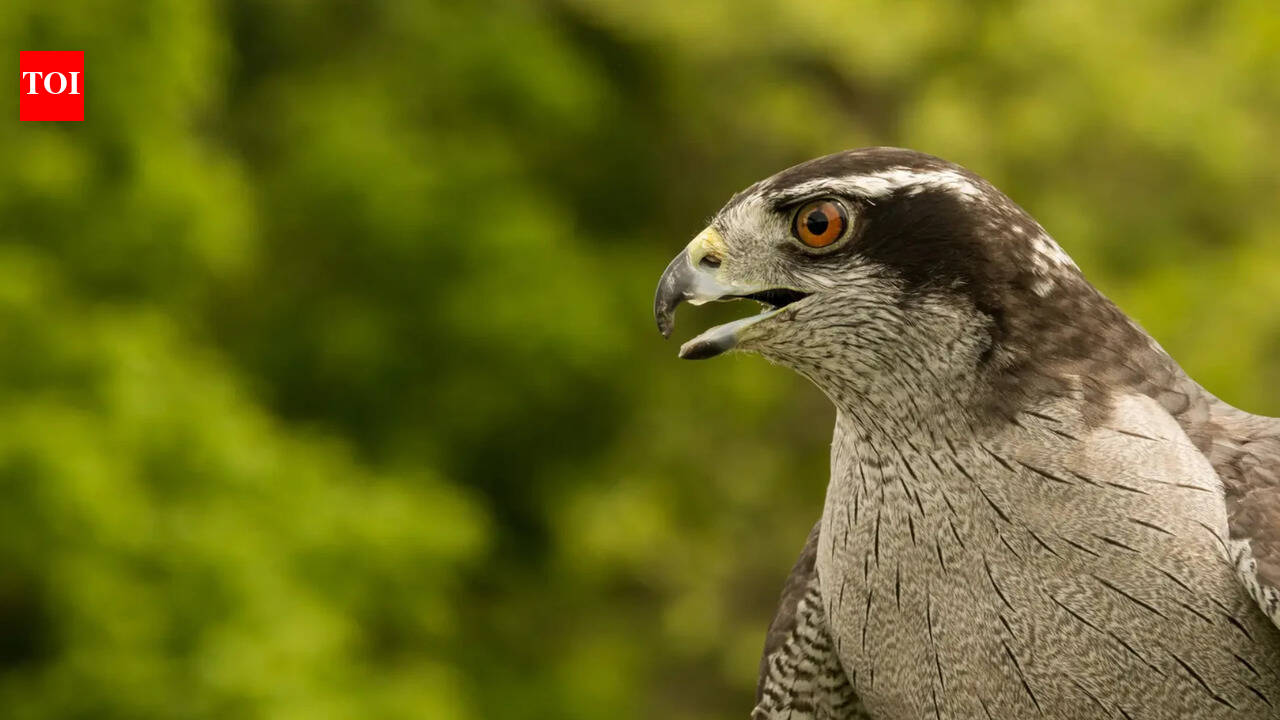
Scientists from the Cornell Lab of Ornithology used microphones to record bird songs and calls, unveiling their complex behaviour. Though scientists have used microphones before, they have only applied them to determine whether a species was present in an area. The Cornell researchers, on the other hand, decided to learn more about the birds using microphones. They placed microphones throughout California’s Sierra Nevada as part of their ongoing study to monitor bird diversity. They analysed hundreds of thousands of hours of sound. They tried to understand how birds respond to calls from the American goshawk, a hawk that often preys on other birds. Using BirdNET, a machine-learning tool, they identified birds in the recordings and also verified recordings of American goshawks.The researchers noted that birds called and sang less after hearing an American goshawk. However, their response varied by location. Birds in the farther south of the Sierra Nevada sang and called less often in the presence of a goshawk than birds farther north.
The chickadee dilemma
The researchers also explored the behaviour of mountain chickadees, a small songbird. These birds use their ‘fee-bee’ song to attract mates and also mark their territories. When danger approaches, they use the ‘chickadee-dee’ alarm call to warn others and scare predators. The researchers also noticed that these small birds would switch from songs to alarm calls when they heard a goshawk. They observed that chickadees sang more in areas with less vegetation beneath the forest canopy. Once a goshawk calls, they switch from territorial songs to alarm calls, but only in places where understory plants are sparse. The researchers think these birds are making trade-offs between defending a territory and evading predators.
How microphones turned out to be the saviours
“Monitoring birds using hundreds of microphones across the Sierra Nevada revealed subtle patterns of risk assessment that birds make based on habitat quality. They seem to be thinking, I’m going to sing more here because it’s a high-value nesting site worth defending, but I’m also more exposed to predators here, so if I hear a goshawk I’ll switch to alarm calls to avoid getting eaten,” Connor Wood, co-author and ecologist at the Cornell Lab of Ornithology, explained.They also explained how these subtle changes in behaviour are challenging for scientists to document using traditional field methods. “We’ve shown that you can use microphones placed out in the forest with no attending human observers to study really fine-scale behaviours at a really large spatial scale,” Mickey Pardo, lead author and postdoctoral researcher at the Cornell Lab of Ornithology at the time of the study (now a researcher at ElephantVoices and Colorado State University), said.The researchers emphasised that the sound data could revolutionise the field at a fraction of the cost of traditional methods. “Understanding the behavioural aspects of birds is really important for conservation, because if we are relying on their behaviour to inform our knowledge of where they are on the landscape, we need to be pretty sure that we’re interpreting their behaviour the right way, and sound recordings are a tool that can help,” Wood concluded.