
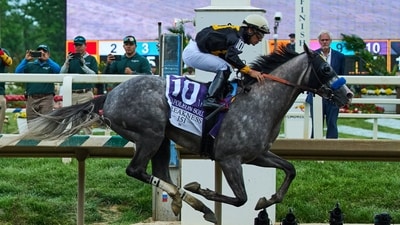
Napoleon Solo stormed to victory in the 151st edition of the Preakness Stakes at Laurel Park. The colt, trained by Chad Summers and ridden by jockey Paco Lopez, not only captured one of horse racing’s biggest prizes but also secured a massive payday from the race’s $2 million purse.
How much money does the Preakness winner receive?
The winner of the Preakness Stakes earns $1.2 million from the overall purse.
The remaining payout structure is divided among the next four finishers:
1st place — $1.2 million
2nd place — $400,000
3rd place — $220,000
4th place — $120,000
5th place — $60,000
The total purse for the race has remained at $2 million since 2024.
How the money is split
Traditionally, the winning purse is divided between the horse’s owner, trainer and jockey.
That breakdown works as follows:
Owner — 80%
Trainer — 10%
Jockey — 10%
As a result, Napoleon Solo’s ownership group will receive $960,000 from the victory.
Trainer Chad Summers earns $120,000, while jockey Paco Lopez also pockets $120,000 for guiding the colt home at Laurel Park.
Napoleon Solo completes dramatic turnaround
Napoleon Solo entered the Preakness carrying major question marks despite once being viewed as one of the leading Kentucky Derby contenders.
Named after the fictional spy from The Man from U.N.C.L.E., the colt exploded onto the scene as a two-year-old with dominant wins in his first two starts, including a dazzling Grade 1 Champagne Stakes victory.
However, his three-year-old season had been filled with setbacks.
He faded to fifth in both the Fountain of Youth Stakes and Wood Memorial, leading many to doubt whether he could rediscover his early brilliance at longer distances.
Trainer Chad Summers remained optimistic entering the race after a series of eye-catching workouts.
“Everything went right as a 2-year-old, but everything has gone wrong as a 3-year-old,” Summers said before the Preakness.
The trainer later added: “His works since the Wood indicate to us he’s getting back to himself.”
“It’s good to see him do what he’s capable of doing and hopefully we’ll see something closer to what we saw last year as opposed to what we’ve seen this year.”
Speed proved decisive at Laurel Park
Napoleon Solo’s blistering early speed once again became the key storyline in the race.
The colt had posted remarkable training times leading into the Preakness, including a six-furlong workout in 1:10 at Belmont Park — a performance one veteran trainer reportedly described as extremely rare.
Owner Al Gold even compared the workout to the style often associated with legendary trainer Bob Baffert.
“That was a Bob Baffert-style workout,” Gold said.
Summers also praised the horse’s ability to produce fast times naturally without being heavily pushed during training sessions.
“Sometimes you worry when they work fast. But good horses will do it. It’s how they do it. You don’t want it under a drive or under duress,” Summers explained.
Laurel Park hosts unique Preakness
This year’s Preakness was held at Laurel Park instead of Pimlico Race Course, which is currently undergoing redevelopment.
The race also lacked a Triple Crown storyline after Golden Tempo skipped the event following his Kentucky Derby triumph.
That created one of the most open Preakness fields in recent years, with Iron Honor, Taj Mahal, Chip Honcho and Incredibolt all entering with strong expectations.
Napoleon Solo, however, delivered the biggest statement of all by reviving his season on one of racing’s biggest stages.