
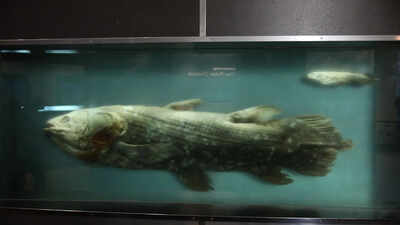
Some of the greatest scientific findings indeed tend to occur when people least expect them to. For example, on one winter day in 1938, the curator of a small museum in South Africa got an unexpected telephone call from a fisherman who had been out at sea. The fisherman explained that his trawler had just landed, bringing along quite a haul of sharks and rays.It was a routine, everyday task for a museum worker, but as she sorted through the slippery heap of marine life, a flash of brilliant iridescent blue caught her eye. She pulled aside the upper layers of fish to reveal a massive, five-foot-long creature that looked entirely alien. It had strange, armour-like scales, a heavy lizard-like jaw, and most peculiarly, fleshy fins that looked more like small legs than standard swimming paddles.Unknown to her, what Courtenay-Latimer had found was a coelacanth. As of that freezing day, all the world’s scientists concurred that this ancient group of animals had become extinct from the planet at precisely the same time that the dinosaurs became extinct. It would have been the equivalent of discovering a living T. rex in a remote mountain valley.Unravelling the mystery of an ancient survivorThis finding rocked the scientific world because it shattered everything that had been believed about evolution since before anyone could remember. As described in a historical article called In the 1930s, This Natural History Curator Discovered a Living Fossil Well, Sort of, written for Smithsonian Magazine, the fish was from a species that had supposedly been extinct for over 66 million years. All of a sudden, a creature that scientists could only study from its two-dimensional, flattened fossil remains had sprung to life before their very eyes.This discovery made biologists reevaluate all of their assumptions concerning the patterns of extinctions and life in the oceans. While the coelacanth is often referred to as a living fossil in the media, recent genetic research indicates that these fish have never stopped evolving, but adapted themselves so successfully to the conditions of underwater volcanic caves that the structure of their bodies became appropriate for several geological epochs.
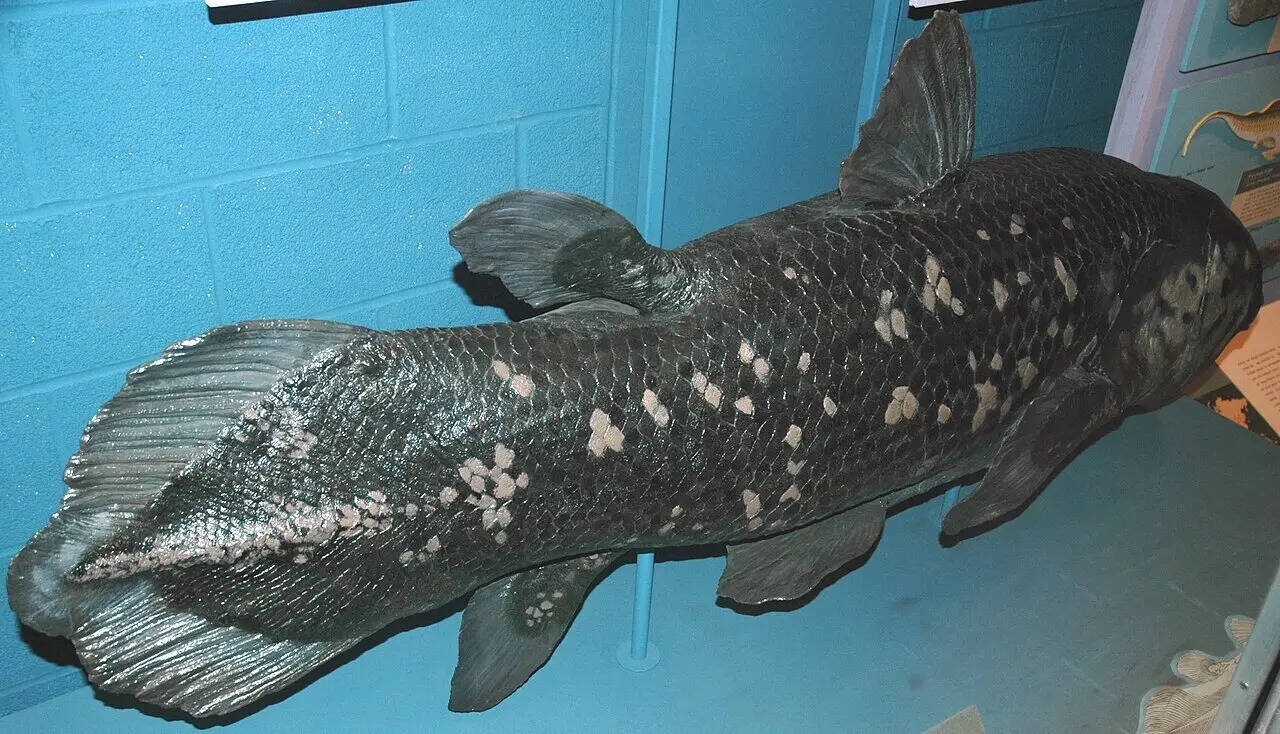
Modern technology reveals its unique skull structure and leg-like fins, highlighting the ocean’s unexplored depths and the enduring mysteries of ancient life. Image Credits: Wikimedia Commons
Looking inside the skull of a living legendMany decades after its discovery, the latest advancements in technology continue to unveil surprising facts about how this unique animal functions. Another article by the Smithsonian Magazine mentions that micro-CT scanning has helped scientists analyse the skull of this unusual fish.The research reveals that the coelacanth possesses a unique intracranial joint, an internal hinge running right through its skull that allows it to swing its upper jaw upward while feeding. This gives the fish an incredibly wide, powerful bite that is entirely unlike modern ocean predators. Furthermore, the study notes that their large, lobed fins move in an alternating, leg-like pattern that closely mirrors how four-legged land animals walk.Today, the coelacanth remains one of the greatest natural history success stories of all time. It serves as a beautiful reminder that our oceans are incredibly deep, dark, and mostly unexplored. While human civilisations build cities and map the stars, there are still ancient branches of life swimming quietly in the depths, completely untouched by the passage of millions of years.The idea that for thousands upon thousands of generations, fishing vessels engaged in commercial fishing probably returned these amazing animals to the waters because they considered them garbage without even realising they held history in their hands is quite an astounding one.