In the first key developer conference keynote of this summer, Alphabet and Google CEO Sundar Pichai laid out the tech giant’s artificial intelligence (AI) vision. Pichai noted extraordinary momentum with AI usage, saying Google is now processing 3.2 quadrillion tokens per month, a 7x increase from 480 trillion tokens at the time of last year’s Google I/O keynote.
That momentum, underlined by a year which saw Google continually ship new AI tech to consumers and enterprise users, marks the arrival of two new AI models, an agentic push and new integrations. Some recent shipments include significant AI layering for millions of Android phones with Gemini Intelligence, and Ask Maps for complex, conversational questions within the Google Maps app.
“Ten years since we pivoted the company to be AI-first, we still see AI as the most profound way to advance our mission and improve people’s lives at scale. That’s why we’ve been taking a differentiated, full-stack approach to AI innovation, from our custom silicon and secure foundation, to our world-class research and models, to our products and platforms that touch billions of people,” Pichai said.
The Google I/O 2026 keynote set stage for two new AI models, Gemini Omni and Gemini 3.5 Flash which improve understanding and multimodality, a fresh Spark for the Gemini app marking advancements to the agentic push, as well as focus on conversational prompts.
Koray Kavukcuoglu CTO, Google DeepMind and chief AI architect at Google, described Gemini Omni, the natural language creation model, as “where Gemini’s ability to reason meets the ability to create”.
With Omni, users will be able to combine images, audio, video and text as input, to generate high-quality videos that will find basis with Gemini’s real-world knowledge. There’s immediate relevance for consumers, with Gemini Omni rolling out in the Gemini app, Google Flow and YouTube Shorts.
“Gemini Omni gives you an easier way to edit video — with natural language. Every instruction builds on the last. Your characters stay consistent, the physics hold up and the scene remembers what came before,” Kavukcuoglu explains.
Gemini 3.5 has unwavering focus on delivering execution of tasks as part of agentic workflows, which Jeff Dean Chief Scientist, Google DeepMind and Google Research notes combines frontier intelligence with action.
“Gemini 3.5 Flash delivers intelligence that rivals large flagship models on multiple dimensions, at the speeds you have come to expect from the Flash series. It’s our strongest agentic and coding model yet,” Dean explains.
Gemini 3.5 Flash is returning a significantly higher score of 76.2% in the Terminal-bench 2.1 agentic terminal coding benchmark, ahead of Gemini 3.0 Flash (58%), Gemini 3.1 Pro (70.3%) and Anthropic’s Claude Opus 4.7 (66.1%), but just behind OpenAI’s GPT-5.5 (77.2%).
Google’s data suggests Gemini 3.5 Flash leads benchmarks across these models in multistep workflows, real-world general tool use, financial analysis, information synthesis from complex charts and multimodal reasoning.
Gemini app’s spark
The Gemini app is attaining more powers in its latest iteration, including the Gemini Spark agent. The company’s official figures peg Gemini app’s user base at 900 million, up from 400 million users at this time last year.
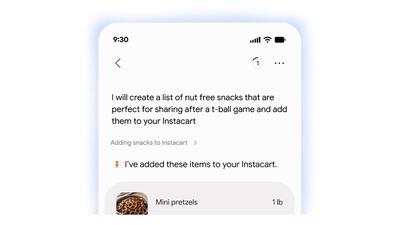
Josh Woodward, who is VP, Google Labs, Gemini app and AI Studio, noted that “Spark represents a big shift for Gemini, transforming it from an assistant that can answer your questions into an active partner that does real work on your behalf and under your direction”.
Spark is web based, and will integrate with other Google apps — the former is key to recurring tasks or triggering background action even when your phone or computer may be powered off — Spark is available on the Gemini app across Android and macOS too.
“Spark operates under your direction. You choose whether to turn it on and what apps it connects to, and it’s designed to ask you first before performing high-stakes actions like spending money or sending emails,” Woodward said, confirming the fail-safes that are in place. Spark will be first made available to Google AI Ultra subscribers next week as part of a beta test — this is because the $100 per month Ultra plan is available only in the U.S., for now.
Google has also announced new MCP or model context protocol connections with popular creative platform Canva, underlined by Spark. More such connections, including with Adobe, Xiaomi, Samsung, CapCut, OnePlus, and Dropbox, are on the menu.