
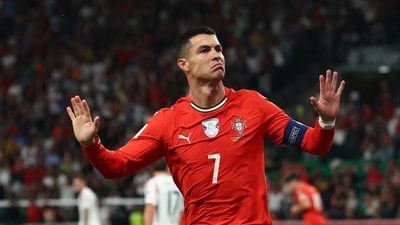
Cristiano Ronaldo’s sixth World Cup will be read first as a record, because records have always followed him like weather. At 41, the Portuguese Superstar has been named in Roberto Martinez’s squad for the 2026 FIFA World Cup, a tournament that can make him the first men’s player to feature in six editions of football’s biggest stage.
Portugal need that history to work as strategy. Martinez has not chosen a squad that looks trapped by the past. He has chosen one deep enough, flexible enough and modern enough to change the old Ronaldo equation. For almost two decades, Portugal often needed Ronaldo to carry their threat, their gravity and their tournament identity. In 2026, the strongest argument for taking him may be that they no longer need him to carry all of it.
Portugal finally have the depth to reduce Ronaldo’s burden
The full squad explains the logic better than the record does. Portugal have Diogo Costa, Jose Sa, Rui Silva and Ricardo Velho in the goalkeeping group, although only three can be officially registered unless an injury opens the door for Velho. The defence has Ruben Dias, Nuno Mendes, Joao Cancelo, Diogo Dalot, Goncalo Inacio, Renato Veiga, Tomas Araujo, Nelson Semedo and Matheus Nunes, who gives Martinez another hybrid option.
The midfield has Vitinha, Joao Neves, Ruben Neves, Samuel Costa, Bruno Fernandes and Bernardo Silva. The attack includes Joao Felix, Francisco Trincao, Francisco Conceicao, Pedro Neto, Rafael Leao, Goncalo Guedes, Goncalo Ramos and Ronaldo.
That is not a squad built around one route to goal. It has carriers, passers, runners, crossers, midfield controllers, wide accelerators and alternative centre-forward profiles. Bernardo can slow possession without killing it. Bruno can turn a flat move into a vertical wound. Vitinha and Joao Neves can stop Portugal from becoming frantic. Leao, Neto and Conceicao can stretch opponents in different ways. Felix and Trincao can work between lines. Ramos gives Martinez a more natural pressing-and-running No. 9 option when the game asks for that kind of forward.
Ronaldo’s value sits inside that abundance. Portugal can now pick him without asking him to be the whole attacking weather system. His role can be narrower, and that narrowness may protect the selection from becoming a sentimental drag.
Also Read: Cristiano Ronaldo makes it to his 6th World Cup roster as Portugal announce squad for 2026 edition
The old Ronaldo equation has changed
Earlier, Portugal teams often looked emotionally and tactically tied to the Ronaldo question. If he was fit, the team bent toward him. If he was quiet, the attack seemed to wait for the old inevitability to return. That relationship grew heavier over time, especially when opponents could press around him, isolate him from service, or force Portugal into slower circulation.
Martinez has a different opportunity. He can treat Ronaldo as a match-state player rather than a permanent organising principle.
Start him when Portugal expect territory, crosses and deep defensive blocks. Save him when the first hour needs pressing speed and repeated defensive sprints. Keep him close for set-pieces, penalties, late pressure and knockout phases where one lost marker can decide a tournament.
That is the football case. Cristiano Ronaldo remains dangerous when the game shrinks. World Cup matches do not always reward the most complete attacking system. They often collapse into one delivery, one loose ball, one back-post run, one defender caught watching, one penalty taken under a noise that turns knees into paper. Ronaldo has spent his career living in those spaces. Even at 41, that instinct still changes the way defenders behave before the ball arrives.
Portugal must avoid the old trap
The risk is obvious. Portugal cannot pretend that age has no tactical cost. Ronaldo does not cover ground the way he once did, and Martinez cannot afford to turn every attack into a search for his final touch. If his presence slows the tempo, weakens the press, or forces better-suited players into unnatural roles, the selection can quickly become a problem.
Portugal’s depth only helps if Martinez is willing to use that depth honestly. A squad with Bruno, Bernardo, Vitinha, Joao Neves, Leao, Neto, Conceicao, Felix, Trincao and Ramos cannot be reduced to service duty around one ageing forward. The strength of this Portugal group lies in its variety. Ronaldo can sharpen that variety only if he does not consume it.
That is why the 2026 Ronaldo decision should not be judged through the lens of the old superstar. The question is no longer whether Portugal should build around him. The question is whether Portugal can use him without surrendering the rest of the team’s range.
The sixth World Cup is the headline, not the full argument
The record is enormous. Ronaldo has already played at the 2006, 2010, 2014, 2018 and 2022 World Cups. A sixth tournament would put him in a different historical corridor altogether.
But history cannot be the reason Portugal carry him. Tournament squads cannot be museums. Martinez’s job is not to honour longevity. His job is to win football matches.
That is where the full squad makes the decision more convincing. Portugal are no longer dragging a thin attack behind Ronaldo’s mythology. They have enough quality to create without him, press without him, control without him and change matches without him. That reduces the emotional pressure around his role.
For Ronaldo, reduction is not humiliation. It may be survival. His career has already been shaped by ruthless reinvention. The electric winger became a penalty-box destroyer. The all-action forward became a specialist in movement, timing and finishing. CR7 now needs one more transformation: from national-team centre of gravity to high-value tournament tool.
Why the gamble still makes sense
Portugal enter the tournament with the profile of a serious contender. They are experienced, technically rich and balanced across departments. Their group-stage path gives Martinez space to manage bodies and rhythm, but the real test will arrive later, when matches become tighter and more hostile.
That is where Ronaldo can still matter. A knockout game does not always need a forward to press for 90 minutes or touch the ball 60 times. It may need one clean run across a centre-back, one header at the far post, one penalty under suffocating pressure, one finish from a half-chance that younger players might snatch at. Ronaldo’s value now lives in those reduced but brutal moments.
Portugal once needed him to drag them through tournaments. At 41, the task has changed. The team may have to carry him through the parts of a World Cup that no longer suit his body, so that he is still available for the parts that still suit his instincts.
The sixth World Cup will dominate the headlines. The calculation underneath is colder and more interesting. Portugal have moved far enough from Ronaldo dependency to make Ronaldo useful again.