
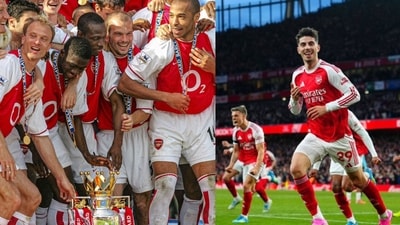
Arsenal’s Premier League title was confirmed without a final-day explosion, without a last-minute winner, without the kind of staged theatre that usually defines football’s grandest endings. Manchester City drew 1-1 at Bournemouth, the chase died on the south coast, and Mikel Arteta’s players became champions while watching another match decide their fate.
That quiet confirmation did nothing to reduce the scale of the moment.
A title confirmed away from the spotlight
Arsenal’s 22-year wait is now over. The club that last ruled English football through the Invincibles has finally returned to the top of the Premier League. The final step came after Arsenal’s 1-0 win over Burnley left City needing victory to drag the race into the last weekend. City could not find it. Bournemouth held firm, Arsenal’s four-point lead became uncatchable, and one of English football’s longest modern title absences ended with one match still left to play.
The trophy will be lifted after the final league fixture against Crystal Palace, but the release had already arrived before then. Arsenal did not need to beat City on the last day, did not need a stoppage-time goal, did not need a cinematic collapse from the defending champions. Their season had already done the work. Bournemouth merely closed the door City had been trying to keep open.
A drought that became a football era
The number is simple. Twenty-two years. The meaning is far heavier.
Arsenal last won the league in 2003-04, when Arsene Wenger’s Invincibles completed an unbeaten Premier League season. Patrick Vieira was the captain. Thierry Henry was the best forward in England. Dennis Bergkamp still gave Arsenal’s attack its cold intelligence. Robert Pires, Freddie Ljungberg, Sol Campbell, Ashley Cole, Jens Lehmann and Gilberto Silva belonged to a side that felt both elegant and untouchable.
That team did not merely win a title. It became a reference point. Every Arsenal side after it had to live under the old gold light of that achievement.
The wait that followed stretched beyond normal sporting frustration. It crossed stadiums, managers, ownership cycles, tactical ages and entire player generations. Highbury disappeared from Arsenal’s daily football life. The Emirates became home. Wenger’s long reign aged, fractured, and ended. Unai Emery came and went. Freddie Ljungberg held the seat briefly. Arteta arrived in December 2019 with Arsenal drifting far from the league’s centre of power.
The Invincibles turned into inherited memory
By the time Arsenal won the league again, almost every direct playing link to their previous title had moved into retirement, coaching, broadcasting, administration or memory.
Henry had left, returned briefly, and retired. Bergkamp had retired. Vieira had retired. Pires had retired. Campbell had retired. Ashley Cole had retired. Cesc Fabregas, once the teenage face of Arsenal’s next era, had completed his own career too.
The club’s last title had stopped being recent history. It had become an inherited memory.
An entire generation of Arsenal supporters grew up with the Invincibles as a story rather than a lived experience. The yellow shirts, Vieira’s authority, Henry’s glide, Wenger’s stare from the touchline, the unbeaten season and the old Highbury aura became archive footage, family mythology, and YouTube education. Arsenal were champions in the imagination of younger fans long before they saw the club become champions on the table.
That is why this title carries such weight. It does not simply update a roll of honour. It repairs a broken timeline.
Chelsea, City, Leicester and Liverpool all rose in between
Chelsea won their first Premier League title during Arsenal’s wait. Jose Mourinho arrived in 2004 and changed the rhythm of English football almost immediately. Chelsea’s 2004-05 side won the league with 95 points and conceded only 15 goals. Roman Abramovich’s investment, Mourinho’s tactical certainty and a new hard-edged winning culture shoved the Premier League into another shape.
Arsenal had gone unbeaten the previous season. Chelsea answered by making the league colder, tighter and more ruthless.
Manchester City’s transformation was even more dramatic. When Arsenal last won the league, City had never won a Premier League title. During Arsenal’s drought, City became the defining English club of the modern age. Sergio Aguero’s 93:20 goal delivered their first Premier League crown in 2011-12. Pep Guardiola later built the 100-point side, the treble side, and the first men’s team in English top-flight history to win four consecutive league titles. Arsenal spent years trying to return to a summit that kept moving.
Leicester City won the league before Arsenal did again. That remains the sharpest measure of the drought. Leicester began the 2015-16 season as 5000-1 outsiders and ended it as champions of England. A club with no previous top-flight title delivered the greatest modern Premier League miracle while Arsenal’s wait continued.
Liverpool also crossed the desert. Their 30-year league title drought ended in 2019-20 under Jurgen Klopp. They climbed from heartbreak to European champions to English champions, then won the league again under Arne Slot in 2024-25. Arsenal’s own absence from the top had become so long that Liverpool moved from generational longing to restoration and then into another title cycle.
The Premier League did not wait for Arsenal. It kept remaking itself. Chelsea rose. City became a dynasty. Leicester performed the impossible. Liverpool returned to the summit. But Arsenal remained trapped between memory and ambition, carrying a history too grand to ignore and a present too incomplete to celebrate.
Messi and Ronaldo’s entire age passed through the wait
The wider football world spun even faster.
When Arsenal last won the Premier League, Lionel Messi had not yet played a La Liga match. Cristiano Ronaldo was still a teenage winger at Manchester United, more promise than empire, more stepovers than legacy. In the years that followed, Messi and Ronaldo did not just arrive. They swallowed the football’s main stage.
Lionel Messi debuted for Barcelona, became the club’s greatest player, won the Champions League, collected Ballon d’Ors, left Spain, won the World Cup with Argentina, moved to Inter Miami and entered the closing chapters of a career that had seemed endless.
Ronaldo became a Manchester United star, a Real Madrid monument, Portugal’s European champion, a Champions League obsession, a global scoring machine and, by 2026, a 41-year-old preparing for another World Cup conversation.
Arsenal’s league drought contained almost the entire Messi-Ronaldo era.
That is the absurd scale of this title. A child who started watching football after the Invincibles could grow up, finish school, enter work, watch Messi and Ronaldo define the sport, watch Leicester win the league, watch City build a dynasty, watch Liverpool end 30 years of pain, and still never see Arsenal become champions until now.
Football’s two greatest modern careers rose, peaked, bent history and approached their final bends during Arsenal’s wait. The game changed its superstars, tactics, finances, media economy, and centre of gravity. Arsenal’s absence from the league summit survived all of it.
Also Read: Arsenal’s Premier League curse ends: Mikel Arteta’s rebuild ends 22 years of heartbreak
Arteta’s Arsenal finally broke the nearly-team label
Arteta’s side has finally broken that chain.
Their title was not built on nostalgia. It came through a team very different from the Wenger sides that still dominate Arsenal’s imagination. This Arsenal were harder, more controlled, more exact in defensive structure, more ruthless from set-pieces and less dependent on aesthetic persuasion. They conceded only 26 league goals, the best defensive record in the division, and turned dead-ball efficiency into a genuine weapon.
The run-in carried the old danger. Arsenal had finished second in each of the previous three Premier League seasons. The label had sharpened around them. Attractive. Improving. Nearly. Brave. Still second. Those words can become a cage if a team keeps hearing them for long enough.
This time, Arsenal did not collapse under the weight of the chase. They absorbed the pressure, kept control of their own results, forced City to keep answering, and then watched the champions run out of road. The title was confirmed through City’s failure to win, but it was earned over the full season by Arsenal’s consistency, defensive authority and refusal to let another campaign become a lesson in pain.
Arteta now stands in a different place in Arsenal history. His rebuild had already taken Arsenal back into title races. This season gave the project its proof. The club that had spent years trying to convince itself that progress would eventually become silverware now has the trophy that changes the entire argument.
The manager inherited a side outside the elite conversation and rebuilt its standards piece by piece. Arsenal became younger, sharper, more secure, more physically reliable and more tactically demanding. The emotional volatility that once defined their difficult years gave way to control. Their title push did not depend on one golden attacker or one romantic surge. It came from structure, trust, repeated habits and a squad that finally knew how to live with pressure.
One more final, one restored club
The final league match against Crystal Palace will carry ceremonial weight. The table has already been settled. The wait has already ended. Arsenal will lift the Premier League trophy again, 22 years after Vieira’s Invincibles last carried the club to English football’s peak.
There is still a Champions League final against Paris Saint-Germain to come, and that gives this season another possible dimension. A European title would push Arteta’s team into a different historical bracket. The league, however, has already restored something Arsenal had lost for a generation.
Arsenal are champions of England again.
The sentence sounds simple. It took 22 years, four Premier League dynasties, one Leicester miracle, Liverpool’s own resurrection, the end of Wenger’s reign, the rise of Arteta, the retirement of the Invincibles, and almost the full careers of Messi and Ronaldo for it to become true again.