
The biggest celebration in football is ready to return as the FIFA World Cup gears up for another historic edition next month across the USA, Canada and Mexico. Every four years, the tournament captures the attention of fans around the globe, but the previous edition in Qatar felt truly unforgettable. It delivered drama, emotion and one of the greatest finals the sport has ever witnessed. The spotlight belonged to Lionel Messi, who finally lifted the World Cup trophy after years of heartbreak and near misses. On the other side stood Kylian Mbappe, whose stunning performance in the final turned the contest into an instant classic. Their battle on football’s grandest stage elevated the tournament to another level and left supporters wondering how the sport could possibly top it.
Now, FIFA hopes the upcoming edition can create another defining chapter in football history. Before the world turns its attention to North America, it is worth revisiting where the journey began in 1930, when Uruguay hosted the very first FIFA World Cup.
Hosting the first FIFA World Cup in 1930 was far from easy for Uruguay. The nation had only a year to prepare after being awarded hosting rights, and the scale of the tournament created major logistical and financial challenges. Despite the pressure, Uruguay earned the opportunity largely because of its dominance at the Olympic Games. The national team had stunned the football world by winning gold medals in both the 1924 and 1928 Olympics, establishing itself as the strongest side of that era. Those triumphs convinced FIFA that Uruguay was capable of staging football’s first global tournament despite the obstacles.
Organising the first FIFA World Cup was a difficult task for Uruguay, with several challenges threatening to disrupt the tournament before it had even properly begun. One of the biggest problems was the construction of the Estadio Centenario, the stadium that was supposed to host all of Uruguay’s matches during the competition. Continuous delays meant the venue was only completed five days after the tournament had already started, forcing organisers to work under enormous pressure.
Travel arrangements created another major headache. In those days, football was far removed from the glamour, fame and financial rewards associated with the modern game. Most players were not full-time professionals and relied on regular jobs to earn a living. Travelling to South America for weeks meant risking their employment back home, something many players and associations simply could not afford. Because of that, several of Europe’s biggest football nations decided against taking part in the inaugural tournament.
In the end, just four teams from Europe agreed to make the long trip to Uruguay for the inaugural World Cup. Belgium and Yugoslavia were not viewed as major forces in international football at the time, while Romania only joined the tournament after strong encouragement from King Carol II, who was also said to have had a direct say in the selection of the players. France arrived with a side missing several key names, but their participation carried symbolic importance because French officials had played a significant role in pushing for the creation of the FIFA World Cup in the first place.
Before Brazil emerged as the dominant force it would later become, the strongest teams in world football were widely considered to be Uruguay and Argentina. The rivalry between the neighbouring nations was already fierce by 1930, and the tension surrounding the first FIFA World Cup only added to it. Every meeting between the two sides carried enormous emotion, both on and off the pitch.
Argentina entered the tournament in impressive form but faced a hostile reception throughout much of the competition. Crowds regularly jeered the team, yet it did little to slow them down. After comfortably progressing through the group stage, the Argentines produced a dominant display against the United States, winning 6-1 in the semifinal to book a place in the final against Uruguay. It was a repeat of the gold-medal match from the 1928 Olympics, a contest that had already intensified the rivalry between the two countries.
Chaos before high-octane finale
The final itself unfolded in an atmosphere unlike anything football had seen before. With more than 80,000 spectators expected inside the stadium, thousands of Argentine supporters travelled to witness the match. Security concerns quickly became serious, with reports claiming Argentine players had received death threats before kickoff. Travelling fans were subjected to strict customs inspections as authorities searched for weapons before allowing entry into the country. Even the referee, John Langenus, reportedly refused to officiate unless life insurance was arranged for himself and both linesmen. The tension surrounding the match reflected just how explosive the occasion had become.
The tension was not limited to the atmosphere surrounding the match, as the rivalry between Argentina and Uruguay spilt onto the pitch even before kickoff. Both sides became the preferred ball to be selected. After lengthy discussions and rising tempers, FIFA stepped in to settle the issue with a compromise. Argentina’s ball was used during the first half, while Uruguay’s choice was introduced after the break.
A dramatic finale
The final turned into a dramatic contest with momentum swinging constantly between the two rivals. Uruguay struck first through Pablo Dorado, sending the home crowd into celebration early in the match. However, Argentina responded strongly and took control before halftime. Carlos Peucelle found the equaliser before centre-forward Guillermo Stabile added another, giving Argentina a 2-1 lead at the break.
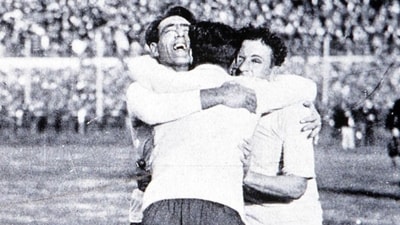
Uruguay came out with renewed intensity in the second half and quickly changed the direction of the game again. Jose Cea restored parity after a powerful run through the defence, while left-winger Santos Iriarte produced a stunning long-range strike to put the hosts ahead. With Argentina pushing desperately for another comeback, centre-forward Hector Castro sealed the match with a late header, completing a 4-2 victory and securing Uruguay’s place as the first-ever FIFA World Cup champions.
Uruguay received the World Cup trophy from Jules Rimet, the FIFA president who had been instrumental in turning the idea of an international football tournament into reality. The original trophy featured Nike, the Greek goddess of victory, holding a cup above her head. In later years, the trophy came to be known as the Jules Rimet Trophy in honour of the man behind the competition’s creation. It remained the symbol of football’s greatest prize until 1970, before FIFA introduced the modern gold trophy in 1974 – the design that continues to be lifted by World Cup winners today.