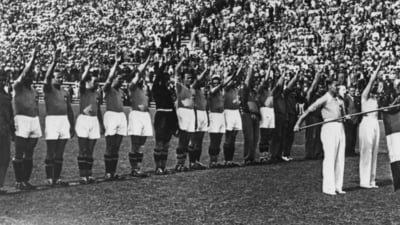
The second FIFA World Cup, hosted in 1934, was expected to be a showcase of football’s growing global appeal. Thirteen teams across three confederations had participated in the inaugural World Cup in 1930 in Uruguay. Four years later, 32 teams across four confederations entered the qualification campaign, of which 16 made it to the finals. Yet, at the end of it all, the 1934 World Cup, hosted by Italy under dictator Benito Mussolini, became one of the most politically charged tournaments in sporting history.
Mussolini’s grand stage
Italy wanted to host the World Cup in 1930, along with four other European nations, but withdrew the bid once Uruguay emerged as the clear favourite. Four years later, Uruguay returned the favour when Italy was awarded hosting rights in 1932. However, barring the politics involved in the decision, it made more sense, as the 1934 World Cup was a straight knockout competition, as seen in the case of Brazil and Argentina, who made an extraordinarily long sea journey only to play one game each in Italy. Even host Italy had to qualify — still the only host nation ever forced to do so.
But more than looking at it as an opportunity to stage a grand spectacle, the fascist regime quickly recognised the tournament’s propaganda value. Stadiums were upgraded, posters carried fascist imagery, and the World Cup became a symbol of national power under Mussolini. In fact, coach Vittorio Pozzo later revealed ‘Il Duce’ had asked him only to pick players who were part of the Fascist Party, which was denied by the members of the squad, saying they were only interested in football and had little choice but to ‘support’ the nationalistic cause.
Pozzo’s tactical masterpiece
Italy’s victory in the World Cup was largely credited to the mastermind Pozzo, a man fascinated by Manchester United who had an insignificant career as a footballer before turning to coaching, albeit not full-time, as he often juggled working for Italian tyre manufacturer Pirelli. This man remains the only manager to win two World Cups, and the only one to triumph in the World Cup and the Olympics.
Physical dominance and tactical discipline were at the core of his philosophy as he built one of the strongest teams in early football history, around stars like Giuseppe Meazza, Angelo Schiavio and Raimundo Orsi. The standout decision, however, was the gamble he took in recalling midfielder Attilio Ferraris despite concerns over his lifestyle and discipline. And it worked. Ferraris became one of Italy’s standout performers during the tournament.
Italy crushed the United States 7-1 in the opening round before surviving a brutal quarter-final against Spain. The first match ended 1-1 after extra time, forcing a replay the next day because penalty shootouts did not exist at the time. Italy won the replay 1-0 in a match marred by accusations of lenient refereeing and excessive physicality.
One of Pozzo’s best moves came in the semifinal against Austria. Pozzo was among the first coaches to make the centre-half play deeper and mark the rival striker closely. Luis Monti did this brilliantly, especially in the semi-final, where he successfully stopped Austria’s star player, Matthias Sindelar, from making an impact.
Surprisingly, Monti had played the 1930 World Cup final, but for Argentina. But since he had Italian citizenship and was signed by Juventus, Pozzo was adamant about getting him on board. That happened before FIFA clamped down on players switching their international allegiance, making Monti one of a kind in World Cup history.
Similar was the story of Orsi, who played 12 games for Argentina, and right-winger Enrique Guaita, who played four games for Argentina. Both had Italian ancestry and were later signed by Italian clubs – Juventus and Roma, respectively.
The final that defined an era
In front of a half-empty Stadio Olimpico, Mussolini also saw his dream getting crushed when Antonín Puč fired home from a tight angle to send Czechoslovakia, who throughout played the better football, into a lead with 19 minutes remaining.
Just when it looked all but over, Italy responded with a wave of pressure, culminating into the equaliser from Orsi with nine minutes left on the clock. And then came the winning goal in the extra time – by Bologna centre-forward Angelo Schiavio. The image of Italian players celebrating before fascist officials instantly became part of football folklore.
Glory and controversy, forever linked
Even today, debate continues over how much political influence shaped Italy’s success. Allegations surrounding referees and Mussolini’s involvement have never fully disappeared.
But history also remembers the football. Pozzo’s team would win Olympic gold in 1936 and another World Cup in 1938, proving Italy’s dominance was not built on politics alone.