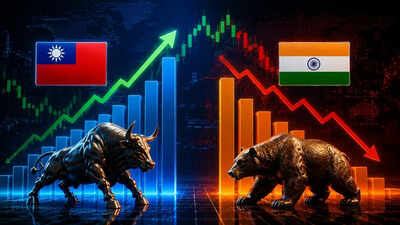
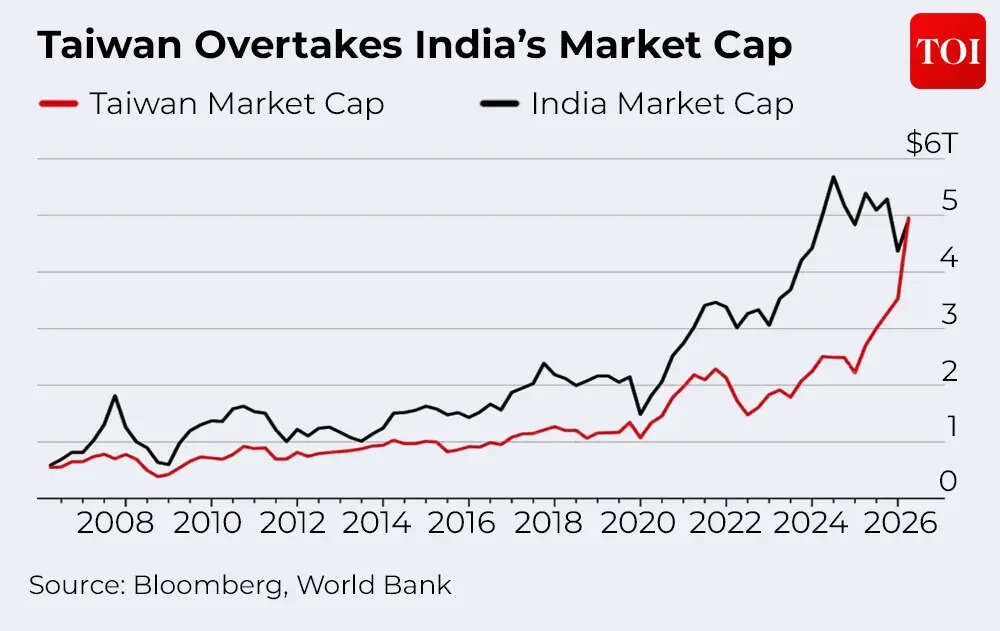
After months of AI-led rallies, Taiwan has finally overtaken India in terms of total stock market valuation, driven largely by the sharp rally in shares of Taiwan Semiconductor Manufacturing Company (TSMC), the world’s largest chipmaker.According to data compiled by Bloomberg, Taiwan’s overall market capitalisation rose to $4.95 trillion as of Monday, while India’s market value declined to $4.92 trillion. With this, Taiwan has become the world’s fifth-largest equity market, behind only the US, mainland China, Japan, and Hong Kong.
Why Taiwan’s stock market is rallying
According to a Bloomberg report, the jump in Taiwan’s market value underscores the strong investor optimism surrounding artificial intelligence, which has fuelled a global rally in technology stocks and disproportionately benefited manufacturing-driven economies such as Taiwan and South Korea.Taiwan’s rise in global market rankings has been powered mainly by TSMC, which now makes up nearly 42% of the benchmark index, reflecting the high level of concentration within the market.
Shares of the semiconductor giant have surged 49% this year as the company emerged as one of the biggest beneficiaries of the artificial intelligence-led boom, with its chips occupying a major position in the global market.Yi Ping Liao, a fund manager at Franklin Templeton said Taiwan’s growing market capitalisation is largely being driven by the country’s significant concentration in technology hardware companies, which currently sit at the heart of the global artificial intelligence investment wave.According to Liao, markets that have relatively lower exposure to tech hardware are increasingly losing attention to markets such as Taiwan and South Korea, where technology hardware companies dominate benchmark indices.Also Read | The big AI shock: Have Indian IT sector stocks lost their lustre?Fresh regulatory changes have also worked in favour of Taiwan Semiconductor Manufacturing Company. Last month, Taiwan’s financial regulator relaxed investment limits for domestic funds investing in individual stocks.Under the revised rules, funds exclusively focused on Taiwanese equities are now permitted to invest as much as 25% of their net assets in a single listed company if that company accounts for more than 10% of the Taiwan Stock Exchange weighting. Earlier, the cap stood at 10%.At present, TSMC is the only company that qualifies under the new criteria.JPMorgan Chase & Co. said in a research note that the regulatory change could potentially attract more than $6 billion in fresh inflows into Taiwan’s market.
Why Indian stock market has fallen
India, meanwhile, is dealing with rising energy costs, moderating corporate earnings growth, and a relatively limited presence of companies directly tied to the expanding AI ecosystem. In fact, in India IT sector stocks have fallen on fears of AI boom disrupting technology sector’s business model.BSE Sensex and Nifty50 saw selloffs last year largely due to tariff related uncertainties. The US-Iran conflict since the start of March is weighing heavily on sentiment.However, despite Taiwan moving ahead of India in overall market capitalisation, India’s economy remains significantly larger. According to International Monetary Fund estimates, India’s economy is valued at around $4.15 trillion, compared with Taiwan’s gross domestic product of approximately $977 billion.Indian equities have declined this year amid record foreign investor outflows, driven by concerns around expensive valuations and a weakening rupee. Rising energy prices have further added to inflation worries and clouded the country’s growth outlook. Global investors have sold nearly $24 billion worth of Indian equities so far this year as capital shifted towards the artificial intelligence-driven rally in Taiwan and South Korea.India’s benchmark market index has fallen 8%, putting it on track for its first annual decline after a decade of gains. India’s weighting in the MSCI Emerging Markets Index has also slipped to nearly 12%, down from 19% last year.Alison Shimada, portfolio manager at Allspring Global Investment told Bloomberg TV on Monday that India has remained relatively overlooked for much of the past two years.Shimada said India continues to be an expensive market, making stock selection important, but added that the increasing financialisation of household savings remains a major theme, with more people steadily shifting towards financial assets.(Disclaimer: Recommendations and views on the stock market, other asset classes or personal finance management tips given by experts are their own. These opinions do not represent the views of The Times of India.)