Ferrari has finally done it. After years of speculation, hesitation and debate around electrification, the Italian marque has unveiled the Luce, its first fully electric production car. But while the Prancing Horse entering the EV world was always going to spark conversation, the Luce has triggered something far more intense: disbelief, curiosity and, in many corners of the internet, outright backlash.
The reason is simple. The Luce doesn’t look like a traditional Ferrari.
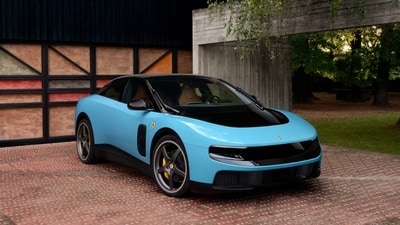
There’s no screaming naturally aspirated V12, no mid-engine supercar proportions and none of the familiar visual aggression typically associated with Maranello. Instead, Ferrari’s first EV is a dramatic four-door, five-seat grand tourer with a clean, almost futuristic silhouette, massive 23-inch front and 24-inch rear wheels, and an ultra-minimal design language developed alongside Sir Jony Ive and Marc Newson’s creative collective, LoveFrom.
Social media reactions have ranged from fascination to fury. Purists have called it “un-Ferrari-like,” questioned its styling and criticised the idea of an electric Ferrari altogether. But perhaps that reaction was inevitable. Every major shift in Ferrari’s history (turbocharging, hybrids, SUVs) has first been met with scepticism before eventually becoming part of the brand’s identity.
And Ferrari knows exactly how bold this moment is.
“Today is a day for celebration,” said John Elkann, Chairman of Ferrari said in an exclusive interaction with HT Auto. “Ferrari Luce is a car of the future and uniquely Ferrari. Ferrari Luce reaffirms what has always defined this company: the courage to redefine the limits of possible.”
That “redefining” is visible everywhere in the Luce. Unlike some legacy automakers that adapted existing platforms for electrification, Ferrari insists the Luce was conceived as an EV from day one. The car sits on an all-new architecture with four independent electric motors, one at each wheel, a 122 kWh structural battery pack and fully active suspension working alongside rear-wheel steering.
The numbers are staggering even by Ferrari standards: 0–100 kmph in 2.5 seconds, 0–200 kmph in 6.8 seconds, over 1,050 hp and a claimed range exceeding 530 km.
But Ferrari’s challenge isn’t simply about building a fast EV. Plenty of brands already do that. The bigger challenge is preserving Ferrari’s emotional identity in a world without combustion soundtracks.
“Ferrari Luce wasn’t adapted to be electric: it was born that way,” said Ferrari’s Chief Product Development Officer, Gianmaria Fulgenzi. “That distinction matters. Starting from a clean sheet gave us the freedom to design an architecture where four independent motors, a battery integrated into the chassis, and perfect weight distribution result in an extremely agile and reactive car.”
Ferrari has even engineered a patented sound system that amplifies vibrations generated by the car’s mechanical components to create what it calls an “authentic and functional” sound experience. Whether enthusiasts accept that as a worthy replacement for a V8 or V12 remains to be seen.
What’s particularly interesting, however, is how Ferrari is positioning the Luce. This isn’t being presented as a replacement for its petrol-powered supercars, but as an expansion of the Ferrari universe itself.
“Ferrari Luce is a new phase for Ferrari,” said Enrico Galliera, Chief Marketing & Commercial Officer. “It was born to offer new emotion to existing owners, opening the door to entirely new audiences. Ferrari Luce is unique because it combines worlds that have never existed in one car before: supercar performance, extraordinary comfort, and genuine everyday space.”
That positioning could become especially relevant in markets like India.
India’s premium EV segment is growing rapidly, with brands like Mercedes-Benz and BMW currently dominating the luxury electric space through high-end electrified products. Buyers at the top end of the market are increasingly warming up to EVs, not necessarily as replacements for enthusiast cars, but as high-tech luxury statements.
And HT Auto has exclusively learnt that Ferrari plans to bring the Luce to India in the future.
That move could significantly alter the perception of luxury EVs in the country. Until now, performance EVs in India have largely been associated with German luxury brands or niche startups. A Ferrari EV arriving on Indian roads would instantly elevate the category’s aspirational value.
Still, Ferrari’s biggest challenge may not be engineering, performance or even pricing. It may simply be convincing traditionalists that this is still a Ferrari.
The irony, though, is that Ferrari has always evolved by challenging conventions. The brand once moved from naturally aspirated engines to turbocharged powertrains, introduced hybrid technology with the LaFerrari and even launched the Purosangue SUV, all controversial decisions at the time.
Now, it is stepping into an even more uncertain future.
And while the internet debates whether the Luce “looks like a Ferrari,” Ferrari itself seems more interested in answering a bigger question: what should a Ferrari of the future actually be?