
5 min readNew DelhiDec 24, 2025 06:47 PM IST
At first glance, Pluribus looks deceptively familiar. There’s a strange outbreak, an altered world, and a sense that normal life has quietly slipped out of reach. For a moment, it feels like it could be another zombie allegory, or an alien-invasion riff dressed up in prestige television grammar. But that assumption doesn’t last long. The series, created by Vince Gilligan, the mind behind Breaking Bad and Better Call Saul, has little interest in spectacle for its own sake. What Pluribus really wants is to sit with discomfort, and to see how long you’re willing to stay there with it.
Released on Apple TV+, a platform that’s already had a remarkable year with shows like Severance and The Studio, Pluribus feels very much in conversation with the streamer’s broader identity: cerebral, patient, and quietly ambitious. Yet Gilligan’s new series carves its own space. The premise, an inexplicable phenomenon that alters humanity’s emotional and social fabric, unfolds not as a race to survival, but as a slow, unsettling recalibration of what it means to exist in a changed world.
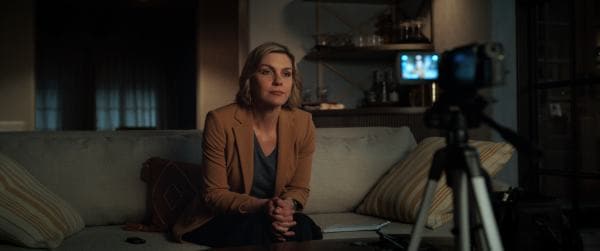
At the centre of this recalibration is Carol Sturka, played by Rhea Seehorn, who once again proves how powerful restraint can be on screen. Best known for her work on Better Call Saul, Seehorn brings a similar internalised intensity here, but the context is entirely different. Carol is not fighting criminals or systems; she is fighting a world that seems to have moved on and left her behind. The story is largely filtered through her perspective, allowing the show to remain minimal in both characters and plotlines. This is not a sprawling ensemble drama. Instead, the first season prefers to let you walk through this altered reality step by step, absorbing it the way Carol does, uneasily, cautiously, and often in silence.
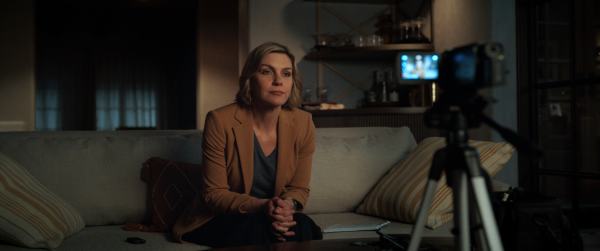 A still from Vince Gilligan’s new series Pluribus
Pluribus unfolds in a non-linear fashion. The first image it offers is almost clinical: astronomers intercepting a strange signal from space, one that doesn’t resemble language so much as a biological instruction. The signal is eventually decoded as a viral RNA sequence. Scientists, doing what scientists do, try to run tests in a lab. A year later, something goes wrong, a quiet breach that spreads faster than anyone can react.
By the time the story narrows its focus to Carol, the damage has already begun. A romance novelist returning to Albuquerque after a book tour with her partner and manager, Helen, Carol finds herself at the wrong place at the wrong time. An aerosol release passes almost unnoticed, until it isn’t. People around her begin to convulse, then change. The shift is abrupt, deeply unsettling, and oddly bloodless. The world doesn’t descend into chaos; it simply… recalibrates.
Carol is among a tiny group, just 13 people globally, who remain unaffected by what comes to be known as the Joining. The rest of humanity becomes something else entirely: a collective consciousness calling itself the Others. They are calm. They are cooperative. They are, in many ways, happier than before. That minimalism is both Pluribus’ greatest strength and its most divisive quality. The show is a deliberate slow burn, sometimes to the point of testing your patience. At times, it almost seems like the show wants to get on your nerves, daring you to either tune out or lean in closer.
As the season progresses, Pluribus subtly shifts shape. What begins as a singular character study gradually opens up, briefly flirting with the idea of becoming a dual-protagonist narrative. Even then, the balance never truly wavers. Seehorn remains the gravitational centre of the series, Her performance anchors the show during moments when the storytelling feels intentionally sparse, ensuring that emotional engagement never completely slips away.
Story continues below this ad
Pluribus trailer:
Perhaps the most resonant idea Pluribus explores is the necessity of human connection. The series gently dismantles the fantasy of total self-sufficiency, the belief that one can have everything and still be content alone. Again and again, it circles back to the same quiet truth: no matter how complete a life may appear on paper, meaning often emerges only when there is someone else to share it with. In a world that promises peace, harmony, and even happiness, Pluribus asks a deceptively simple question: what are those things worth if they come at the cost of intimacy?
By the time the season draws to a close, Pluribus has not reinvented science fiction, nor does it try to. What it offers instead is something more intimate and more unsettling, a series that uses genre as a lens rather than a crutch. It won’t work for everyone, and it doesn’t try to. But for viewers willing to surrender to its rhythm, Pluribus reveals itself as a thoughtful, quietly provocative meditation on loneliness, connection, and the uneasy comfort of belonging.
Pluribus
Pluribus Cast – Rhea Seehorn, Karolina Wydra, Carlos-Manuel Vesga, Miriam Shor
Pluribus Directors – Vince Gilligan, Gordon Smith, Melissa Bernstein
Pluribus Rating – 3.5/5


Click here to follow Screen Digital on YouTube and stay updated with the latest from the world of cinema.
© IE Online Media Services Pvt Ltd