
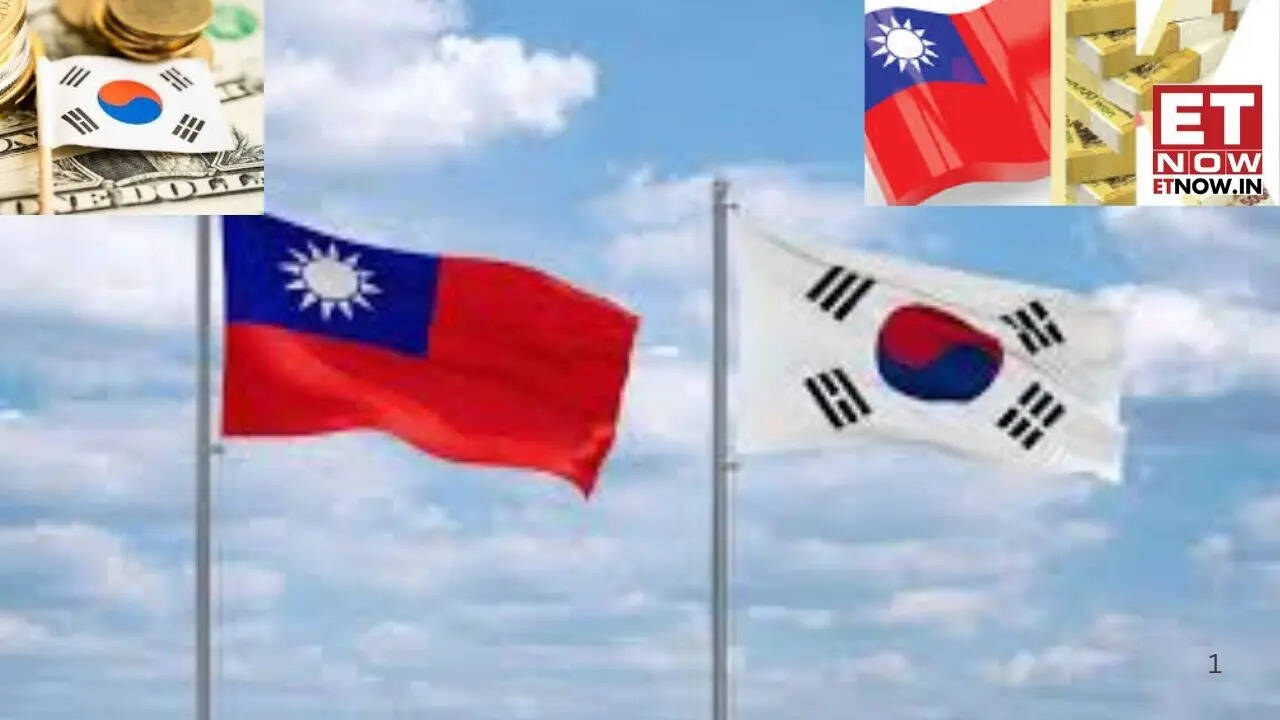
South Korea and Taiwan are pulling ahead of India in global stock market rankings, thanks to a powerful rally driven by a small group of big technology companies that make chips and AI hardware. Foreign investors are moving billions of dollars into those two Asian markets and selling Indian stocks at the same time.
How much Taiwan’s market grow?
Taiwan’s total stock market value has grown by about 54 per cent in 2026 so far, while South Korea’s market has jumped by around 81 per cent. In contrast, India’s market cap has shrunk by nearly 7 per cent since the start of the year. Taiwan now sits close to India in total market size and is on track to overtake it, while South Korea is rising fast as well.
The trend began early in 2026, as the global artificial intelligence (AI) boom accelerated. Foreign investors started shifting money out of India in large numbers from January, and the outflow has continued through May. By May 27, FPIs had sold Indian equities worth USD 24.3 billion (about Rs 2.3 lakh crore), which is more than their total outflow in all of 2025.
The phenomenon is happening across major Asian stock markets: the Taiwan Stock Exchange, the Korea Exchange (KOSPI), and India’s National Stock Exchange and Bombay Stock Exchange. The money is flowing from India toward East Asian markets that are directly linked to the AI supply chain.
The main reason is that Taiwan and South Korea are home to the most important companies that make chips and memory used in AI systems. TSMC alone makes up nearly 38 per cent of Taiwan’s total market cap of about USD 5 trillion. In South Korea, Samsung and SK Hynix together account for 46 per cent of the country’s USD 4.8 trillion market cap. The top 10 stocks in Taiwan and South Korea make up more than half of their total market value.
India’s market is much more spread out. Its top three companies, Reliance, HDFC Bank and Bharti Airtel each have a market value above USD 100 billion, but together they add up to only about 9 per cent of India’s USD 4.9 trillion market cap. The top 10 Indian stocks account for just over 18 per cent. None of India’s top 10 stocks has given a positive return so far in 2026.
Foreign investors are chasing AI-driven earnings and prefer markets with strong exposure to tech hardware. India, by contrast, has little direct exposure to the chip and AI hardware boom. Analysts say this “negative exposure” may continue for one to three years.
How is this affecting investors and markets?
Taiwan’s market cap has climbed to around USD 4.95 trillion, while India’s has fallen to about USD 4.92 trillion, according to Bloomberg’s report. South Korea’s market cap is near USD 4.8 trillion and rising. India’s weight in the MSCI Emerging Markets index has dropped sharply, from about 19 per cent last year to around 12 per cent now.
South Korea has about 2,730 actively traded stocks, and Taiwan has 2,437. India has more than 6,186 actively traded stocks, showing a deeper and more diversified capital market. However, that depth is not helping in the current AI-driven rally, which favors concentrated tech-heavy markets.
Analysts warn that unless India builds stronger ties to the global AI and semiconductor chain, foreign money may stay away for some time. The current pattern shows a clear shift: big tech is giving South Korea and Taiwan the edge over India in the global market race.