
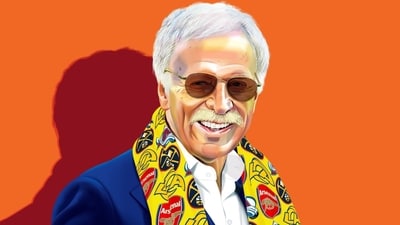
Stan Kroenke was sitting in the back of a conference room full of other NFL owners this month when he stealthily pulled out an iPad to watch the other kind of football.
He was in Orlando, ostensibly listening to Roger Goodell, in his capacity as the owner of the Los Angeles Rams. But at that moment, he was far more concerned with goings-on 4,000 miles away that affected Arsenal, the storied North London soccer club that had been in his portfolio for nearly two decades.
Surrounded by a couple of top lieutenants, Kroenke watched in amazement as Bournemouth mathematically eliminated powerhouse Manchester City from contention. After a 22-year wait, Arsenal were champions again.
For Arsenal fans, it was an overdue moment of euphoria—despite once holding protests against Kroenke outside their own stadium. And for Kroenke, it was just the latest title in what might be the greatest global run by any owner in sports.
“It was extremely emotional,” Kroenke said in a rare interview. “I don’t think we can do these things without emotion, without a deep belief.”
Over the past five years, that belief has helped the 70-year-old Kroenke conquer nearly all of the richest and most popular leagues in sports. His Rams, Denver Nuggets (NBA) and Colorado Avalanche (NHL) had all won championships before Arsenal joined the bunch. Arsenal’s women’s side and Kroenke’s pro lacrosse team, the Colorado Mammoth, had recently taken home major trophies, too.
And Kroenke might not be done. If Arsenal beats Paris Saint-Germain in Saturday’s Champions League final, the club won’t just be on top of England. It will be crowned champion of all of Europe—a scenario few could have imagined in the late 2010s when Arsenal supporters mounted a “Kroenke Out” campaign behind the slogan, “We care, do you?”
“We know the relationship that was with the ownership at that time,” Arsenal manager Mikel Arteta says. “For me, this is one of the biggest wins that we had.”
Kroenke, whose tenures have yielded as much controversy as success, does his best to stay out of the spotlight. Yet those who work around him say that shouldn’t be confused with apathy. Instead, they say, he plans for the long haul in an industry that demands instant gratification by giving sweeping powers to those he personally selects, from savvy executives to previously untested head coaches, like Arteta or the Rams’ Sean McVay.
“He’s very consistent: he’s going to really have significant ambition, a significant picture of where he wants to go,” says Dallas Cowboys owner Jerry Jones. “And boy, when he does it, it’s substantive.”
The success also marks an extraordinary turnaround for an investor who was better known for the rare feat of enraging constituencies on both sides of the Atlantic.
In the NFL, he upset fans in his home state of Missouri by moving the Rams to Los Angeles in 2016 after a contentious relocation process within the league. Subsequent litigation with St. Louis authorities over the move resulted in a $790 million settlement, which in turn roiled other NFL owners over who would foot the bill. Kroenke eventually agreed to pay more than $500 million of it. He spent 10 times as much to build the state-of-the-art Sofi Stadium in Los Angeles.
“He had a very expensive go of it within the NFL. He took that standing up,” Jones says. “Out of all of that came really one of the shining stars of the NFL.”
Over in Europe, he was pilloried for acting too slowly to move on from Arsenal’s longtime manager Arsene Wenger in 2018 and accused of reaping profits from the team without making a meaningful investment. Later, in 2021, he drew the ire of supporters who hanged him in effigy for participating in the failed European Super League project—a cash grab that would have seen the game’s elite clubs form a breakaway competition.
And through it all, Kroenke said next to nothing in public. Critics dubbed him “Silent Stan.”
“If you’re going to let those things deter you when you think you’re doing what’s right for your organization and your view of the world,” Kroenke says, “that would never get you very far.”
Before he was an international sports mogul, he was Enos Stanley Kroenke from rural Missouri with sporting heritage scrawled right on his birth certificate—his namesakes were St. Louis Cardinals legends Enos Slaughter and Stan Musial. Kroenke went on to make a fortune in real estate and marry Ann Walton, a Walmart heiress, before diving into sports. He began with a minority stake in the St. Louis Rams in 1995.
At the same time, he was also acquiring vast tracts of land. The only thing he might be just as passionate about as sports, it turns out, is ranching. After buying up 937,000 acres in New Mexico last year, or 1.2% of America’s fifth-largest state, he brought his holdings to 2.7 million acres across the country—the equivalent of about two million football fields. He’s believed to be the largest private land owner in the U.S.
“He is the most long-term thinker I’ve ever been around,” says Kevin Demoff, president of team operations for Kroenke Sports and Entertainment, his umbrella company. “That comes from his real estate background. You invest in something, you build it and give it time.”
That patient approach underpinned every decision he has made in his three decades in sports. With the Rams, Kroenke had the conviction to stick with general manager Les Snead through lean seasons before they landed on one of the boldest hires the game had ever seen. When they hired McVay in 2017, he became the youngest head coach in modern NFL history.
It wasn’t long after their final interview, held over dinner at Spago in Beverly Hills, that Kroenke understood he’d hit the jackpot. In McVay’s first season, the Rams’ offense went from worst to first. Since then, they have reached two Super Bowls and lifted the Lombardi Trophy four years ago at SoFi.
“He’s not afraid to step outside the box if he believes in it,” McVay says. “Great leadership takes courage, and he certainly has a bunch of that.”
It took more than that to shepherd Arsenal through its most turbulent spell in a generation. When Kroenke nudged Wenger toward the door in 2018, ending his 22-year reign at the club, he was also pushing out two decades of deep roots and institutional knowledge. So Kroenke’s next hire, Unai Emery, was almost doomed from the start. He lasted just 18 months.
The easy thing then would have been to play it safe and hire a big name from the glittering ranks of unemployed managers. Instead, Kroenke and his son Josh opted for something else entirely: Arteta was a 37-year-old former Arsenal midfielder who had been cutting his teeth as an assistant coach at Manchester City.
“To turn around a squad normally takes four years,” says Arteta, now 44. “And we didn’t have that time. So we had to reinvent the manner that we were going to do it.”
During that time, Kroenke not only stuck with Arteta through three consecutive finishes outside the Premier League’s top four. He also spent over $1.25 billion on new talent for the squad. The result was a perennial contender led by a man whose 6.5 years in charge make him the longest tenured manager in England’s top division.
“That’s very, very, very rare to find in our industry,” Arteta says.
Kroenke believes it helps that having a broad portfolio of teams helps the entire network, because he encounters “similar problems across leagues and similar opportunities” even in entirely different sports. Most of them begin and end with culture. Which is why Kroenke has encouraged interconnectedness between them, with the same executives, including Josh Kroenke, spread across several franchises.
McVay has made the most of those connections, too. He says that learning from other sports has made him a better coach and even considers Arteta a good friend.
“It’s a definite edge,” McVay says. “There is no question.”
With a chance to add to his trophy case on Saturday, Kroenke won’t be sweating this outcome on a hand-held device. He’s already in Budapest, which is hosting the final.
Whichever way it goes, the Kroenkes have learned that the thrill of success can be fleeting.
“We always say you’re only as good as your last game or your last match,” Josh Kroenke says. “If you’re not finishing at the top in a championship, you’re immediately back to the drawing board trying to figure out how to get there again.”
Write to Andrew Beaton at andrew.beaton@wsj.com and Joshua Robinson at Joshua.Robinson@wsj.com