
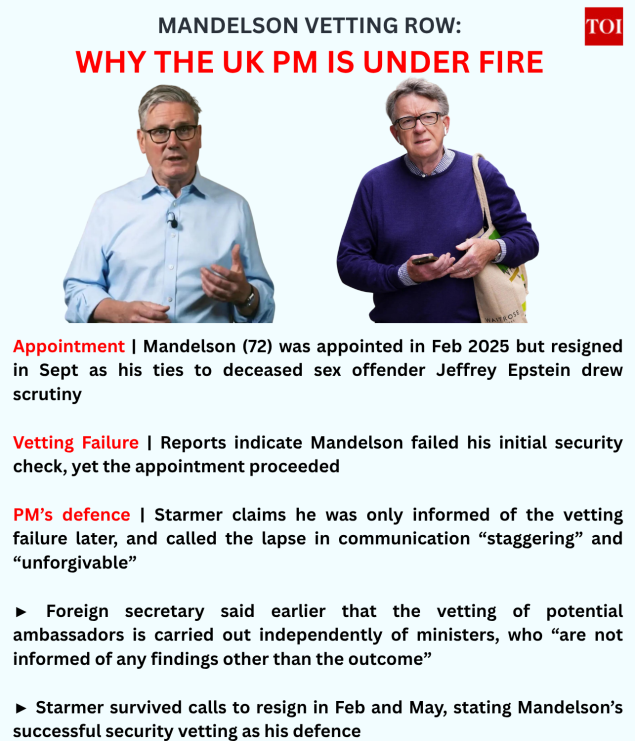
There is a number haunting British politics right now and, oddly enough, it is six and seven (yes like the viral 6-7 meme). Last November, Keir Starmer visited Welland Academy in Peterborough to speak about free school meals when a pupil pointed out they were on page 67 of their workbook. Starmer flashed the now-viral “67” hand gesture, the classroom burst into laughter, and a teacher jokingly told him off. As he walked out, the prime minister grinned and said, “I didn’t start it, Miss.” Six months later, he is saying much the same thing about the crisis now threatening his premiership. The numbers, however, are becoming harder to laugh off. If Starmer falls and Labour installs a successor without a general election, Britain will have had six prime ministers in seven years. In most democracies, that would be considered an extraordinary period of instability. In modern Britain, it is beginning to feel routine. David Cameron gambled on a Brexit referendum and lost his office. Theresa May tried to implement Brexit and failed. Boris Johnson delivered it, only to collapse under the weight of scandal and dysfunction. Liz Truss survived just 44 days before the markets effectively ended her premiership. Rishi Sunak inherited the wreckage and was swept aside in a landslide. Now Starmer, elected as the calm corrective to years of Conservative chaos, finds himself trapped in the same cycle. The warning signs are already flashing. More than 70 Labour MPs have reportedly demanded either Starmer’s resignation or a clear timetable for his departure, a BBC report noted. Labour has lost over 30 councils in local elections. Senior resignations have rattled Downing Street. And the betting markets are turning increasingly brutal. On Polymarket, traders currently place the chances of Starmer leaving office before the end of July at nearly 40 per cent. By the end of 2026, the probability rises to around 70 per cent. Prediction markets are not destiny, but they are often a useful measure of political confidence. Right now, confidence in Starmer’s survival appears to be draining fast. The more important question, however, is why Britain keeps producing leaders who rise promising stability and leave consumed by crisis.
Why is Starmer under fire?
The immediate trigger for Starmer’s crisis is a scandal that has all the ingredients of a political thriller. His appointment of Peter Mandelson as British ambassador to Washington unravelled spectacularly after it emerged that Mandelson had failed security vetting in January 2025, only for his posting to go ahead anyway after the Foreign Office overruled that decision. Mandelson’s links to the late sex offender Jeffrey Epstein then became public, and what followed was a cascade of exits. Starmer’s chief of staff Morgan McSweeney resigned. His communications director resigned. A cabinet minister, Health Secretary Wes Streeting, resigned. By mid-May 2026, over 95 Labour MPs had called on Starmer to resign or at least set out a timetable for his departure.
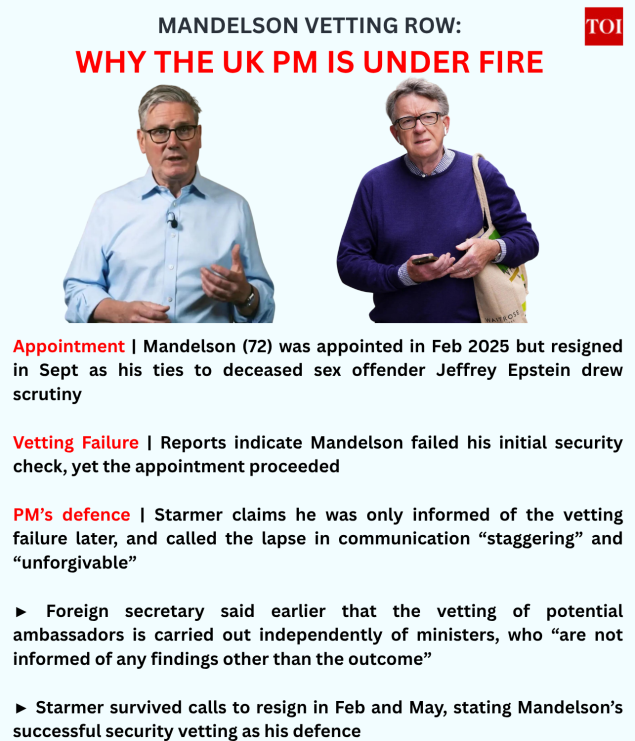
The revolving door
To understand where Starmer finds himself, it helps to look at what happened to those who came before him.Theresa May inherited an impossible assignment. She took office in 2016 after David Cameron resigned having lost the very Brexit referendum he had called, a gamble that cost him his job and, arguably, set off the chain reaction that still has not stopped. May was tasked with delivering a Brexit she had privately opposed, negotiating a withdrawal deal with Brussels and then selling it to a parliament that did not want it. She failed three times to get her deal through the House of Commons, a record humiliation, and resigned in July 2019 in tears, acknowledging that she had been unable to deliver on the central promise of her tenure.Boris Johnson replaced her and did, by his own definition, “get Brexit done.” He also won a massive majority in the 2019 election by reshaping the Conservative coalition, pulling in working-class voters in the English Midlands and North who had never voted Tory before. For a time, it looked like Johnson might actually be the man to stabilise things. Then came the pandemic, the Downing Street parties during lockdown, the mounting evidence of a culture of rules-for-thee-but-not-for-me at the top of government. Ministers resigned en masse. The weight of scandal became too much even for his own MPs and he was defenestrated by his own party in July 2022, departing with a characteristically theatrical farewell speech.
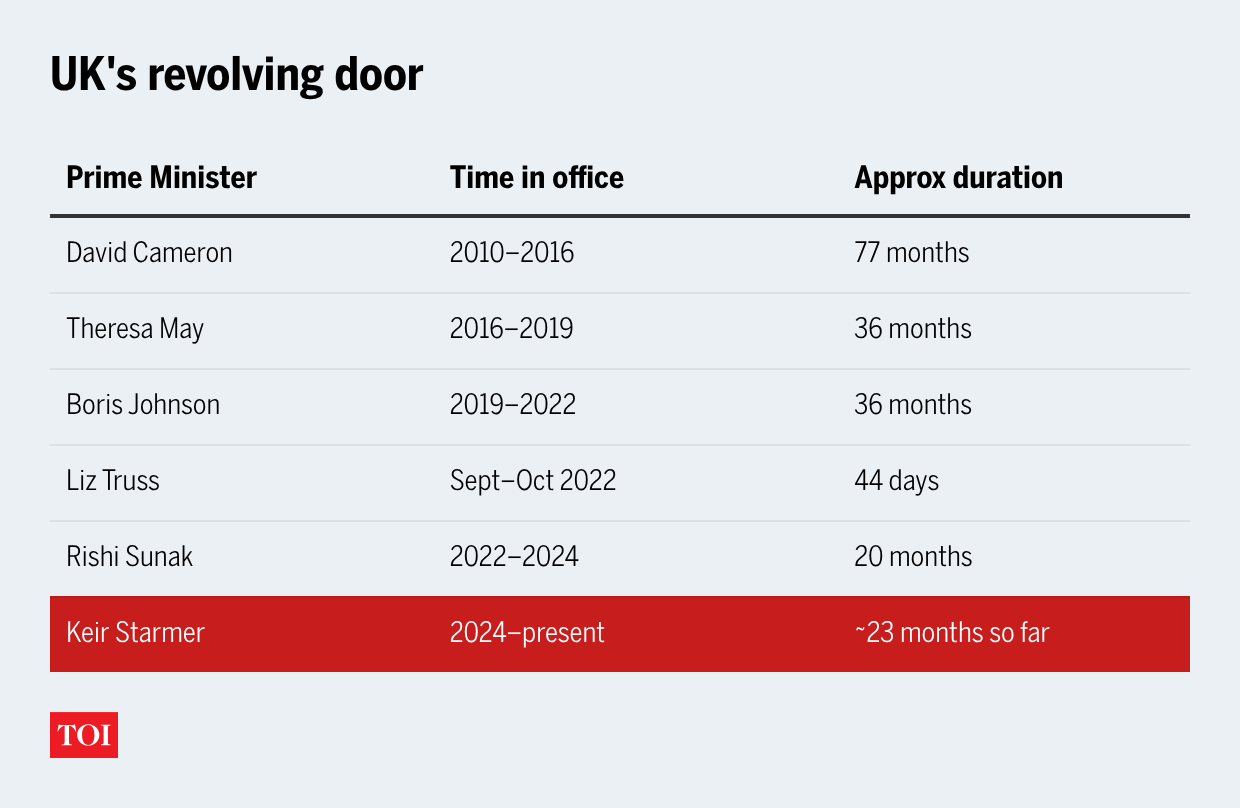
Liz Truss lasted 44 days. Her mini-budget in September 2022, packed with unfunded tax cuts and delivered without even a basic assessment from the Office for Budget Responsibility, sent the pound into a tailspin and UK mortgage rates surging. Financial markets essentially rejected a sitting British government in real time. Truss sacked her own chancellor, reversed nearly every measure she had just announced, and then resigned anyway, making her the shortest-serving prime minister in British history.Rishi Sunak was supposed to be the grown-up who cleaned up the mess. He was intelligent, economically literate, and he did manage to bring inflation back down. But he never managed to shake the sense that he had been handed the keys to a burning house. He made five pledges, kept two of them, and watched the others crumble. He called a snap election in May 2024 in the rain, drowned out by a protester blasting “Things Can Only Get Better,” and lost to Starmer’s Labour Party in one of the most crushing electoral defeats in Conservative history.And then came Starmer, the forensic barrister and former Director of Public Prosecutions, who was supposed to represent a different kind of politics entirely. Serious, methodical, not flashy. He won in a landslide. Less than two years later, his own cabinet ministers are resigning and his own backbenchers are demanding he go.
The common thread
Look at all five exits and a pattern begins to emerge. It is not simply incompetence, though there has been some of that. It is something deeper: the consistent failure to match what was promised with what was delivered, in a political environment that has become almost uniquely unforgiving.Cameron promised a referendum as a way to settle the European question in the Conservative Party. It did the opposite. May promised to deliver Brexit. She could not. Johnson promised to govern with integrity after getting Brexit done. He did not. Truss promised economic growth through deregulation and tax cuts. She got market chaos instead. Sunak promised to restore stability and trust. He oversaw the continued decline of public services while failing to make a persuasive case for why any of it was worth enduring.So what is causing the mass resignation? Party loyalty, which used to give PMs a cushion of time in which to manage a crisis, has eroded dramatically. The British political system was designed for an era of stronger party discipline. When backbenchers decide the leader is a liability, there is now very little to stop them saying so publicly, immediately, and loudly. That is not entirely new, but the speed and co-ordination of modern political rebellions is something different.
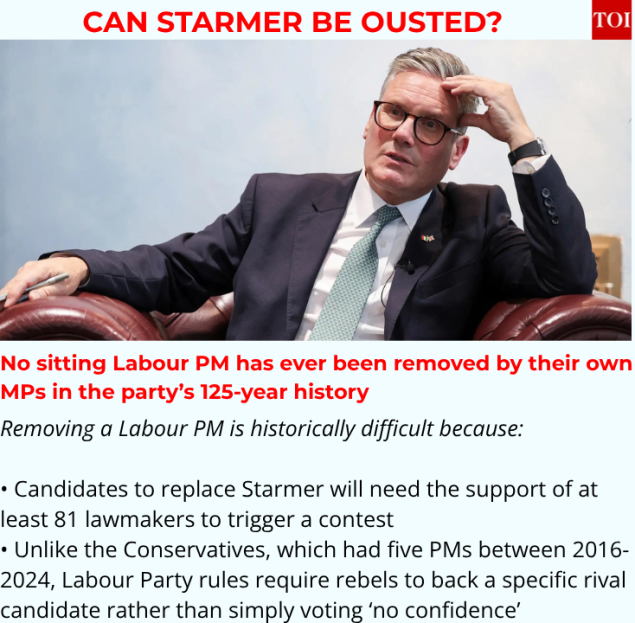
Can they be removed relatively easily? There is also a structural problem with the way the British system concentrates power without necessarily providing stability. Prime ministers can be removed by their own parties without a general election. They can be removed at extraordinary speed. Truss’s 44 days makes the point almost absurdly. A system designed to be decisive and flexible has, in this period, been decisive mainly about ejecting leaders.Starmer’s specific failure is also worth examining on its own terms. His government cut the winter fuel allowance in the middle of a cost-of-living crisis. It struggled to articulate a clear position on Gaza. And then the Mandelson affair confirmed, for many Labour MPs, a pattern of poor judgement at the top. The fact that Starmer was reportedly warned about the reputational risks of the Mandelson appointment before proceeding made it worse.
The Brexit hangover that will not end
No serious account of this period of British political instability can avoid Brexit. It is the originating event. It is the wound that has not healed.The 2016 referendum did not just cause David Cameron’s resignation. It restructured British politics in ways that made stable government structurally harder to achieve. It split both major parties. It elevated a class of politicians, primarily on the Conservative side, who had built careers on opposition and critique rather than on the harder work of governing. It created a set of promises, from the famous £350 million a week for the NHS to a bonfire of red tape and a trade deal bonanza, that could not be honoured because they were not based in reality.
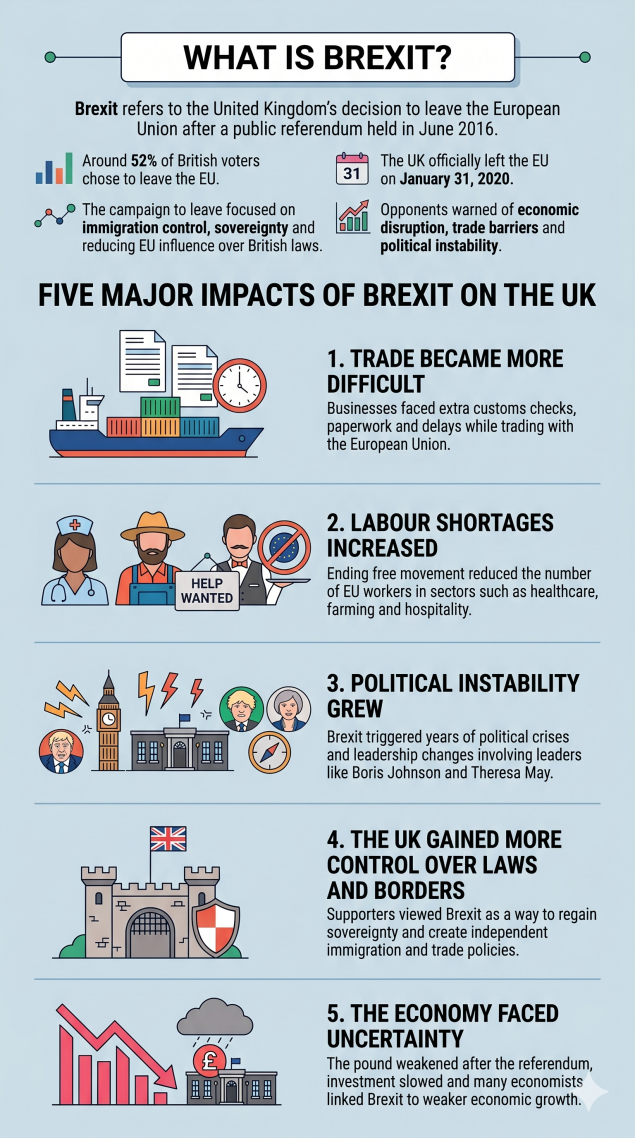
Since the referendum, successive governments have failed to deliver a coherent post-EU strategy. The promises made during the Leave campaign largely did not materialise. The NHS still faces severe staff shortages, partly exacerbated by the loss of EU workers. Businesses face more red tape in trade and immigration than they did before. Northern Ireland’s governance remains complicated by trade arrangements that Brexit created. Rather than the liberated, globally confident Britain that Leave campaigners described, the country has spent nearly a decade managing the costs and contradictions of a decision that was made with far too little thought about its practical consequences.The Conservative Party’s particular tragedy is that it was torn apart by Brexit and then forced to govern through its aftermath. May, Johnson, Truss, and Sunak were all, in different ways, unable to square the contradictions of Brexit. May failed to get it done. Johnson got it done but then governed chaotically. Truss tried to use the notional freedoms of Brexit to run a deregulated economy and was punished by the markets. Sunak, a Brexiteer leading a party that still wanted credit for the project, could not limit its damage without seeming to disown it.Brexit did not just unseat prime ministers directly. It degraded the quality of British political leadership across a generation.
Is there a way out?
When Britain used to rule the seas, there was a saying that the sun never set on the British Empire. It was meant to reflect power, stability, and the idea that Britain was one of the few countries capable of shaping the world around it. Today, the phrase feels almost ironic. Modern Britain is no longer struggling to manage an empire. It is struggling to manage political stability at home.Since the Brexit referendum, Downing Street has become a revolving door. Prime ministers arrive promising stability and renewal, only to leave weakened by crisis, scandal, rebellion, or simple public exhaustion. The problem is no longer just about individual leaders. It is about a political system that increasingly seems unable to sustain authority for very long.Perhaps that is the real story of modern Britain. Not simply that leaders keep failing, but that the political system itself has become addicted to crisis. The sun may no longer set on the old empire, but in modern Westminster, it barely seems to rise before another prime minister is already fighting for survival.