
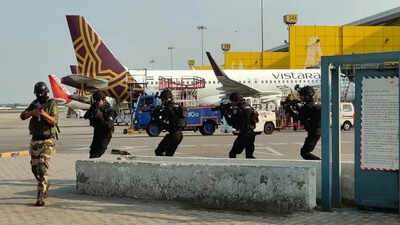
NEW DELHI: With drones emerging as a prime source of low-altitude threats at sensitive airports, particularly in J&K and Punjab, the CISF, which guards 72 airports across the country, has tied up with the Indian Army to equip its personnel with advanced capabilities to detect, track and neutralise hostile unmanned aerial systems (UAVs). Simultaneously, 659 personnel from its specialised aviation security group have undergone rigorous ‘military-grade battle inoculation training’ to prepare for quick response teams (QRTs) to be deployed at all CISF-protected airports by the year-end.The progress of the counter-drone training programme and the battle inoculation training for airport QRTs was reviewed at an operational review for the CISF’s north sector and airport sector, chaired by CISF DG Praveer Ranjan in Chandigarh on Friday. The meeting took stock of the progression of key technological and operational upgrades across the commercial airports under CISF protection. Discussions centred on reinforcing perimeter security at airports, upgrading surveillance networks and adopting next-generation screening tools, including full body scanners, to maintain world-class aviation security standards.Senior officers and commanders of various CISF units participated in the meeting, which saw detailed discussions on strengthening security preparedness, enhancing response capabilities through better inter-agency coordination, and the adoption of advanced technologies for the protection of critical infrastructure and civil aviation installations.Addressing the commanders, the DG said: “CISF remains fully committed to ensuring the safety and security of the nation’s critical infrastructure and providing a secure environment for citizens through proactive, technology-driven, and responsive security measures.”With Operation Sindoor having exposed the threat of drone intrusions from across the western border, the review focused on ensuring effective counter-response in strategically sensitive regions like J&K, Punjab, Rajasthan, Haryana and Gujarat. Emphasis was also laid on strengthening preparedness against sabotage and disasters.The meeting reviewed joint training initiatives being undertaken with the Indian Army and other agencies in the areas of counter-terrorism, quick reaction response and disaster management.Initiatives to modernise the aviation sector with key technological and operational upgrades across the commercial airports under its protection were discussed. A review was taken on the ongoing trial of full-body scanners at Delhi, Bengaluru, Hyderabad and Kochi airports. The three-month trial report will be shared with the Bureau of Civil Aviation Security (BCAS), which is likely to recommend the installation of FBS across all airports with footfall of over 5 million passengers per annum.CISF is also set to roll out the 2-D barcode reader system, which will help scan/track airport staff with a barcode and CCTV camera as they move within airport premises and pinpoint any unauthorised access to critical terminal zones.