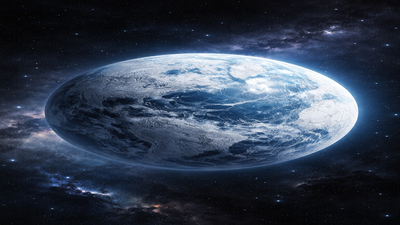
The discovery of what existed before what we consider modern-day matter has led scientists to change their view of cosmology from an explosion to one of looking at it as if it were made up of a primordial liquid. MIT physicists, along with the CMS Collaboration at CERN, were able to publish a groundbreaking study in Physics Letters B (2025) identifying the universe’s original state as a Quark-Gluon Plasma (QGP). The use of rare Z bosons as silent tags in high-energy lead-ion collisions allowed researchers to observe for the first time the presence of a wake or physical ripple created by one quark passing through this state. The observation of this fluid-like response indicates that the early universe could be characterised as a perfect liquid with very little to no friction, which provides us with the best evidence to date for this very strange state of matter; the same state of matter that existed in the Universe within microseconds of the beginning of our cosmos.
Scientists recreate the Big Bang ’s ‘primordial soup’ and reveal its true nature
Directly after the Big Bang, the universe experienced an immense amount of energy that would have made it impossible for normal atoms to form. Instead, the universe was filled with a burning primordial soup called quark-gluon plasma, which had a temperature greater than a trillion degrees. Researchers at CERN have used high-energy collisions created by colliding lead ions at almost the speed of light to recreate this unusual form of matter. The researchers from MIT have recently confirmed that this quark-gluon plasma behaves as nearly a perfect, frictionless liquid that is much smoother than any substance known to be found on Earth.
The ‘wake-tag’ technique
In the past, it has been very difficult to see how this primordial plasma behaved with individual particles due to the tremendous amount of ‘subatomic mess’ that results from high-energy collisions. To solve the problem, the CMS collaboration at CERN developed an innovative method called ‘wake-tag’ with the Z boson; this is a massive but electrically neutral particle that can pass through the quark-gluon plasma without interacting with it. With the Z boson acting as a fixed reference point, the physicists were able to identify the V-shape wake (or physical ripple) that was created by a high-energy quark moving in the opposite direction of the Z boson.
Beyond the Big Bang, evidence of what existed before everything
This groundbreaking finding validates the first real-world example of the ‘Hybrid Model’ of the Universe, an equation developed at the Massachusetts Institute of Technology, created by Krishna Rajagopal. The research supports those cosmological theories that consider the early universe may have undergone a phase similar to a ‘perfect liquid’ before it became what we refer to today as the Universe. The researchers have recorded a distinct evidence signature of a ‘negative wake,’ confirming the nature of the primordial liquid that existed before everything- stars, planets, and even atoms- had stabilised.