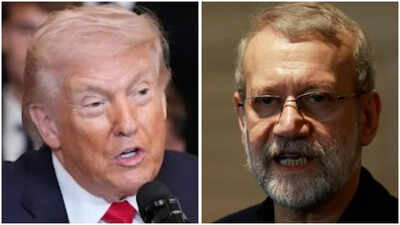
A senior Iranian security official issued a sharp warning to US President Donald Trump on Tuesday, dismissing his threats against Iran and cautioning him to “be careful not to get eliminated yourself”.Ali Larijani posted the message on X after Trump warned that the United States would hit Iran “twenty times harder” if Tehran disrupted oil flows through the Strait of Hormuz.
“The sacrificial nation of Iran doesn’t fear your empty threats. Even those bigger than you couldn’t eliminate Iran. Be careful not to get eliminated yourself,” Larijani wrote.“Iran is not afraid of your empty threats. Even those greater than you could not eliminate the Iranian nation,” he added in a separate message.In another post, he wrote, “Strait of Hormuz will either be a Strait of peace and prosperity for all or will be a Strait of defeat and suffering for warmongers.”The exchange marks the latest escalation in the war that erupted after the United States and Israel launched strikes on Iran on February 28, killing the country’s Supreme Leader Ali Khamenei and triggering a wider regional conflict.
Iran intensifies regional attacks
Iran continued its military pressure across the Middle East on Tuesday, launching missile and drone attacks against Israel and several Gulf countries, reported news agency AP.Sirens warning of incoming missiles were heard in Dubai, while authorities in Bahrain said an Iranian strike hit a residential building in the capital, killing a 29-year-old woman and injuring eight others.Saudi Arabia said it intercepted two drones over its oil-rich eastern region, while Kuwait’s National Guard reported shooting down six drones.In Israel, air-raid sirens sounded in Jerusalem and explosions were heard in Tel Aviv as Israeli defence systems attempted to intercept incoming missiles, AP reported.Iran’s parliament speaker Mohammad Bagher Qalibaf signalled that Tehran was not seeking to end the conflict.“We are definitely not looking for a ceasefire,” Qalibaf wrote on X. “We believe that the aggressor should be punched in the mouth so that he learns a lesson so that he will never think of attacking our beloved Iran again.”
Strait of Hormuz disruption fuels oil fears
The conflict has also triggered major disruptions to global energy supplies.Iran has targeted shipping and energy infrastructure around the Strait of Hormuz, a critical waterway linking the Persian Gulf to the Gulf of Oman through which about 20 per cent of the world’s traded oil normally passes.Iran’s paramilitary Revolutionary Guard said it would not allow “the export of even a single liter of oil from the region to the hostile side and its partners until further notice,” according to AP.Attacks on merchant vessels near the strait have killed at least seven sailors, the International Maritime Organization said.The disruption has already pushed oil prices sharply higher. Brent crude surged to nearly $120 a barrel earlier this week before easing to around $90 on Tuesday, still about 24 per cent higher than before the war began on February 28, AP reported.
Trump warns of harsher US retaliation
Trump earlier warned that the United States would retaliate strongly if Iran attempted to block oil shipments through the Strait of Hormuz.“If Iran does anything that stops the flow of Oil within the Strait of Hormuz, they will be hit by the United States of America TWENTY TIMES HARDER than they have been hit thus far,” he wrote on Truth Social.Despite the growing tensions, Trump sought to play down fears that the war could drag on.The US president said the conflict would likely be “a short-term excursion,” although he has previously suggested it could last for a month or longer.Meanwhile, Israeli Prime Minister Benjamin Netanyahu vowed that Israel’s military campaign against Iran would continue.“Our aim is to bring the Iranian people to cast off the yoke of tyranny,” Netanyahu said during a meeting with Israeli health leaders. “There is no doubt that with the actions taken so far, we are breaking their bones,” he said, according to AP.
Conflict spreads across the region
The war has rapidly spread across the Middle East, drawing in multiple countries and armed groups.Israel has carried out attacks on the Iran-backed militant group Hezbollah in Lebanon, while militias aligned with Tehran have targeted US military bases in Iraq.On Tuesday, an airstrike hit the 40th Brigade of Iraq’s Popular Mobilisation Forces in the city of Kirkuk, killing at least five fighters and injuring four, according to officials cited by AP.Elsewhere, five members of Iran’s women’s national football team who were in Australia for a tournament when the war began have been granted asylum, Australia’s Home Affairs Minister said.Since the conflict began, at least 1,230 people have been killed in Iran, 397 in Lebanon and 11 in Israel, while seven US service members have also died, according to AP.