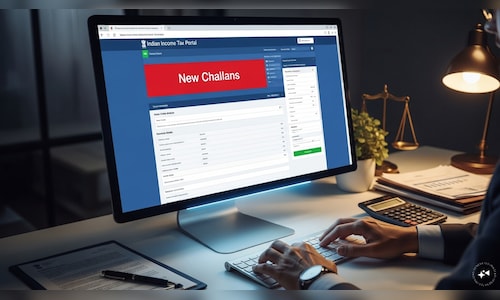
According to Mrinal Mehta, Joint Secretary, BCAS, the revised system aims to simplify tax payments by aligning them with a “Tax Year” (TY) framework and improving backend integration.
The department has rolled out updated challan forms — ITNS 280N, 282N and 288N — replacing earlier formats for payments under the new law.
These new challans, as per Mehta:
- Align with the Tax Year (TY) concept instead of the earlier Assessment Year (AY) system
- Come with simplified fields for easier selection and filing
- Integrate digital features such as CRN (Challan Reference Number) generation for better tracking
Shift to ‘Tax Year’ for new payments
One of the most significant changes is the move from AY to TY for current tax payments.
- Payments linked to income earned from April 1, 2026 onwards must be made under Tax Year 2026–27
- The challan interface now directly reflects this option, reducing confusion for new-period payments
However, the AY system has not been completely removed.
Dual system during transition
Taxpayers will need to navigate both AY and TY depending on the nature of payment:
- For FY 2025–26 (pre-transition income): Use AY 2026–27
- For FY 2026–27 onwards: Use Tax Year 2026–27
For example, self-assessment tax paid in June/July 2026 for FY 2025–26 must still be filed under AY 2026–27, even though the new Act is in force.
No change for old challans and past dues
Existing challans linked to the Income-tax Act, 1961 will continue to be used in specific cases:
- Tax deducted before April 1, 2026 must be deposited using old challans and codes
- Pending tax demands (such as AY 2022–23) must still be paid under the relevant AY
This ensures that legacy transactions remain unaffected by the transition.
Updated section reporting for TDS/TCS
The new challans also require updated legal references for tax deducted or collected:
- Deductors must quote Section 393 (TDS) or Section 394 (TCS) under the 2025 Act
- Use of old sections like 194C, 194J or 194H for post-April 2026 transactions may lead to system validation errors
What it means
The changes are largely structural, focusing on improving the payment framework and reducing complexity through a Tax Year-based system.
As indicated by Mehta, while the new challans and digital integration aim to simplify compliance, taxpayers will need to be mindful of the dual system during the transition to ensure accurate reporting and avoid errors.