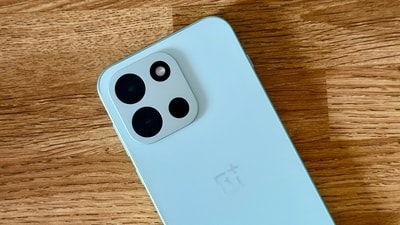
It is time for the next Nord chapter, the journey that began many years ago, in search of the true north for the company. Over the years, this has served OnePlus well in cornering a share of the upper mid-range price bands. The reason is simple—OnePlus managed to find a balance between specs and price, better than some rivals and on par with others. The OnePlus Nord 6, which effectively learns from five generations before it, is imbibing some design cues from the flagship too. If you notice some visual similarities with the OnePlus 15, don’t be surprised. It’s part of the growing up journey for Nord phones.
The OnePlus Nord 6 is priced at ₹38,999 onwards, with the options being 8GB memory and 256GB storage, or 12GB memory with the same amount of storage. The latter is certainly a good option to choose, for an additional ₹3,000 monetary outlay. The choice of the Qualcomm Snapdragon 8s Gen4 chip very much defines the pricing of the new OnePlus Nord 6 with some competition including the Nothing Phone (3) that started out as a flagship last year and still delivers good value (this is now around ₹40,000), as well as the Poco F7 5G (that’s around ₹32,999).
Continuing with the chip discussion in the interim, this silicon sits a notch below flagship chips, and that’s just the ticket for the Nord 6 with its pricing in perspective. Performance is never really a doubt, but the biggest transition you’ll feel is how well thermals have been kept in check—and that aids performance in the longer term as well. OnePlus has done well with the choice of the Snapdragon 8s Gen 4, which has more than a fair advantage in terms of performance over the MediaTek Dimensity 8350 Extreme. It all comes together as apps respond quickly, and the system feels nimble on its feet.
OnePlus wants potential buyers to get a sense of the value from a broader feature set. The 165Hz refresh rate display (and that ties in with the chip choice, for gaming scenarios) is another one of those elements. In terms of overall specs, it is a very similar display real estate to that in the OnePlus 15, including the 6.78-inch AMOLED canvas, 2772 x 1272 resolution and 1800-nits high brightness mode. But this isn’t exactly same in all respects—while the OnePlus 15 was the first Android flagship to support 4K 120fps Dolby Vision video recording and playback, the Nord 6 doesn’t have Dolby Vision (but does support HDR10+).
In my book, the 9000mAh silicon-carbon battery is most likely the reason to buy the OnePlus Nord 6. Rare as it may still be despite efficiency improvements elsewhere, you’ll be looking at the Nord 6’s battery meter and calculating when you need to plug this in for a top-up charge (that itself is quick, at 80-watt wired charging, as well as bypass charging when gaming) in a matter of days, not hours. This is by far the largest battery capacity in a phone in this price band, and that’s equally been made best use of with optimisations across hardware and the Oxygen OS software. In my experience, the Nord 6 responds well enough to last 2 full workday usage scenarios, with still around 15% battery remaining.
Nord cameras, over the previous five generations of this particular device, have leaned more towards likeable, consistent photography. Instead of attempting major quality and processing leaps. OnePlus must have resisted the urge to draw on more of its years of experience with Hasselblad optimisations. In the fork consisting of a 50-megapixel main camera and an 8-megapixel ultra wide camera. And you’d be better off sticking with the 50-megapixel camera for most of your photos, for the sake of better detailing and colours in tricky lighting.
There is a clear sense that the Nord 6 has taken a big step forward as far as image processing algorithms are concerned. This is a combination of the silicon paired support, and the enhanced pipeline additionally. The main sensor has optical image stabilisation (OIS), which has a wholesale positive effect. In terms of what you’ll see, there is a fair amount of detailing to work with if you’re interested in running some photos through the Lightroom or Google Photos edits. Colours are very natural from the outset, and it’s not just about the accuracy, but also look pleasing within the overall frame.
It is not just the camera, but Oxygen OS’ building with a very useful artificial intelligence (AI) suite that helps with editing as well as fixing things rather well. More often than not, AI eraser will derive some value. And if you’re taking portrait photos often, the AI portrait glow will be useful too. One could argue that a lot of this functionality is already part of Google Photos, and why the duplication? There is very much substance to that, though I’d like to point out mileage may vary depending on the composition of photos and your preference of type of results.
The OnePlus Nord 6 is not just well crafted, but also rather ruggedly built. The IP66, IP68, IP69 and IP69K water and dust resistance ratings, as well as the use of the Corning Gorilla Glass Victus+ (that’s another key difference with the OnePlus 15 display), does lend credence to an assumption that the Nord 6 will hold up well in the face of rough usage. There are three distinct colour choices too, with the conventional black inevitably likely to find more takers, but silver and mint colour ways deserve attention too.
I’ve noticed that with every generation of the top-tier Nord phone, OnePlus tries to make a statement of intent. If you see hints of a good old flagship-killer, you’d be on the right path, for the most part.
This has the spec sheet very much on point for the price, and certainly sets a new benchmark with its battery capacity and build specifics. By using a display very, very similar to the flagship OnePlus 15, a user gets a feel of the full premium-esque experience every time they pick up the phone. For a value proposition, the Nord 6 also does the sensibility thing very well.