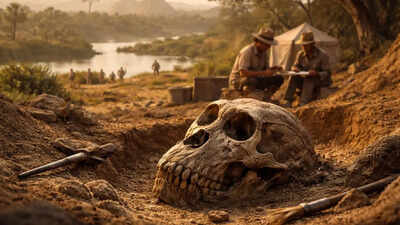
The theory that East Africa is the most likely birthplace for human beings has persisted over many years. A new find, however, from a part of Egypt not extensively studied before, is raising doubts about this theory. New evidence shows that humans’ earliest ancestors might have evolved over a more extensive geographic territory than had earlier been supposed.Such a finding is significant as it directs the spotlight on North Africa, an area that has largely been ignored in research into human origin.
Fossil discovery in Egypt changes human origins theory
The recent discovery is from an area in Egypt that is less explored. This discovery is important due to its age and characteristics, which connect it with primate species that may be associated with human evolution.According to the study “An Early Miocene ape from the biogeographic crossroads of African and Eurasian Hominoidea,” published in the journal Science, the fossil provides evidence that early ape evolution may not have been limited to East Africa.The fossil suggests that early evolutionary events did not occur only in East Africa but that areas such as Egypt may also have been responsible for our early history as humans.
Why scientists say we’ve been looking in the wrong place for human origins
For years, most research was done in regions of East Africa, such as Ethiopia and Kenya, where lots of fossils were found. Therefore, one would assume that human evolution happened in these regions.However, this finding shows that studying these regions alone may make researchers miss out on other important regions. Human evolution may have happened in North Africa, such as in Egypt.
What the Egypt fossil reveals about early human ancestors
The Egyptian fossil bears some traits that suggest its relation to early primates from which humans descended. The fossil is important in that it assists researchers in understanding evolution and adaptation among various species.The fossil is an indicator of movement and migration since early primates were able to migrate from one place to another.
Forgotten regions like Egypt are now key to human evolution research
This finding demonstrates the significance of researching less familiar areas. Places which have not been studied much before might be hiding important information regarding the origin of mankind.Researchers are starting to venture into other areas for conducting their studies.
Why this Egyptian discovery matters for understanding human evolution
In addition to merely expanding the fossil records, the discovery alters the way we think about human evolution. Evolution is not constrained to one area; rather, it is a complicated process that takes into consideration many different environmental factors.It may change the course of future studies, prompting researchers to explore other areas that have not been thoroughly studied yet.
Final insight on human origins and Egypt fossil discovery
This finding from Egypt shows us that scientific knowledge is continually developing. That which was once believed to be true can easily become false when more information comes to light.In searching outside the normal places where humans originated, science is giving us a better and fuller understanding of our beginnings.