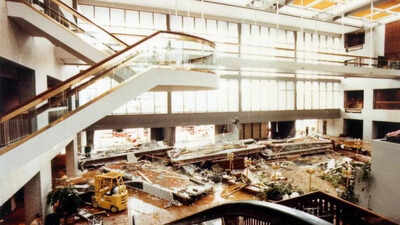
While dancing on a floor with full energy and excitement, completely carefree, suddenly a structural failure causes a fatal fall that claims your partner’s life or leaves you heavily injured can be an unimaginable tragedy. But, this has happened in reality on the evening of 17 July 1981 at the Hyatt Regency Hotel in Kansas City, Missouri. An evening that shook more than 1500 people who were gathered there at a popular tea dance party on the first floor of the Kansas City Hyatt Regency. This fatal engineering took the lives of one hundred and fourteen people and more than two hundred innocent injured, marking it as the deadliest structural failure in US history.
The Hyatt Skywalk tragedy, when the floor disappeared beneath the dancers
This Hyatt Skywalk tragedy is that haunting scene of 1981 evening that doesn’t go away from the eyes till the present day. Just one year after opening, the fourth-floor skywalk collapsed onto the second-floor skywalk. Then, they both collapsed onto the ground floor, where people were enjoying the dance. The American Society of Civil Engineers called it “one of the most devastating structural failures in US history in terms of lives lost.”According to ASCE, when the fourth-floor skywalk fell, it took the weight of 64 tonnes of concrete, steel and glass onto the crowded lobby below. Another reason ASCE emphasised is that during the tea dance contest, there were over 1500 people, and the skywalks were packed with spectators who came to watch the dancers below them; they were unaware that the structure was already under fatal engineering.
The missing link between the design and the construction team
The Hyatt skywalk collapse wasn’t just the failure of engineering, but the real gap came in communication. The gap between the engineer’s drawing board and the steel fabricator’s workshop led to this accident. The original design was held by Jack D. Gillum and Associates, who called for a single 46-foot hanger rod to support the fourth and the second floor skywalks.But the steel fabricator, Havens Steel Company, thought that this would be practically impossible, and it could be damaged during the time of installation. Instead of a single rod, they used two shorter, offset rods. This change was logical, but no one noticed the physics behind it. As with the single continuous rod, the weight of each walkway could have been distributed independently. But, in the revised design, the fourth-floor walkway was now forced to carry its own weight and the entire weight of the second-floor walkway.This led to the weight being doubled on the fourth-floor beams. According to the ASCE investigation, the revised connection was so fundamentally flawed that it could barely satisfy one-third of the building code requirements.
Who was held responsible for the Hyatt Skywalk collapse
The Missouri Board for Architects, Professional Engineers and Land Surveyors found the structural engineers (Jack D. Gillum and Associates) guilty of misconduct. No one went to jail, but the firm lost its engineering licenses in several states.
How did this disaster change modern engineering
The ASCE used this disaster to set a strict precedent. The Engineer of Record (EOR) is responsible for every structural member and connection.The ASCE Rule: Even if a contractor or fabricator suggests a change (like the double-rod), the EOR must personally review and verify the math before signing off. You cannot “assume” a shop drawing is safe just because it was made by a professional fabricator. This disaster essentially ended the use of ‘conceptual’ drawings. Today, engineers must prove the math for every nut, bolt, and beam on paper.Additionally, it resulted in the requirement for Independent Peer Reviews and a rewrite of the ASCE Code of Ethics. The tragedy showed the industry that a signature on a drawing is not merely a formality; it is a life-safety guarantee. Engineers now consider the safety of the public their main duty. They ensure that ease of construction never again comes at the cost of human lives.