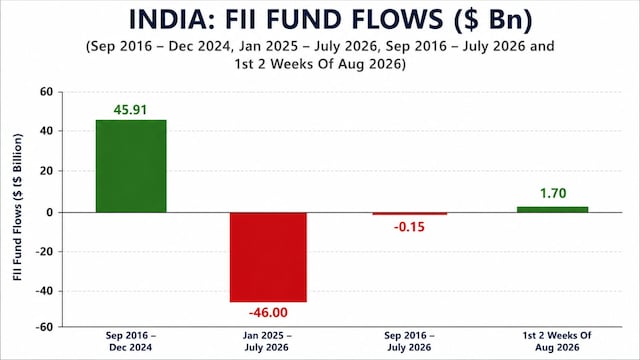
Between September 2016 and December 2024, foreign investors pumped around $45.9 billion into Indian equities, according to National Securities Depository Ltd. (NSDL) data. However, from January 2025 through July 2026, the selling accelerated sharply, with cumulative outflows touching nearly $46 billion.
As a result, FII equity flows from September 2016 to July 2026 stood almost exactly at zero, at around -$156 million.
The trend, however, has shown an early sign of reversal in August.
Foreign investors have bought around $1.71 billion in Indian equities in the first two weeks of the month, taking cumulative flows since September 2016 to approximately +$1.55 billion. The numbers underline just how extraordinary the recent reversal has been.
Nearly a decade of net foreign buying has effectively been erased in little over a year. The journey since September 2016 has been anything but linear.
The final four months of calendar year 2016 saw FII outflows of around $2.97 billion, amid the US Federal Reserve’s rate-hike cycle and the liquidity shock following India’s demonetisation.
The environment changed dramatically in 2017, when global emerging-market liquidity drove $7.77 billion of foreign money into Indian equities. But 2018 brought another reversal. FII outflows stood at around $4.39 billion, as a spike in crude oil prices and a broader emerging-market sell-off hurt investor sentiment.
Source: NSDL
The biggest turnaround came in 2019, when FII inflows surged to $14.37 billion, supported by the government’s corporate tax-rate cut and improving investor sentiment. The COVID-19 crisis produced an even stronger wave of liquidity. In 2020, foreign investors poured $23.01 billion into Indian equities as global central banks unleashed unprecedented monetary stimulus and markets rebounded sharply from the pandemic sell-off.
Flows moderated in 2021 to $3.76 billion, even as the global economy recovered strongly, with global gross domestic product (GDP) growth rebounding to roughly 6% after contracting around 3% in 2020.
Then came another major outflow phase. In 2022, FII selling reached $16.50 billion as global inflation surged and the US Federal Reserve aggressively raised interest rates. India regained favour in 2023, attracting $20.74 billion of foreign equity inflows.
Strong domestic economic growth and the government’s capital expenditure push helped make India an important destination for global investors. The following year was almost flat. FII flows in 2024 stood at just $124 million, as election-year uncertainty and a significant re-rating in Indian equity valuations limited fresh foreign buying.
The real break from the previous trend came in 2025. Foreign investors withdrew nearly $18.91 billion from Indian equities, as elevated US bond yields increased the attractiveness of dollar assets while global funds also reallocated capital towards China and US technology stocks.
But the selling intensified further in 2026. Between January and July 2026, foreign investors pulled out a staggering $27.16 billion from Indian equities, making it the most severe sustained outflow phase in this period.
The latest selling wave appears to reflect a broader global risk-off environment, with markets seen as having a high exposure to artificial intelligence (AI) and semiconductor themes, particularly South Korea and Taiwan, drawing a larger share of global capital. The scale of India’s outflows may therefore not simply reflect domestic concerns. It also point to a wider reallocation of global portfolio capital.
FII inflows of $1.71 billion in the first two weeks of August 2026 have pushed cumulative foreign equity flows since September 2016 back into positive territory, at $1.55 billion. It is too early to call this a structural change, but the numbers suggest that the intense selling pressure seen over the previous 19 months may be easing.
The key question now is whether August marks the beginning of a sustained return of foreign capital or merely a temporary pause in a broader global reallocation. The next few months will determine whether this is merely a bounce – or the beginning of a fresh foreign-investor cycle for India.