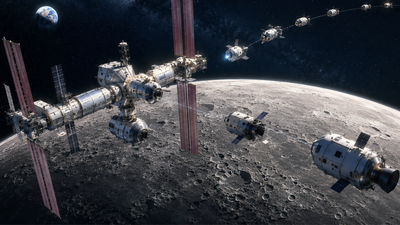
Nearly 240,000 miles from Earth, Nasa is preparing a new kind of transportation hub where spacecraft could one day arrive, wait, dock and depart without a single runway, road or parking bay. The Gateway space station, planned for lunar orbit as part of the Artemis programme, is expected to host Orion crew capsules, lunar landers and cargo spacecraft as human activity around the Moon grows. But there is a problem that sounds surprisingly familiar on Earth. Spacecraft cannot simply stop and pull over when another vehicle arrives. Every vehicle remains in motion while navigating a complex gravitational environment. Researchers from Texas A&M University, Nasa’s Johnson Space Center and Purdue University are therefore developing mathematical “rules of the road” to help spacecraft safely wait for their turn, maintain predictable positions and avoid dangerous encounters around Gateway.
Nasa’s 240,000-mile ‘space airport ’ will need its own traffic rules
Gateway is Nasa’s planned space station in lunar orbit and a central part of its Artemis architecture. Rather than being a conventional airport, it is intended to function as a staging point where astronauts can live and work, visiting spacecraft can dock and missions can be coordinated before astronauts travel towards the lunar surface. Nasa says Gateway will have docking ports for Orion, lunar landers and logistics resupply spacecraft, while also supporting scientific research and future deep-space exploration. The station is being developed with international partners including the European Space Agency, Japan’s JAXA, the Canadian Space Agency and the Mohammed Bin Rashid Space Centre. Its first two elements, the Power and Propulsion Element and Habitation and Logistics Outpost, are planned to launch together on a SpaceX Falcon Heavy before Artemis IV. Nasa currently lists Gateway’s launch as no earlier than 2027, while its first astronauts are expected to arrive during Artemis IV, currently targeted for 2028.Gateway will be much smaller than the International Space Station and is not intended to remain continuously occupied. Nasa says early configurations can accommodate up to four astronauts, with crews staying for periods of roughly 30 to 90 days before returning to Earth. Between crewed missions, Gateway will operate autonomously and through remote operations. The station is being designed as long-term infrastructure for lunar exploration rather than simply as another spacecraft passing through lunar orbit.
The lunar ‘highway’ is nothing like a normal orbit
Gateway will travel along a near-rectilinear halo orbit, known as NRHO, rather than following a simple circular path around the Moon. The highly elongated orbit will take the station to within roughly 1,000 miles of the lunar surface at its closest point before carrying it tens of thousands of miles away. Nasa says Gateway will travel as far as about 43,500 miles from the Moon and complete an orbit roughly every 6.5 days.The orbit was selected because it provides several advantages for lunar exploration. Gateway will have continuous line-of-sight communications with Earth and access to the lunar South Pole and other areas of the Moon. It also requires relatively little propellant for orbit maintenance compared with many alternative trajectories. But the unusual shape and gravitational environment make navigation and traffic management considerably more complicated than simply assigning spacecraft a point in space and telling them to stay there.The Moon and Earth both influence spacecraft travelling through this region. Gateway and visiting vehicles therefore have to maintain carefully calculated trajectories while accounting for navigation uncertainty, manoeuvre errors and other disturbances. The research published in Acta Astronautica focuses on precisely this problem, examining how spacecraft can maintain controlled relative positions around Gateway while waiting for their next operation.
Spacecraft will have to ‘park’ without ever stopping
This is where the airport comparison becomes particularly useful. On Earth, an aircraft can circle while waiting for a runway or sit at a gate. A vehicle can pull over to the side of a road. A spacecraft around the Moon has no equivalent option because it is constantly travelling along its trajectory.The Texas A&M-led research examines loitering, in which a spacecraft maintains a carefully controlled position relative to a particular orbit or trajectory while waiting. A visiting vehicle might need to wait because another spacecraft is using a docking port, because a crewed operation is taking place or because mission planners need to coordinate multiple arrivals and departures.Researchers describe a possible arrangement as a “string of pearls”, with spacecraft positioned ahead of or behind Gateway along its orbital path. Rather than hovering motionless beside the station, the vehicles would maintain predictable relative positions until they are ready to move towards the next stage of their mission.Thousands of computer simulations were used to examine how such arrangements could work under realistic conditions. The simulations accounted for navigation errors, imperfect thruster manoeuvres and small disturbances that could cause spacecraft to drift from their intended trajectories. The objective was to find a balance between keeping spacecraft safely separated and preventing them from wasting excessive amounts of propellant simply to maintain their positions.
The biggest challenge is avoiding a lunar traffic jam
The problem is not simply preventing spacecraft from crashing. Mission planners also have to determine how close vehicles can safely operate while keeping fuel consumption under control.Moving a spacecraft farther away from Gateway could create a larger safety margin, but every additional manoeuvre requires propellant. Keeping a spacecraft closer could make future rendezvous easier, but it could also leave less room for navigation errors and unexpected disturbances.The researchers therefore studied the trade-offs involving relative distance, orbit maintenance, manoeuvre requirements and delta-v, the change in velocity needed to perform a manoeuvre. Their results indicate that improving positional accuracy can help spacecraft remain closer to their intended locations while requiring only modest changes in propellant use. Relative orbit-maintenance techniques can also reduce variations in the distance between loitering spacecraft.That predictability will become increasingly important as Gateway begins supporting different types of missions. Orion could arrive carrying astronauts while a logistics spacecraft delivers supplies and a lunar lander prepares for a surface mission. Each vehicle will have its own trajectory and operational requirements, but they will all have to share the same broader lunar environment. Nasa intends Gateway to support docking with Orion, human landing systems and logistics spacecraft.The phrase “traffic jam” should not be taken literally. The researchers are not predicting a permanent swarm of spacecraft around Gateway or saying that every vehicle will routinely wait for weeks. Instead, the study investigates scenarios in which spacecraft need to loiter while waiting for access or coordinating operations. The longer-term concern is that as lunar missions become more frequent, the number of vehicles requiring carefully managed trajectories will increase.
Engineers are writing the rules before lunar traffic arrives
The significance of the research lies in its timing. Humanity has not yet established a busy transportation network around the Moon, but engineers are already working out how such a system could operate safely. The work effectively lays down the mathematical foundations for an orbital traffic-management system before Gateway becomes a major staging point for Artemis missions.Gateway’s first two elements are expected to launch together and travel to their operational lunar orbit before Artemis IV. Nasa plans for Artemis IV to deliver additional Gateway hardware and bring astronauts to the station for the first time. The mission is also expected to involve a human landing system, making it an early example of several different spacecraft and operations being coordinated around the same lunar hub.Nasa has already tested aspects of the NRHO environment through CAPSTONE, a small spacecraft that entered the unusual orbit in 2022. The mission demonstrated navigation and communications technologies and helped validate Nasa’s understanding of the orbit before Gateway arrives.If Gateway develops into the transportation hub Nasa envisions, spacecraft traffic around the Moon could eventually become a routine part of human spaceflight. Vehicles may arrive from Earth, position themselves along carefully calculated trajectories, wait for their turn, dock with the station, transfer astronauts or cargo and then depart for the lunar surface or back towards Earth.There will be no roads, runways or conventional parking spaces. Instead, the “traffic lights” will be mathematics, the “roads” will be gravitational trajectories and the “parking spaces” will be carefully calculated orbital positions. The research now underway at Texas A&M, Nasa and Purdue is aimed at making sure that when lunar traffic finally begins to build, spacecraft know who moves, who waits and where everyone needs to be.