
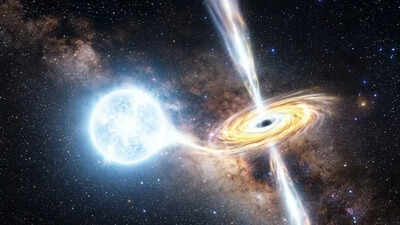
For over six decades since its discovery, Cygnus X-1 – the first black hole confirmed to exist – has yielded some very interesting and important discoveries. A few recent discoveries include information about the power of the jets, which comes from the Cygnus X-1 binary system, where a collection of 18 years’ worth of radio-telescope observations was compiled, as noted in a study at Oxford University. This data provides scientists with evidence of the ‘dancing’ jet mechanism, but it also allows scientists to identify that the powerful winds from the supergiant companion star (in this case) were changing the shape of the jets as they led away from Cygnus X-1 as well as to calculate that these jets produce energy equivalent to the luminosity of 10,000 Suns and are travelling at approximately half the speed of light. According to the research published in Nature Astronomy, the empirical evidence regarding jet energetics created by the black holes provides empirical evidence for the theoretical model that theorists have presented for years about how black holes channel energy to influence the formation of galaxies throughout the universe.
Cygnus X-1 study reveals how black holes channel energy into powerful jets
Cygnus X-1 is a system containing a black hole that has a mass approximately 21 times that of our Sun and a massive supergiant star. Since the 1960s, Cygnus X-1 has been the prototype for black hole research. Astronomers have encountered difficulties over the years in obtaining ‘instantaneous’ jet power from black holes and have primarily depended upon long-term averages. By using archival data and taking into account the physical distortion of the outflow due to the wind from the companion star, Lead author Dr Steve Raj Prabu (Department of Physics, University of Oxford, formerly at CIRA) has determined that roughly 10 per cent of the energy from the infalling material is channelled into the powerful jets.
How astronomers used stellar winds as a ‘cosmic scale’
The movement of the jets appears to dance due to the powerful wind produced by the companion star. The two objects are in an orbit about each other approximately every 5.6 days, so the wind blows on the jets, causing the jets to have a varying bent shape. Astronomers used the deflection caused by the companion star’s wind to measure the strength of the jets on a ‘cosmic scale.’ The measurements indicate that the jets are ejected at speeds of about 150,000 kilometres per second or approximately half the speed of light. The measurements confirm several important theories about how energy is released from black holes and redistributed into the surrounding interstellar medium.
How these findings shape future galactic evolution models
The research presented in this article supports an ‘anchor point’ for astrophysicists. Since black hole accretion physics is assumed to be similar in scale, these measurements of Cygnus X-1 can be used to calibrate simulations of supermassive black holes, which are much larger. Astronomers are prepared to apply these new measurement techniques to identify and quantify jets from many distant galaxies using data collected through the upcoming Square Kilometre Array (SKA) project; this information will help create a more complete picture of how black holes generate shocks, turbulence and contribute to the evolution of the Universe’s structure.