
A Bench comprising Justices Sanjay Karol and N. Kotiswar Singh observed that for a compensation claim to be maintainable under Section 166 of the Motor Vehicles Act, the vehicle must have played a direct role in the accident.
What is the case about?
The matter arose from the case of Commissioner, Bruhat Bengaluru Mahanagara Palike (BBMP) vs Umesh Kumar.
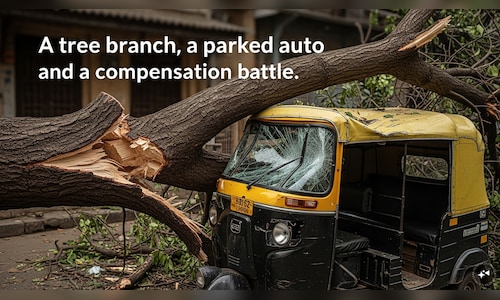
On June 23, 2007, Umesh Kumar was travelling in an autorickshaw in Bengaluru. Due to heavy rainfall, the driver stopped the vehicle by the roadside beneath an old tree. While the autorickshaw was stationary, a tree branch suddenly fell on it, causing Kumar grievous injuries.
Kumar subsequently filed a compensation claim seeking ₹50 lakh. However, in 2013, the Motor Accident Claims Tribunal (MACT) dismissed the claim, treating the incident as a natural calamity.
Karnataka High Court awarded compensation
The Karnataka High Court later awarded ₹17.10 lakh in compensation and apportioned liability as follows:
25% to BBMP
50% to the autorickshaw’s insurer
25% to the State Horticulture Department
What did the Supreme Court say?
The Supreme Court held that the vehicle had no active role in the occurrence of the accident and, therefore, the incident could not be categorised as a motor vehicle accident under the Motor Vehicles Act.
The court also acknowledged that municipal authorities have a duty to maintain trees within city limits. However, it noted that expecting civic bodies to maintain constant vigilance over every tree in an expanding city would be impractical.
Compensation enhanced under Article 142
Despite holding that the claim did not strictly fall within the ambit of a motor accident case, the court invoked its extraordinary powers under Article 142 of the Constitution to ensure complete justice.
Taking into account the life-altering injuries suffered by Kumar, the Bench decided to enhance the compensation payable to him from ₹17.10 lakh to ₹25 lakh.
The court emphasised that merely being seated inside a vehicle at the time of an accident does not automatically make it a motor vehicle accident. At the same time, it observed that the victim was entitled to just and fair relief, and that the law must be applied in a humane and equitable manner.
(Edited by : Sheersh Kapoor)