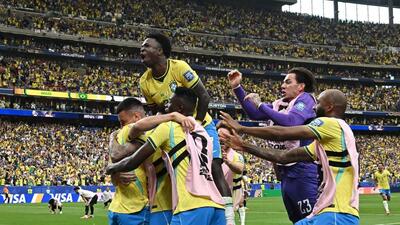
Kolkata: Brazil’s progress into the last-16 of the World Cup was eventually secured by a stoppage-time winner from Gabriel Martinelli, but the decisive moment was less about a brilliantly constructed move. Rather it was about the gradual dismantling of one of the most disciplined units of this World Cup.
The 2-1 comeback win was built on Carlo Ancelotti recognising that Japan were defending the very spaces Brazil were trying to attack before forcing the game in different directions.
It explains why for the entire first half Japan looked so comfortable. Their compact defence block frustrated Brazil, Vinicius Jr was reduced to a peripheral figure and the front third looked short of ideas. They dominated possession, passed around the ball and tried to stretch Japan across the width of the pitch but still couldn’t penetrate. Without the ball, Japan dropped into a narrow 5-4-1, compressed the space between defence and midfield and consistently marked Vinicius Jr with two defenders whom he just couldn’t shake off.
It was a plan that was working perfectly for Japan, barring Matheus Cunha’s early low effort that was comfortably pushed away by goalkeeper Zion Suzuki. As Brazil’s attacks became more predictable, Japan began to string together moves on the counter, culminating in Kaishu Sano making one count. Seizing on a loose pass from Danilo, he powered goalward past a hesitant, already booked Casemiro before firing a low shot from outside the penalty box that beat the diving Alisson. It was an excellent finish, and a warning that Brazil’s positional structure was at the risk of imploding whenever they lost possession.
This is where Carlo Ancelotti’s tactical nous came into play. By introducing the speedy Endrick in place of the injured Paqueta at the start of the second half, Brazil switched to a clearer and more functional 4-2-3-1. “What was important was to keep our structure. We know we’re going down the right path and we have to continue on this path,” Ancelotti said later.
With Endrick, Brazil could afford to deliver vertical recce missions while Bruno Guimaraes could stay behind to operate between Japan’s midfield and defence. Along with that they spread out their attacks and looked to deliver the ball into the penalty area much earlier as part of a bigger, chaotic gameplan. That unlocked Japan’s tight defence as they had to track runners, the aerial deliveries and negate opportunities inside the six-yard box.
“At first we were trying to achieve superiority in midfield, to infiltrate,” Ancelotti said. “It didn’t work because their marking was really tight. They were really closed off. We changed at the interval to try to penetrate their area a little more. We crossed some balls and got forward better, so this is an evolution. We struggled to find space at first but we were able to solve this problem very well.”
Brazil’s first major opportunity after restart came soon. A cross created confusion inside the penalty area as Casemiro’s header struck Takehiro Tomiyasu and Hiroki Ito in what resulted in a miraculous goal-line save. But that only motivated Brazil to double their attacks. The equaliser wasn’t long in coming. Gabriel Magalhaes delivered a ball towards the far post, and Casemiro again attacked free space and headed the ball across Suzuki’s outstretched hands.
With that goal, Brazil had finally identified an area where Japan’s numerical superiority mattered less than physicality and delivery. That spurred Brazil to attack with greater urgency, slowly bringing Vinicius Jr into the picture, quick dashes further unsettling the retreating Japan defences. His diving run and chipped effort that Suzuki tipped onto the post was one of the clearest opportunities for Brazil, created not because Japan had suddenly defended poorly but because Brazil had finally explored the right spaces.
With every passing minute, Japan seemed to defend more inside their own third, while the distances required to launch counterattacks became increasingly difficult to cover. This is where Brazil had won the psychological edge. The winning goal arrived in stoppage time, though it had felt imminent for a long time.
Ao Tanaka won possession, only for Japan to lose it immediately under pressure. Rayan on the right recovered the loose ball before quickly finding Guimaraes, whose pass found Martinelli in the six-yard box. But Japan’s defensive shape hadn’t yet recovered. For perhaps the first time in the game, Brazil attacked an unbalanced defensive line rather than a perfectly organised block. Martinelli’s placement went in helped by the far post despite Suzuki getting a hand to it, finally breaking Japan’s resistance.
Against one of the World Cup’s best-drilled defensive teams, the five-time champions didn’t simply increase the pressure after the break. They changed the questions they were asking of Japan’s defence. Through to the last 16, seeking the verve to win a sixth World Cup, this was exactly the kind of examination Brazil needed to come through.
Like Ancelotti said: “Suffering is part of the game, as is relief.”