
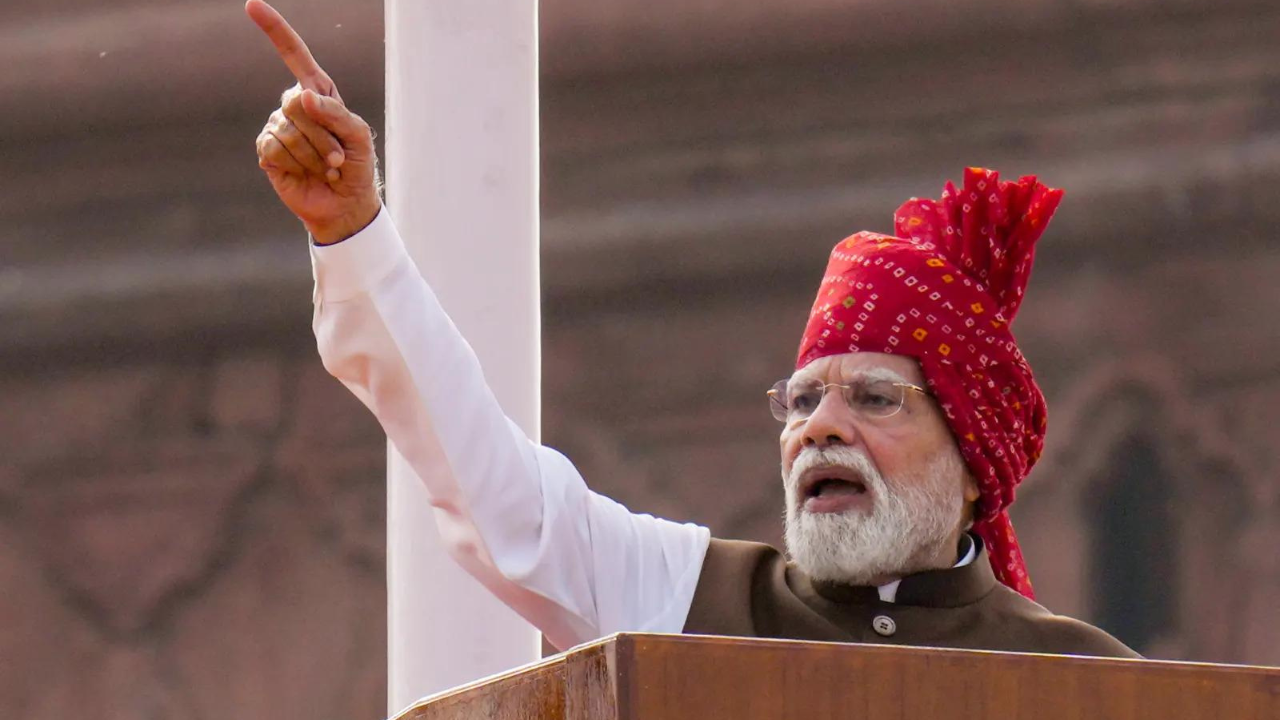
Every Independence Day, the Red Fort becomes the backdrop for one of the country’s most watched political addresses. But over the years, there has been another detail people have started looking out for – what Prime Minister Narendra Modi is wearing on his head.And this year, the choice was hard to miss.For his 13th consecutive Independence Day address from the Red Fort, Modi appeared in a striking red tie-and-dye turban, paired with a simple white kurta and brown vest. The saffron, white and green pocket squares added another subtle reference to the national flag.But the turban itself deserves a closer look.It was a traditional Rajasthani-style safa featuring the familiar tie-and-dye technique associated with Bandhej. And in many ways, it fits a pattern that has become increasingly familiar during Modi’s public appearances – using clothing to put India’s regional textiles, crafts and traditional dressing styles right in the spotlight.
When a turban becomes a textile story
Bandhej, also known as Bandhani, is one of Rajasthan’s best-known tie-and-dye traditions. The technique is remarkably detailed. Small portions of fabric are tightly tied with thread before the cloth is dyed. Once the threads are removed, tiny dots and patterns appear, creating the distinctive textured look associated with the craft.It may look effortless from a distance. It isn’t.The appeal of Bandhej lies in that painstaking process and in the fact that the finished fabric carries a distinctly Indian visual identity. Bright reds, yellows, greens, blues and saffron shades are commonly seen in traditional Bandhej textiles.And Modi’s choice of a red Bandhej turban on Independence Day brings that craft into a setting watched by millions.That’s where the clothing becomes more than just clothing.
Modi has made the Independence Day turban a tradition of its own
Anyone who follows Modi’s Independence Day appearances knows that the turban has become something of a yearly feature.The style, colour and regional influences change from year to year, but the message remains fairly consistent: India’s traditional headgear and textiles have a place on one of the country’s biggest public stages.
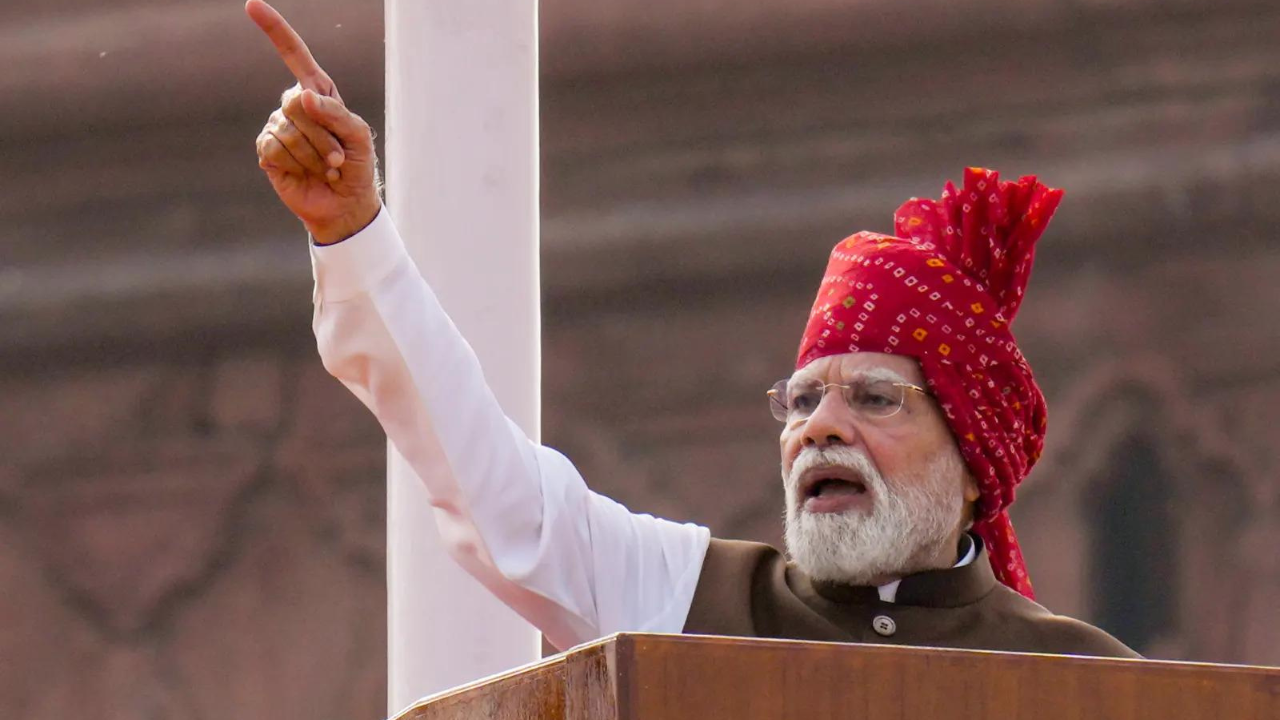
PM Modi delivers his 13th consecutive Independence Day speech from Red Fort. (PTI)
He’s worn turbans inspired by different parts of India, often choosing vibrant colours and regional styles rather than sticking to one conventional look. The choices have included textiles and headgear associated with different states and communities, making the annual appearance something of a visual tour of India’s textile traditions.This year’s red Bandhej safa continues that pattern.And perhaps that’s what makes it interesting. A speech talks to the country, but an outfit can quietly introduce people to a craft they may not have noticed before.
A Rajasthani safa carries its own meaning
The traditional safa isn’t simply a piece of fabric wrapped around the head.In Rajasthan, the pagri or safa has long been associated with pride, honour and identity. The colour and manner of tying it can vary depending on the region, occasion and community.It also has a strong connection with hospitality. Offering a safa to a guest during a wedding, religious ceremony or other important occasion has traditionally been seen as a gesture of respect.So when a Rajasthani-style safa appears at the Red Fort on Independence Day, there’s already a cultural story attached to it.The fact that it’s made using a traditional tie-and-dye technique adds another layer.
It’s not the first time Modi has put Indian textiles in focus
Modi’s interest in Indian textiles and handloom traditions has been visible well beyond Independence Day.From khadi and handloom fabrics to regional weaves and traditional garments, he has frequently used public appearances to wear Indian textiles associated with different parts of the country. His clothing choices often bring attention to crafts that can otherwise remain within their regional boundaries.And this matters because India’s textile story is enormous.A sari from one state can look completely different from one from another. A weave can tell you where it was made. A print can point to a particular community. A dyeing technique can have been passed down through generations.There is a lot packed into something as simple as a piece of fabric.
From khadi to Bandhej, the idea is bigger than fashion
The conversation around Indian textiles isn’t only about looking traditional.For decades, khadi has been tied to India’s freedom movement and remains closely associated with Mahatma Gandhi and the idea of self-reliance. Handloom traditions, meanwhile, continue to support generations of weavers and artisans across the country.That’s why public visibility matters.When a regional textile is worn by a national leader at a major national event, it gets seen by an audience far beyond the place where it originated. Someone watching from Delhi, Mumbai or Bengaluru may suddenly recognise a Bandhej pattern. Someone elsewhere may become curious about the craft behind it.And that curiosity can be valuable.
The Red Fort has become a stage for India’s textile diversity too
Independence Day is, of course, about the country and its journey as a free nation. But India’s identity has never been one single thing. It is made up of hundreds of languages, food traditions, crafts, textiles, festivals and ways of dressing.Modi’s recurring use of regional headgear reflects that diversity in a very visible way.The red Bandhej turban at this year’s celebration is a small example, but an eye-catching one. It brings a piece of Rajasthan into the Red Fort ceremony and, at the same time, reminds viewers that India’s cultural heritage isn’t confined to museums or craft fairs.Sometimes, it turns up on the head of the person delivering the Independence Day address.And perhaps that’s the most interesting part of Modi’s approach to Indian textiles: he doesn’t always need to make a long speech about a craft for people to notice it. Sometimes, wearing it is enough.