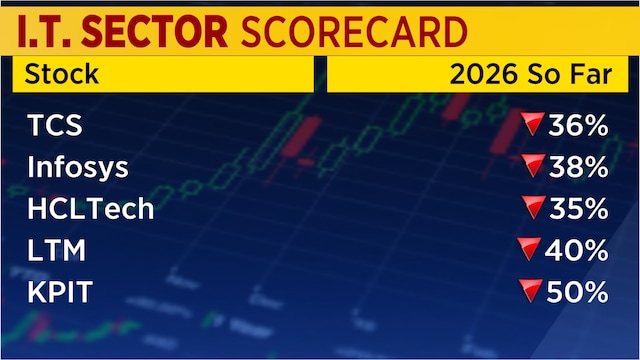
Most largecap IT names are down between 30% to 35% during this period. KPIT Tech, courtesy of Wednesday’s 17% drop, is now down over 50% for the year.
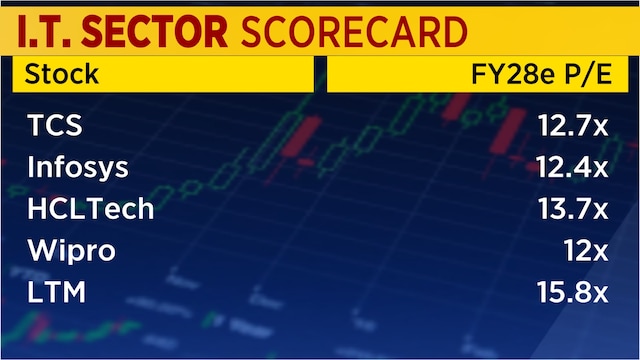
As a result of this correction, the valuations of most of these IT companies have come down to an average of 13 times their estimated earnings for financial year 2028, well below their historical 10-year average of 15 times to 20 times.
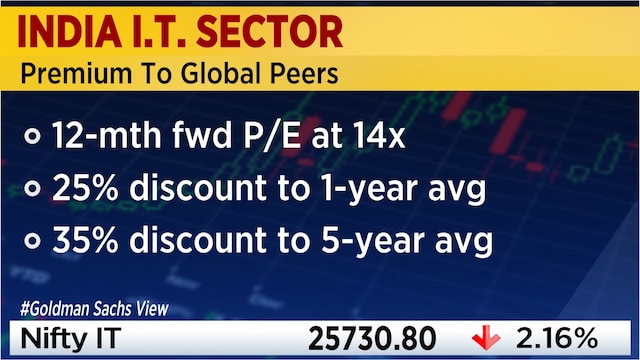
Despite this, the Indian IT stocks still trade at a big premium to their global peers. According to Goldman Sachs, Indian IT’s 14 times 12-month forward price-to-earnings multiple is a 25% discount to its 10-year and a 35% discount to its five-year average valuation. However, the one-year forward average multiple for Accenture, Cognizant and Capgemini is only 8 times.
This means, Indian IT is now trading at a 90% premium to global peers, compared to a historical range of just 20% to 30%.
Therefore, even after a 35% to 40% fall, Indian IT stocks are still expensive and considering the low-single-digit growth prospects, the case to buy is not compelling enough for analysts.
Morgan Stanley also goes on to add that the derating story is not over yet as largecap IT stocks bottomed out previously at a multiple between 11 times to 13 times, and therefore, it sees scope for further downside from current levels.
What Is The Fundamental Reason Behind Fall In IT Stocks?
One simple answer – Growth. Financial year 2027 is likely to be the fourth consecutive year of anemic or subdued growth for these companies. KPIT Tech has already issued a warning for the first quarter, that its US Dollar revenue will decline 1% from last year and that the second quarter could also be on similar lines.
Analysts have also warned that Infosys could cut the upper end of its financial year 2027 organic revenue guidance from the current 1.5% to 3.5%, stating that organic demand recovery is simply too slow to justify the company holding on to the upper end of its guidance.
Goldman Sachs has already cut its aggregate organic growth forecast to 2.4% from 3.2% earlier, while Morgan Stanley has cut down its estimates sharply too, more so for TCS, by nearly 250 basis points. For Infosys, the cut is 150 basis points.
For Infosys, the 3% revenue growth projection for the current year includes 2% from acquisitions. Therefore, organic growth will only be around 1%, well below the 2.4% reported in financial year 2026.
What Are The Next Triggers For IT Stocks?
One, discretionary spending, whether the resilience in the BFSI vertical, helped by cost-takeout deals, enough to offset the softness in telecom and manufacturing?
Two, the AI-led deflation, whether it is worse than the 2% to 4% priced in by investors.
Three, new revenue streams, whether there is evidence that the AI-led revenue is starting to offset the erosion in traditional businesses and not just cannibalize it.
Four, AI investment intensity – how much are the companies investing in AI and capability building.
Five, Cost efficiency programs such as Project Maximus at Infosys, Project Fortius at Tech Mahindra and Project Ascent at HCLTech. Headcount trends are also likely to stay muted across the board.