
Yet, for investors, strong demand does not automatically mean strong stock returns.
Macquarie Capital’s Pharma & Healthcare Research Analyst Kunal Dhamesha is cautious on hospital stocks, not because he doubts the long-term need for healthcare, but because the sector is entering a major capacity expansion cycle at a time when valuations are already elevated.
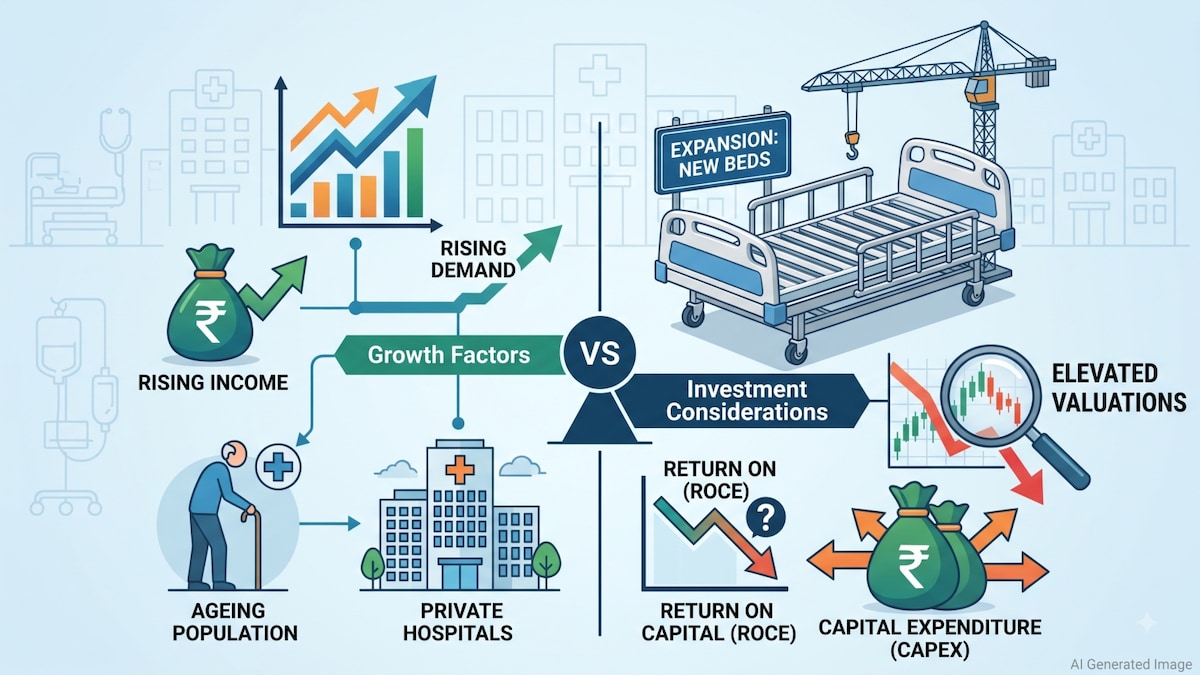
That distinction is important. The debate is not about whether India needs more hospitals. It is about how quickly new beds can be absorbed, what happens to returns when companies spend heavily on expansion, and whether current share prices already reflect much of the expected growth.
India needs more beds, but the shortage is not necessarily acute
India has more than two million hospital beds, according to figures discussed during the CNBC-TV18 conversation. Of these, around 100,000 are with private hospitals in the tertiary and quaternary care segment.
Dhamesha argues that India’s bed availability should not be compared directly with that of developed economies without considering the country’s demographics.
India’s median age is around 29, while countries such as the US and China have significantly older populations. As India ages, demand for specialised healthcare and hospital beds is expected to increase. But that is a gradual process rather than evidence of an immediate shortage of tertiary and quaternary care capacity.
India’s current bed availability is also well below levels seen in developed healthcare systems. Dhamesha’s view is that the gap can be addressed over the next two to three decades rather than requiring the entire additional capacity immediately.
The distinction matters because not every healthcare need requires a tertiary or quaternary hospital. Healthcare systems have a broader base of primary and secondary care, with a smaller proportion of patients requiring highly specialised treatment.
So, while India clearly needs more specialist capacity over time, Dhamesha does not see an acute shortage of tertiary and quaternary beds today.
The bigger issue for investors: a major capex cycle
The more immediate concern for hospital investors is capacity addition.
For several years, large hospital chains focused on improving utilisation, case mix and profitability at their existing facilities. Strong cash generation then gave them the financial capacity to invest in new hospitals and additional beds.
That is now changing the economics of the sector.
Dhamesha points out that large listed hospital operators currently have a combined capacity of around 40,000 beds and are looking to add roughly 20,000 beds over the next three to five years, followed by another 10,000–15,000 beds beyond FY30.
That is a substantial expansion.
A hospital is a capital-intensive business. A new facility requires significant investment in land, buildings, medical equipment and staff before it reaches mature utilisation levels.
This creates an important time lag: the capital is invested today, but the full earnings benefit may come several years later.
A new hospital therefore does not immediately generate the same returns as a mature facility. It has to build occupancy, attract doctors, establish patient volumes and gradually improve its case mix.
Until that happens, the additional capital can drag down return on capital employed, or ROCE.
This is at the heart of Macquarie’s caution.
“Whenever such a large capacity expansion comes, this is a capex-heavy, upfront indirect cost kind of sector, and hence there is always pressure on profitability.”
In other words, hospital companies can continue to report revenue growth while their returns temporarily weaken if the amount of capital invested in new capacity rises faster than profits.
Why the next five years could look different
The post-COVID period was particularly favourable for large hospital chains.
Existing hospitals were operating at high utilisation, case mix improved and companies were able to generate strong cash flows without undertaking a comparable level of capacity expansion.
That helped push profitability and ROCE higher.
Now, however, much of that cash is being reinvested.
Dhamesha’s concern is that investors may be extrapolating the strong returns achieved over the past five years into the next five years, even though the economics of the business are changing.
The difference is simple: a mature hospital with high occupancy can generate strong returns on the capital already invested. A newly built hospital has to absorb additional capital before it reaches similar utilisation.
Dhamesha therefore expects the next phase to be more challenging.
“This is a cyclical business, and whenever there is a large capacity expansion, there is compression of ROCE and profitability.”
That does not mean the sector’s fundamentals are deteriorating. It means growth may initially come at a cost.
Why the bullish case still holds
TVF Capital Advisors Founder and Managing Director Shiv Puri takes a more constructive view.
His argument is that private hospitals are still addressing a large and growing healthcare need. A significant part of India’s population continues to rely on government hospitals because private healthcare can be unaffordable, rather than necessarily because public hospitals offer better care.
As incomes rise, more households are likely to have the ability to spend on private healthcare.
Puri sees three major structural drivers.
The first is the rising burden of lifestyle diseases such as cardiovascular disease and cancer. These conditions often require complex and specialised treatment, which can increase demand for organised hospitals.
The second is rising disposable income. As households become more affluent, healthcare spending tends to increase and patients are more willing to pay for higher-quality care.
The third is the relatively low level of organised private hospital capacity compared with India’s population.
Puri therefore believes the growth runway remains very long.
“The demand for hospital beds from the private sector has a very, very long runway of growth.”
The broader sector outlook also remains supportive. EY-Parthenon has reported strong FY26 growth across hospitals, driven by patient volumes, improving realisations and a shift towards higher-acuity treatments, while identifying capacity expansion as an important growth driver.
So the bullish and cautious views are not necessarily contradictory. One is focused primarily on long-term demand, while the other is focused on near-term returns on the capital required to meet that demand.
Why adding beds is not enough
The interesting part of Puri’s argument is that simply adding capacity does not guarantee value creation.
He believes a successful hospital operator needs to get three things right: real estate, hospital operations and capital allocation.
First, it must be able to develop or acquire hospital assets efficiently and bring them online at the right time.
Second, it needs to operate those hospitals well. Occupancy, pricing, payer mix and treatment complexity all have a direct impact on profitability.
Third, and perhaps most importantly, it must allocate capital sensibly.
A hospital company can destroy value by expanding too aggressively or investing in the wrong locations, even when the underlying healthcare demand remains strong.
This is also why Puri believes scale matters.
Large chains can spread their brands, clinical expertise and operating systems across multiple hospitals. A cluster strategy can also be more efficient than opening hospitals in numerous unrelated cities.
Being present in a large number of cities, therefore, is not necessarily an advantage if an operator lacks sufficient scale in each market.
For investors, the relevant question is not simply how many beds a company adds, but how much return it generates on the capital deployed to add those beds.
Why valuations have become a bigger part of the debate
There is another complication: investors are no longer discovering the hospital story for the first time.
Hospital stocks have delivered substantial gains over recent years, and valuations have risen as investors have priced in the sector’s long-term growth potential. EY-Parthenon has also noted that valuations remain robust, reflecting confidence in the sector’s growth prospects.
That changes the investment equation.
The question is no longer simply whether hospital companies can grow.
It is how much growth is already reflected in their share prices.
A company can have excellent long-term fundamentals and still deliver disappointing stock returns if investors have already paid a high price for those future earnings.
Puri argues that hospital operators should not all be valued in the same way.
A company that can consistently generate high returns on capital and reinvest substantial amounts of capital at similar returns deserves a premium, in his view.
That is because the duration of growth matters. A business capable of compounding capital at high returns for many years can justify a higher valuation than one whose growth requires heavy investment but produces weaker returns.
Dhamesha, however, believes current valuations leave limited room for disappointment. He also points to a valuation gap between Indian hospital companies and some regional peers in markets such as Singapore and Malaysia.
So, what would turn Macquarie positive?
Dhamesha’s position is not permanently bearish.
His concern is specifically about the current phase of the cycle and what the market is assuming about future earnings.
He says the Street has already started cutting earnings estimates for companies such as Apollo Hospitals and Max Healthcare over the past one and a half years. But he believes further downgrades may still be required.
For him, the turning point would come when earnings expectations adequately reflect the economic impact of the expansion cycle.
In other words, Macquarie wants to see expectations reset before becoming more positive.
That is an important distinction for investors. The bearish case is not that hospital demand will disappear or that India’s healthcare sector has run out of growth. It is that the returns generated by mature hospitals over the past few years may not be replicated immediately while companies invest heavily in new capacity.
What the hospital stock debate really comes down to
The two views are not as far apart as they initially appear.
Both Dhamesha and Puri agree that India’s healthcare demand has a long runway. Both recognise that the country will need substantially more hospital capacity as incomes rise, the population ages and chronic diseases increase.
The disagreement is about timing, returns and valuations.
Puri is looking at the next decade and sees a large opportunity for operators that can deploy capital effectively.
Dhamesha is looking at the next phase of the earnings cycle and sees a risk that aggressive capacity additions will temporarily compress ROCE and profitability, while investors are already paying high valuations.
That makes the hospital sector less of a simple “India needs more beds” story and more a question of which companies can add those beds profitably, how quickly new capacity ramps up, and whether their current valuations leave enough upside for investors.
For hospital stocks, therefore, the next leg of the story may depend less on whether demand exists and more on whether operators can convert that demand into returns on the large amounts of capital they are now putting to work.