Cockroaches are already famous for surviving some of Earth’s harshest conditions, but scientists have now pushed their abilities even further. Researchers have developed remote-controlled cockroaches capable of walking underwater for up to three hours by fitting them with miniature oxygen-supplying suits. The unusual technology could one day help emergency teams search flooded buildings, inspect dangerous underground infrastructure and even contribute to future space exploration. Rather than replacing insects with tiny robots, the researchers combined the cockroaches’ natural mobility with lightweight electronics and an innovative breathing system, creating a new type of biohybrid machine designed to reach places that humans and conventional robots often cannot.
How scientists turned cockroaches into underwater explorers
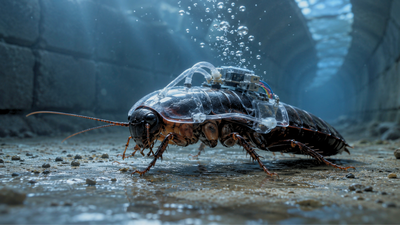
The research was carried out by scientists from Nanyang Technological University in Singapore and Waseda University in Japan. They used living Madagascar hissing cockroaches, a species known for its strength, resilience and ability to squeeze through narrow spaces.The insects were already equipped with tiny electronic backpacks that allow researchers to guide their movements remotely using gentle electrical stimulation. These devices do not control every movement. Instead, they provide directional cues while the cockroaches continue walking using their own muscles and instincts.The latest breakthrough was adding a lightweight underwater breathing system that allows the insects to remain active beneath the surface for far longer than would normally be possible.
The tiny oxygen suit that keeps them breathing
Unlike fish, cockroaches cannot breathe underwater. They rely on tiny openings in their bodies called spiracles, which normally draw oxygen from the air.To solve this problem, researchers designed a miniature 3D-printed suit that works like a tiny life-support system. The device includes a waterproof housing, a compact oxygen generator and four silicone tubes connected directly to the cockroach’s spiracles.Instead of storing compressed oxygen, the suit produces oxygen through a chemical reaction between hydrogen peroxide and manganese dioxide. The oxygen is then delivered directly into the insect’s respiratory system, allowing it to continue breathing while submerged.
Walking underwater for up to three hours
Laboratory tests showed that the suited cockroaches could remain underwater for as long as three hours while continuing to walk through submerged environments.Even with the breathing system attached, the insects moved at nearly their normal pace. Researchers measured underwater speeds of about 78.4 millimetres per second, only slightly slower than their movement on land.The results demonstrate that the lightweight breathing system does not significantly affect the cockroaches’ natural mobility.
Why scientists chose cockroaches instead of tiny robots
Building miniature robots that can move efficiently through rubble, narrow cracks and flooded spaces remains an enormous engineering challenge.Cockroaches already possess many of those abilities naturally. They require very little energy, can climb over obstacles, squeeze through tight gaps and continue operating far longer than battery-powered robots of a similar size.Because they are living organisms, they also power themselves by eating, removing the need for large batteries or complex motors.
Searching places humans cannot reach
The technology is being developed with disaster response in mind.Following floods, earthquakes or building collapses, survivors may become trapped in spaces too small or dangerous for rescue teams to enter. Remote-controlled cockroaches could crawl through submerged tunnels, collapsed structures or narrow gaps while carrying miniature cameras and environmental sensors.Future versions may also include detectors capable of sensing body heat, movement or carbon dioxide from human breathing, helping rescuers locate survivors more quickly.Beyond emergency response, the insects could inspect underground pipelines, sewer systems, flooded utility corridors and other hazardous infrastructure where conventional robots struggle to operate.
Could these insects one day explore Mars?
Although disaster response is the immediate goal, researchers believe the technology could eventually be adapted for even harsher environments.Professor Hirotaka Sato has suggested that future generations of these biohybrid insects could be equipped with more advanced environmental suits capable of operating in low-oxygen or extreme conditions, including planetary environments such as Mars.While such missions remain a long-term vision, the study demonstrates how combining biology with engineering can expand the capabilities of living organisms in ways that were once confined to science fiction.
A new direction for biohybrid technology
The underwater cockroach project represents another step in the growing field of biohybrid robotics, where living organisms are combined with miniature electronic systems to perform tasks beyond their natural abilities.Instead of trying to build ever-smaller robots from scratch, scientists are using millions of years of evolution as the foundation and adding carefully designed technology where it is needed most. If the approach continues to advance, these tiny underwater explorers could become valuable partners in future rescue operations, infrastructure inspections and scientific missions in some of the world’s most challenging environments.